


Targeted exon sequencing fails to identify rare coding variants with large effect in rheumatoid arthritis
- PMID: 25267259
- PMCID: PMC4203956
- DOI: 10.1186/s13075-014-0447-7
Targeted exon sequencing fails to identify rare coding variants with large effect in rheumatoid arthritis
Abstract
Introduction: Although it has been suggested that rare coding variants could explain the substantial missing heritability, very few sequencing studies have been performed in rheumatoid arthritis (RA). We aimed to identify novel functional variants with rare to low frequency using targeted exon sequencing of RA in Korea.
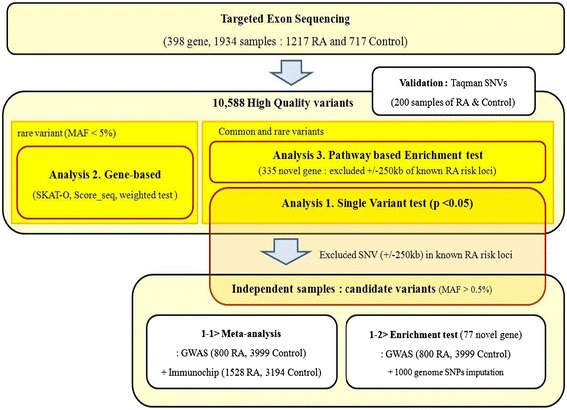
Methods: We analyzed targeted exon sequencing data of 398 genes selected from a multifaceted approach in Korean RA patients (n = 1,217) and controls (n = 717). We conducted a single-marker association test and a gene-based analysis of rare variants. For meta-analysis or enrichment tests, we also used ethnically matched independent samples of Korean genome-wide association studies (GWAS) (n = 4,799) or immunochip data (n = 4,722).
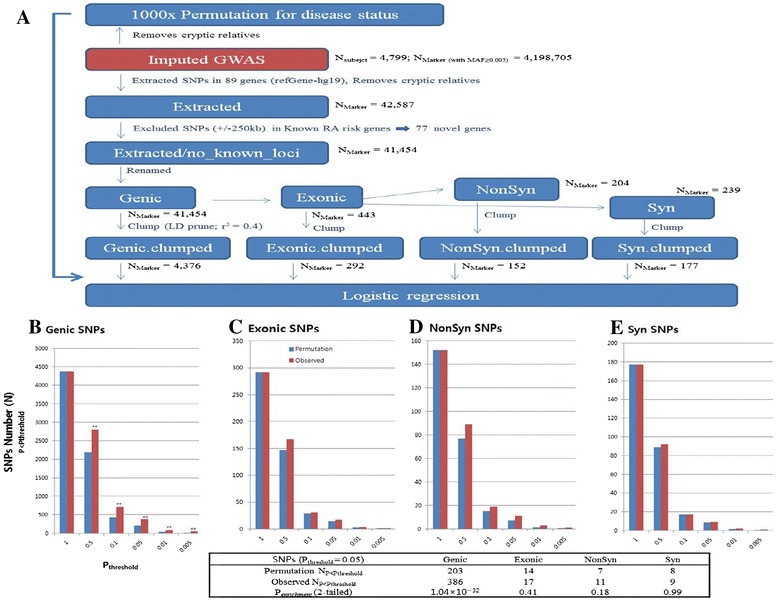
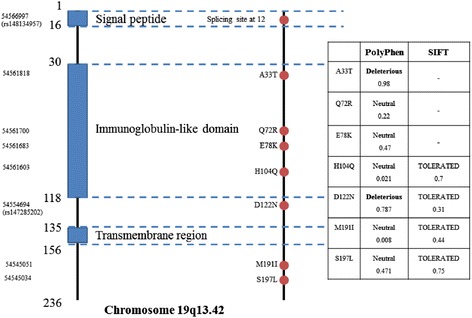
Results: After stringent quality control, we analyzed 10,588 variants of 398 genes from 1,934 Korean RA case controls. We identified 13 nonsynonymous variants with nominal association in single-variant association tests. In a meta-analysis, we did not find any novel variant with genome-wide significance for RA risk. Using a gene-based approach, we identified 17 genes with nominal burden signals. Among them, VSTM1 showed the greatest association with RA (P = 7.80 × 10⁻⁴). In the enrichment test using Korean GWAS, although the significant signal appeared to be driven by total genic variants, we found no evidence for enriched association of coding variants only with RA.
Conclusions: We were unable to identify rare coding variants with large effect to explain the missing heritability for RA in the current targeted resequencing study. Our study raises skepticism about exon sequencing of targeted genes for complex diseases like RA.
Figures
References
-
- Stahl EA, Raychaudhuri S, Remmers EF, Xie G, Eyre S, Thomson BP, Li Y, Kurreeman FAS, Zhernakova A, Hinks A, Guiducci C, Chen R, Alfredsson L, Amos CI, Ardlie KG, Barton A, Bowes J, Brouwer E, Burtt NP, Catanese JJ, Coblyn J, Coenen MJH, Costenbader KH, Criswell LA, Crusius JBA, Cui J, de Bakker PIW, De Jager PL, Ding B, Emery P, et al. Genome-wide association study meta-analysis identifies seven new rheumatoid arthritis risk loci. Nat Genet. 2010;42:508–514. doi: 10.1038/ng.582. - DOI - PMC - PubMed
-
- Freudenberg J, Lee HS, Han BG, Shin HD, Kang YM, Sung YK, Shim SC, Choi CB, Lee AT, Gregersen PK, Bae SC. Genome-wide association study of rheumatoid arthritis in Koreans: population-specific loci as well as overlap with European susceptibility loci. Arthritis Rheum. 2011;63:884–893. doi: 10.1002/art.30235. - DOI - PubMed
-
- Zhernakova A, Stahl EA, Trynka G, Raychaudhuri S, Festen EA, Franke L, Westra HJ, Fehrmann RS, Kurreeman FA, Thomson B, Gupta N, Romanos J, McManus R, Ryan AW, Turner G, Brouwer E, Posthumus MD, Remmers EF, Tucci F, Toes R, Grandone E, Mazzilli MC, Rybak A, Cukrowska B, Coenen MJ, Radstake TR, van Riel PL, Li Y, de Bakker PI, Gregersen PK, et al. Meta-analysis of genome-wide association studies in celiac disease and rheumatoid arthritis identifies fourteen non-HLA shared loci. PLoS Genet. 2011;7:e1002004. doi: 10.1371/journal.pgen.1002004. - DOI - PMC - PubMed
Publication types
MeSH terms
LinkOut - more resources
Full Text Sources
Other Literature Sources
Medical
