


Behavior of bats at wind turbines
- PMID: 25267628
- PMCID: PMC4210316
- DOI: 10.1073/pnas.1406672111
Behavior of bats at wind turbines
Abstract
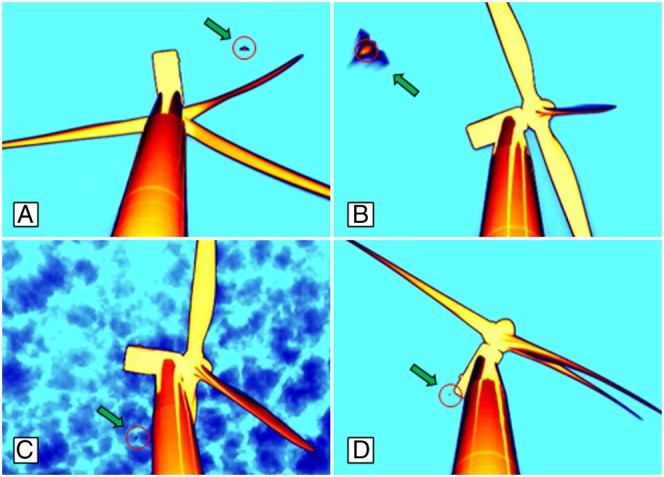
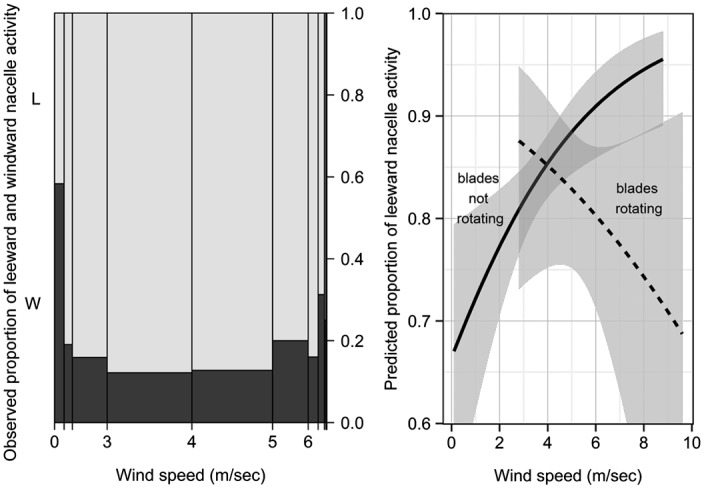
Wind turbines are causing unprecedented numbers of bat fatalities. Many fatalities involve tree-roosting bats, but reasons for this higher susceptibility remain unknown. To better understand behaviors associated with risk, we monitored bats at three experimentally manipulated wind turbines in Indiana, United States, from July 29 to October 1, 2012, using thermal cameras and other methods. We observed bats on 993 occasions and saw many behaviors, including close approaches, flight loops and dives, hovering, and chases. Most bats altered course toward turbines during observation. Based on these new observations, we tested the hypotheses that wind speed and blade rotation speed influenced the way that bats interacted with turbines. We found that bats were detected more frequently at lower wind speeds and typically approached turbines on the leeward (downwind) side. The proportion of leeward approaches increased with wind speed when blades were prevented from turning, yet decreased when blades could turn. Bats were observed more frequently at turbines on moonlit nights. Taken together, these observations suggest that bats may orient toward turbines by sensing air currents and using vision, and that air turbulence caused by fast-moving blades creates conditions that are less attractive to bats passing in close proximity. Tree bats may respond to streams of air flowing downwind from trees at night while searching for roosts, conspecifics, and nocturnal insect prey that could accumulate in such flows. Fatalities of tree bats at turbines may be the consequence of behaviors that evolved to provide selective advantages when elicited by tall trees, but are now maladaptive when elicited by wind turbines.
Keywords: energy development; sensory perception; video surveillance; wildlife; wind energy.
Conflict of interest statement
The authors declare no conflict of interest.
Figures
References
-
- Barclay RMR, Harder LD. Life histories of bats: Life in the slow lane. In: Kunz TH, Parsons S, editors. Bat Ecology. Univ of Chicago Press; Chicago: 2003. pp. 209–253.
-
- Racey PA, Entwistle AC. Life-history and reproductive strategies of bats. In: Crichton EG, Krutzsch PH, editors. Reproductive Biology of Bats. Academic; New York: 2000. pp. 363–414.
-
- Kunz TH, et al. Ecological impacts of wind energy development on bats: Questions, research needs, and hypotheses. Front Ecol Environ. 2007;5(6):315–324.
-
- Rydell J, et al. Bat mortality at wind turbines in northwestern Europe. Acta Chiropt. 2010;12(2):261–274.
-
- Parsons S, Battley P. Impacts of energy developments on wildlife: A southern hemisphere perspective. NZ J Zool. 2013;40(1):1–4.
Publication types
MeSH terms
LinkOut - more resources
Full Text Sources
Other Literature Sources
