Comparative Study
. 2014 Dec;58(12):7331-9.
doi: 10.1128/AAC.03510-14. Epub 2014 Sep 29.

Comparison of intrapulmonary and systemic pharmacokinetics of colistin methanesulfonate (CMS) and colistin after aerosol delivery and intravenous administration of CMS in critically ill patients

Affiliations
Comparative Study

Comparison of intrapulmonary and systemic pharmacokinetics of colistin methanesulfonate (CMS) and colistin after aerosol delivery and intravenous administration of CMS in critically ill patients

Matthieu Boisson et al. Antimicrob Agents Chemother. 2014 Dec.

Abstract

Colistin is an old antibiotic that has recently gained a considerable renewal of interest for the treatment of pulmonary infections due to multidrug-resistant Gram-negative bacteria. Nebulization seems to be a promising form of administration, but colistin is administered as an inactive prodrug, colistin methanesulfonate (CMS); however, differences between the intrapulmonary concentrations of the active moiety as a function of the route of administration in critically ill patients have not been precisely documented. In this study, CMS and colistin concentrations were measured on two separate occasions within the plasma and epithelial lining fluid (ELF) of critically ill patients (n = 12) who had received 2 million international units (MIU) of CMS by aerosol delivery and then intravenous administration. The pharmacokinetic analysis was conducted using a population approach and completed by pharmacokinetic-pharmacodynamic (PK-PD) modeling and simulations. The ELF colistin concentrations varied considerably (9.53 to 1,137 mg/liter), but they were much higher than those in plasma (0.15 to 0.73 mg/liter) after aerosol delivery but not after intravenous administration of CMS. Following CMS aerosol delivery, typically, 9% of the CMS dose reached the ELF, and only 1.4% was presystemically converted into colistin. PK-PD analysis concluded that there was much higher antimicrobial efficacy after CMS aerosol delivery than after intravenous administration. These new data seem to support the use of aerosol delivery of CMS for the treatment of pulmonary infections in critical care patients.


Figures

FIG 1
FIG 1
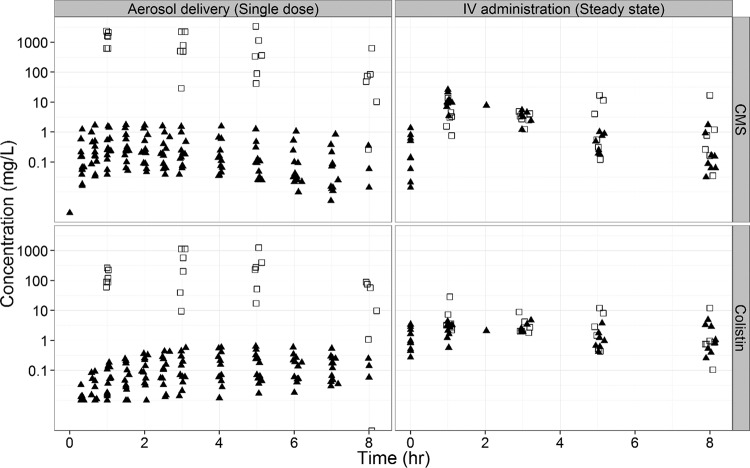
CMS (top panels) and colistin (bottom panels) concentrations in ELF (open squares) and plasma (filled triangles) following a single dose via aerosol or i.v. administration at steady state.
FIG 2
FIG 2
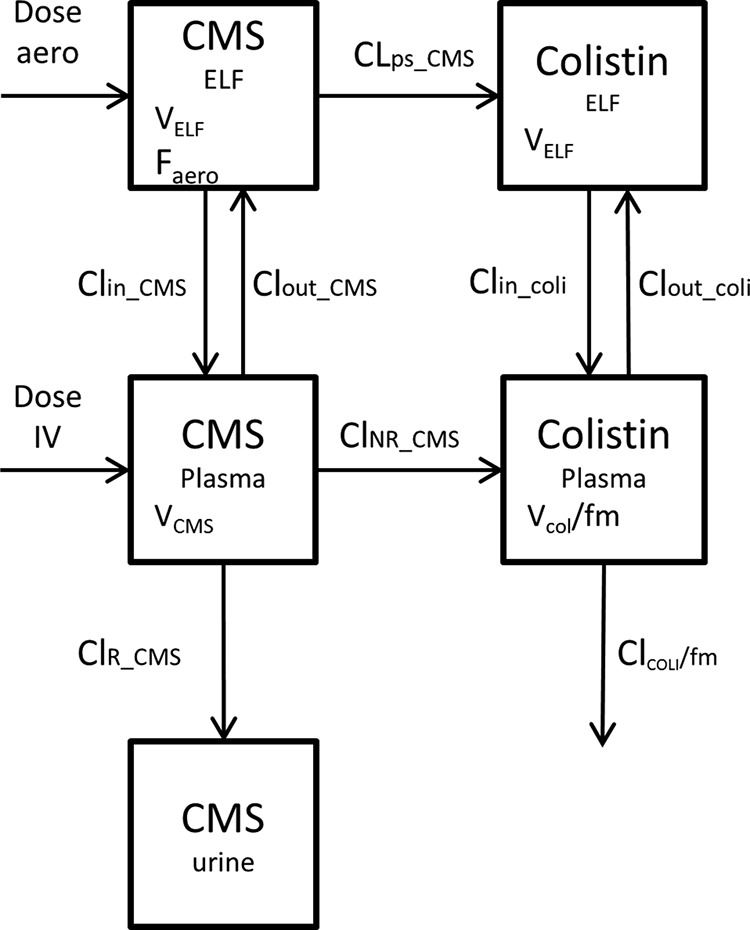
Structural pharmacokinetic model. VELF, volume of distribution in lung compartment; Faero, fraction of the aerosol dose that reaches systemic circulation; CLOUT_CMS, clearance of CMS from central to lung compartments; CLIN_CMS, clearance of CMS from lung to central compartments; CLps_CMS, clearance of CMS presystemic conversion in colistin; CLOUT_COLI, clearance of colistin from central to lung compartments; CLIN_COLI, clearance of colistin from lung to central compartments; VCMS, volume of distribution of CMS; CLR_CMS, renal clearance of CMS; CLNR_CMS, nonrenal clearance of CMS; VCOL, volume of distribution of colistin; CLCOL, total clearance of colistin; fm, fraction of the CMS dose not excreted unchanged that is converted into colistin.
FIG 3
FIG 3
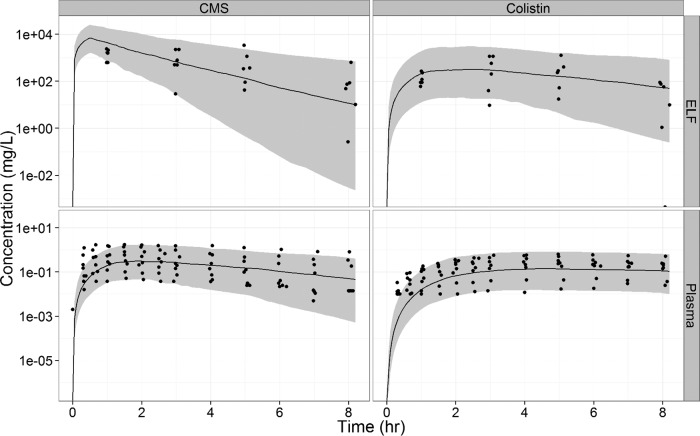
Observed colistin and CMS concentrations in ELF and plasma with model predictions (as medians [solid lines] and 90% prediction intervals [gray shaded areas]) using parameter estimates.
FIG 4
FIG 4
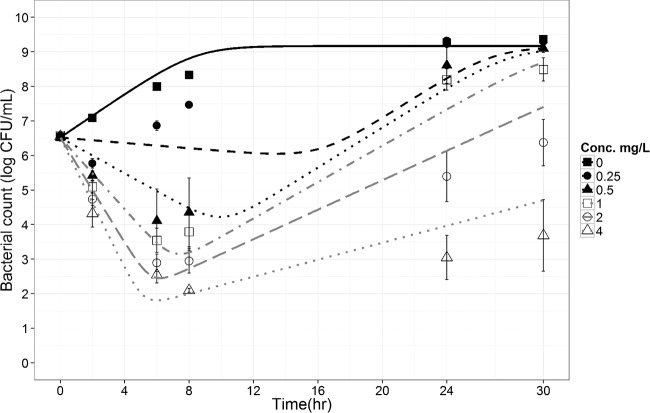
Time-kill curves for P. aeruginosa exposed to colistin at concentrations (Conc.) ranging from 0 to 4 mg/liter for a starting inoculum of 5 × 10⁶ CFU/ml. The results (dots and error bars) are the means and standard deviations of the results from four replicates. Included are the model predicted curves (lines) with mean parameter estimates.
FIG 5
FIG 5
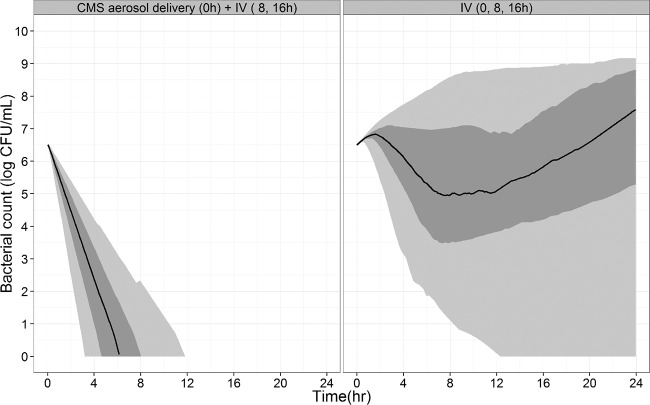
Predicted bacterial count over time after CMS aerosol delivery (2 MIU followed by 2 MIU i.v. at 8 h and 16 h) or i.v. administration (2 MIU every 8 h). The median (solid line), 25th to 75th percentile (dark grey area), and 5th to 95th percentile (light grey area) of the predicted counts are illustrated.

References

    1. Drobnic ME, Suñé P, Montoro JB, Ferrer A, Orriols R. 2005. Inhaled tobramycin in non-cystic fibrosis patients with bronchiectasis and chronic bronchial infection with Pseudomonas aeruginosa. Ann. Pharmacother. 39:39–44. 10.1345/aph.1E099. - DOI - PubMed
    1. Ramsey BW, Pepe MS, Quan JM, Otto KL, Montgomery AB, Williams-Warren J, Vasiljev-K M, Borowitz D, Bowman CM, Marshall BC, Marshall S, Smith AL. 1999. Intermittent administration of inhaled tobramycin in patients with cystic fibrosis. Cystic Fibrosis Inhaled Tobramycin Study Group. N. Engl. J. Med. 340:23–30. - PubMed
    1. McCoy KS, Quittner AL, Oermann CM, Gibson RL, Retsch-Bogart GZ, Montgomery AB. 2008. Inhaled aztreonam lysine for chronic airway Pseudomonas aeruginosa in cystic fibrosis. Am. J. Respir. Crit. Care Med. 178:921–928. 10.1164/rccm.200712-1804OC. - DOI - PMC - PubMed
    1. Conole D, Keating GM. 2014. Colistimethate sodium dry powder for inhalation: a review of its use in the treatment of chronic Pseudomonas aeruginosa infection in patients with cystic fibrosis. Drugs 74:377–387. 10.1007/s40265-014-0181-0. - DOI - PubMed
    1. Lu Q, Girardi C, Zhang M, Bouhemad B, Louchahi K, Petitjean O, Wallet F, Becquemin MH, Le Naour G, Marquette CH, Rouby JJ. 2010. Nebulized and intravenous colistin in experimental pneumonia caused by Pseudomonas aeruginosa. Intensive Care Med. 36:1147–1155. 10.1007/s00134-010-1879-4. - DOI - PubMed

Publication types

MeSH terms

LinkOut - more resources