. 2014 Dec;58(12):7416-23.
doi: 10.1128/AAC.03851-14. Epub 2014 Sep 29.

Potency and resistance analysis of hepatitis C virus NS5B polymerase inhibitor BMS-791325 on all major genotypes

Affiliations

Potency and resistance analysis of hepatitis C virus NS5B polymerase inhibitor BMS-791325 on all major genotypes

Mengping Liu et al. Antimicrob Agents Chemother. 2014 Dec.

Abstract

BMS-791325 is a hepatitis C virus (HCV) inhibitor binding to the thumb domain of the NS5B RNA-dependent RNA polymerase. BMS-791325 is well characterized in genotype 1 (GT1) and exhibits good inhibitory activity (50% effective concentration [EC50], <10 nM) against hybrid replicons containing patient NS5B sequences from GT3a, -4a, and -5a while potency against GT2 is significantly reduced (J. A. Lemm et al., Antimicrob. Agents Chemother. 58:3485-3495, 2014, doi:http://dx.doi.org/10.1128/AAC.02495-13). BMS-791325 potency against GT6a hybrid replicons is more variable, with two of three hybrid clones having EC50s similar to that for GT1 while a third patient clone was ∼ 10 times less susceptible to BMS-791325. To characterize the resistance profile of BMS-791325 beyond GT1, curing studies were performed across GT1a and -3a to -6a and demonstrated that GT1a has the highest resistance barrier versus BMS-791325 while GT6a has the lowest. Selection of GT3 to -6 NS5B chimeric replicon cells at different concentrations of BMS-791325 revealed substitutions in the thumb domain of NS5B at residues 494 and 495 that conferred different levels of resistance to BMS-791325 but remained susceptible to NS5A or NS3 protease inhibitors. In addition, we demonstrate that the reduced potency of BMS-791325 against one GT6a patient is due to an A494 polymorphism present in ∼ 21% of sequences in the European HCV database. The results from this report suggest that BMS-791325 is a candidate for combination treatment of HCV GT3 to -6 chronic infections, and the resistance profiles identified will provide useful information for future clinical development.


Figures

FIG 1
FIG 1
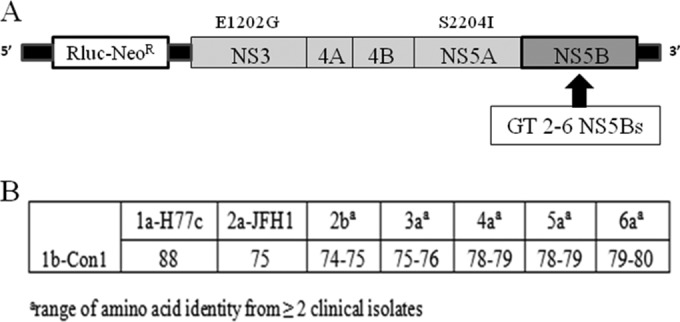
Construction of HCV GT2 to -6 NS5B chimeric replicons. (A) Schematic diagram of 1b-Con1 or 1a-H77c replicons with Renilla luciferase and neomycin resistance genes. GT2 to -6 chimeric replicons were constructed by replacing the entire NS5B coding region of the parent replicon with patient-derived NS5Bs from GT3a for the 1a-H77c backbone and GT2b, -4a, -5a, or -6a for the 1b-Con1 backbone. Each of the replicons contained engineered adaptive mutations of E1202G in NS3 and S2204I in NS5A. All NS5B chimeric replicon cell lines exhibited luciferase activities comparable to those of the GT1a/1b parent cell lines. (B) Percent NS5B amino acid identity of HCV GT2 to -6 patient samples to 1b-Con1.
FIG 2
FIG 2
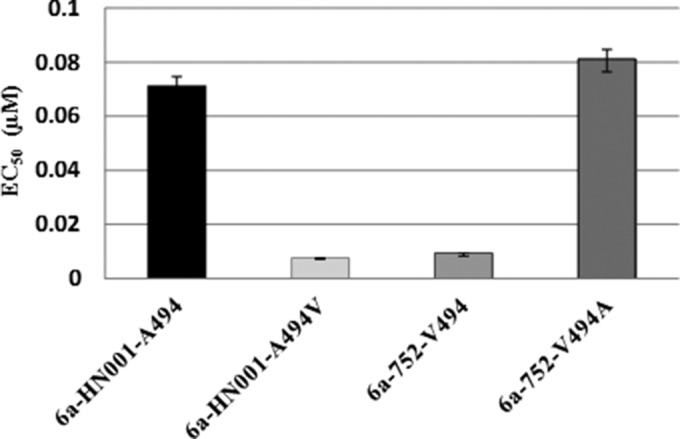
Phenotypic analysis of the NS5B A494V and V494A HCV GT6a replicons. Replicons containing substitutions of A494V in 6a-HN001 and V494A in 6a-752 were generated by site-directed mutagenesis. Stable cell lines were selected and tested for susceptibility to BMS-791325 in a 3-day replicon assay. Results are reported as average EC50 ± standard deviation from at least two independent experiments.
FIG 3
FIG 3
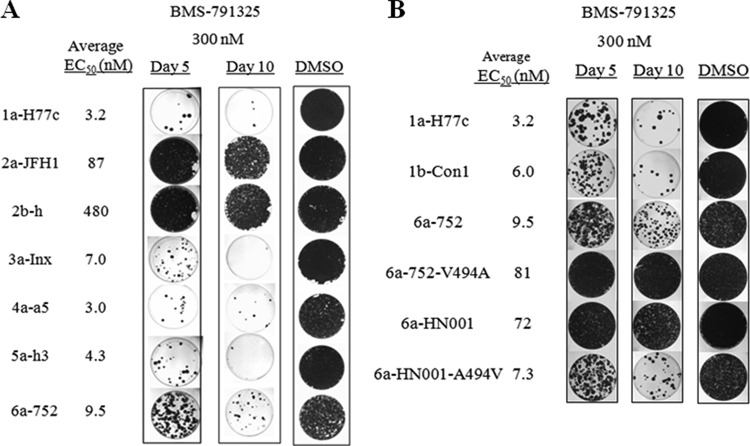
Resistance barrier of BMS-791325 on HCV GT1 to -6. Colony elimination studies were performed on GT1 to -6 wild-type replicons (A) or GT6a mutant replicons (B) using BMS-791325 monotherapy. NS5B chimeric replicon cells were treated with BMS-791325 (300 nM) for up to 10 days. Colonies were stained with crystal violet. Data shown are representative of results from two independent experiments.
FIG 4
FIG 4
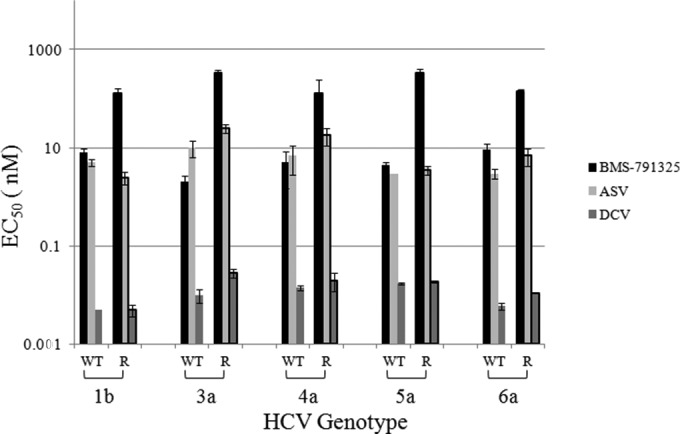
Potency of HCV NS3 protease (ASV) and NS5A replication complex (DCV) inhibitors on BMS-791325-resistant replicon cell lines. GT1 and GT3 to -6 NS5B wild-type (WT) and BMS-791325 resistant (R) replicon cell lines were tested for sensitivity to HCV inhibitors BMS-791325, ASV, and DCV. EC50s are the averages from at least 2 independent experiments, and error bars represent standard deviations.

References

    1. Lindenbach BD, Evans MJ, Syder AJ, Wölk B, Tellinghuisen TL, Liu CC, Maruyama T, Hynes RO, Burton DR, McKeating JA, Rice CM. 2005. Complete replication of hepatitis C virus in cell culture. Science 309:623–626. 10.1126/science.1114016. - DOI - PubMed
    1. Moradpour D, Penin F, Rice CM. 2007. Replication of hepatitis C virus. Nat. Rev. Microbiol. 5:453–463. 10.1038/nrmicro1645. - DOI - PubMed
    1. Bartenschlager R, Cosset F-L, Lohmann V. 2010. Hepatitis C virus replication cycle. J. Hepatol. 53:583–585. 10.1016/j.jhep.2010.04.015. - DOI - PubMed
    1. Simmonds P. 2004. Genetic diversity and evolution of hepatitis C virus—15 years on. J. Gen. Virol. 85:3173–3188. 10.1099/vir.0.80401-0. - DOI - PubMed
    1. Zein NN. 2000. Clinical significance of hepatitis C virus genotypes. Clin. Microbiol. Rev. 13:223–235. 10.1128/CMR.13.2.223-235.2000. - DOI - PMC - PubMed

MeSH terms

Substances

LinkOut - more resources