. 2014 Oct 20;211(11):2307-21.
doi: 10.1084/jem.20132349. Epub 2014 Sep 29.

CARD9 mediates Dectin-1-induced ERK activation by linking Ras-GRF1 to H-Ras for antifungal immunity

Affiliations

CARD9 mediates Dectin-1-induced ERK activation by linking Ras-GRF1 to H-Ras for antifungal immunity

Xin-Ming Jia et al. J Exp Med. .

Abstract

Dectin-1 functions as a pattern recognition receptor for sensing fungal infection. It has been well-established that Dectin-1 induces innate immune responses through caspase recruitment domain-containing protein 9 (CARD9)-mediated NF-κB activation. In this study, we find that CARD9 is dispensable for NF-κB activation induced by Dectin-1 ligands, such as curdlan or Candida albicans yeast. In contrast, we find that CARD9 regulates H-Ras activation by linking Ras-GRF1 to H-Ras, which mediates Dectin-1-induced extracellular signal-regulated protein kinase (ERK) activation and proinflammatory responses when stimulated by their ligands. Mechanistically, Dectin-1 engagement initiates spleen tyrosine kinase (Syk)-dependent Ras-GRF1 phosphorylation, and the phosphorylated Ras-GRF1 recruits and activates H-Ras through forming a complex with CARD9, which leads to activation of ERK downstream. Finally, we show that inhibiting ERK activation significantly accelerates the death of C. albicans-infected mice, and this inhibitory effect is dependent on CARD9. Together, our studies reveal a molecular mechanism by which Dectin-1 induces H-Ras activation that leads to ERK activation for host innate immune responses against fungal infection.


Figures

Figure 1.
Figure 1.
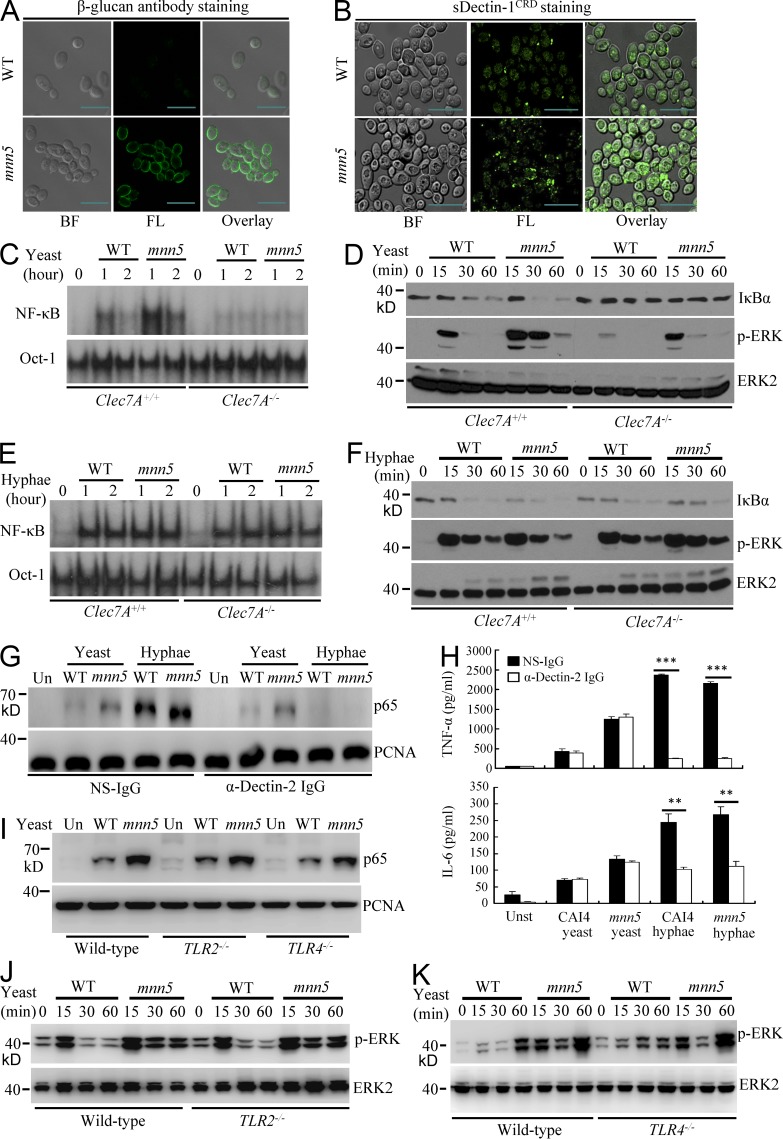
Surface β-glucans on C. albicans yeasts activate NF-κB and ERK through Dectin-1. (A and B) Surface β-glucan accessibility on WT or mnn5 yeast C. albicans strains, which were stained with anti–β-1,3-glucan monoclonal antibodies (β-glucan), followed by staining with FITC-labeled secondary antibodies (A) or soluble GFP-tagged Dectin-1 carbohydrate recognition domain (sDectin-1CRD; B). Bright field (BF), fluorescence (FL), and overlay (right) are shown individually. Bars, 10 µm. (C and D) WT and Dectin-1 (Clec7A)–deficient BMDMs were stimulated with UV-inactivated WT yeasts or mnn5 yeasts (MOI = 5) for indicated times. Nuclear extracts were subjected to EMSA using 32P-labeled NF-κB or Oct-1 probe (C). Cell lysates were subjected to immunoblotting analysis using the indicated antibodies (D). (E and F) WT and Dectin-1 (Clec7A)–deficient BMDMs were stimulated with hyphae of WT yeasts or mnn5 (MOI = 1) for the indicated times. Nuclear extracts were subjected to EMSA using 32P-labeled NF-κB or Oct-1 probe (E). Cell lysates were subjected to immunoblotting analysis using the indicated antibodies (F). (G) WT BMDMs were stimulated with C. albicans WT or mnn5 yeast (MOI = 5) or hyphae (MOI = 1) in the absence or presence of blocking antibodies against Dectin-2 (α-Dectin-2, 20 µg/ml) for 60 min. Nuclear extracts were prepared from these cells and subjected to immunoblotting analysis using indicated antibodies. (H) WT BMDMs were stimulated with the UV-inactivated yeast (MOI = 5) or hyphae (MOI = 1) form of CAI4 or mnn5 mutant in the absence or presence of blocking antibodies against Dectin-2 (20 µg/ml) for 6 h. The amount of TNF and IL-6 in the cultured media was determined using ELISA. **, P < 0.01; ***, P < 0.001. Data are means ± SD of triplicate wells and are representative of three independent experiments. (I–K) WT, TLR2-, and TRL4-deficient BMDMs were stimulated with UV-inactivated WT (CAI4) or mnn5 strains of C. albicans yeast cells (MOI = 5) for 1 h for preparing nuclear extracts (I) or for the indicated times for preparing cell lysates (J and K). Samples were subjected to immunoblotting analysis using indicated antibodies. Data shown are representative of three independent and reproducible experiments.
Figure 2.
Figure 2.
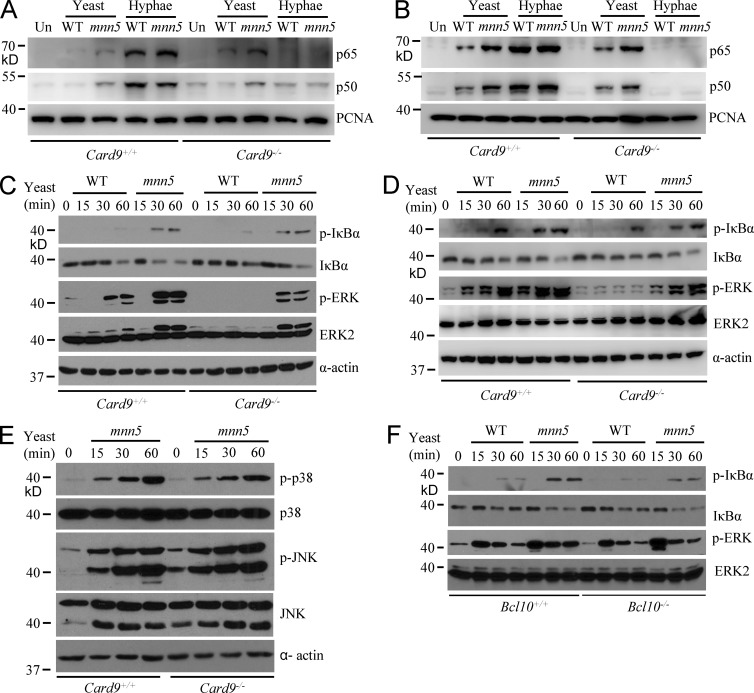
CARD9 engages the yeast-induced ERK, but not NF-κB activation. (A and B) WT and CARD9-deficient BMDMs (A) or BMDCs (B) were stimulated with UV-inactivated WT or mnn5 strains of C. albicans yeasts (MOI = 5) or hyphae (MOI = 1) for 1 h. Nuclear extracts were prepared and subjected to immunoblotting analysis using indicated antibodies. (C and D) WT and CARD9-deficient BMDMs (C) or BMDCs (D) were stimulated with UV-inactivated WT or mnn5 mutant strain of C. albicans yeast for the indicated times. Cell lysates were prepared and subjected to immunoblotting analysis using indicated antibodies. (E) WT and CARD9-deficient BMDMs were stimulated with UV-inactivated mnn5 yeast cells (MOI = 5) for the indicated times. Cell lysates were prepared and subjected to immunoblotting analysis using indicated antibodies. (F) WT and Bcl10-deficient BMDMs were stimulated with UV-inactivated WT or mnn5 yeast cells (MOI = 5) for the indicated times. Cell lysates were prepared and subjected to immunoblotting analysis using indicated antibodies. Data shown are representative of three independent and reproducible experiments.
Figure 3.
Figure 3.
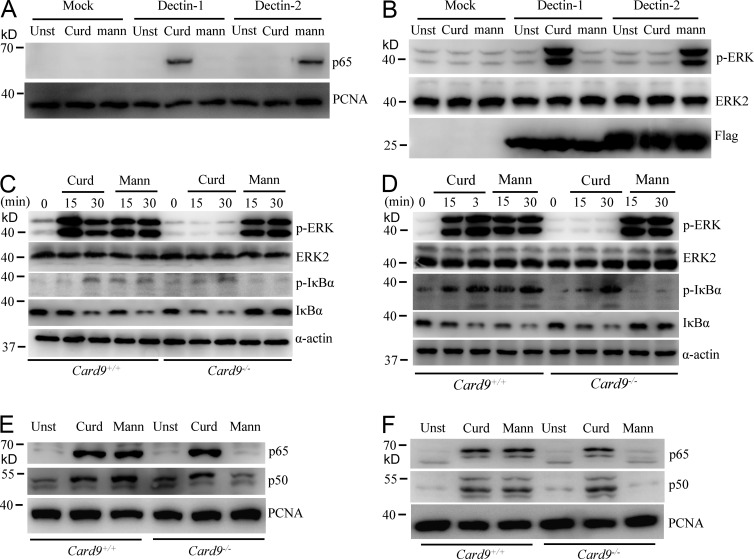
CARD9 mediates Curdlan-induced ERK activation but is not dispensable for NF-κB. (A and B) RAW264.7 cells stably expressing human Dectin-1, Dectin-2, or mock were stimulated with plate-coated curdlan (50 µg/ml) or α-mannans (40 µg/ml) for 1 h for preparing nuclear extract (A) or 30 min for preparing cell lysate (B), and then subjected to immunoblotting analysis using the indicated antibodies. (C–F) WT and CARD9-deficient BMDMs (C and E) or BMDCs (D and F) were stimulated with plate-coated curdlan (50 µg/ml) or α-mannans (40 µg/ml) for the indicated times for preparing cell lysate (C and D) and 1 h for preparing nuclear extract (E and F). The cell lysates or nuclear extracts were subjected to immunoblotting analysis using the indicated antibodies. Data shown are representative of three independent and reproducible experiments.
Figure 4.
Figure 4.
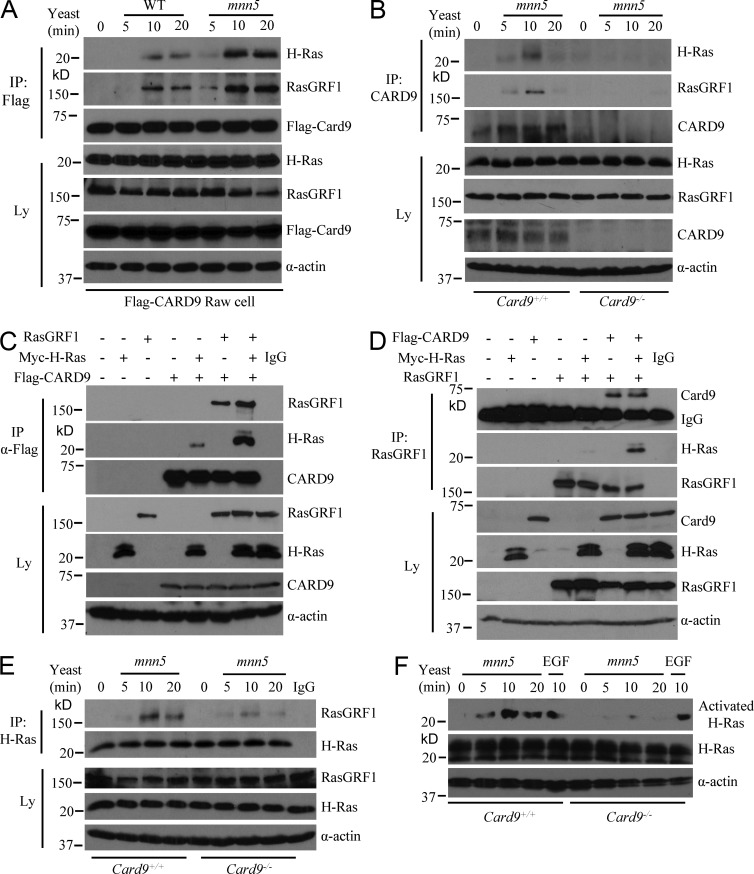
CARD9 links Ras-GRF1 to H-Ras in response to C. albicans yeast stimulation. (A) RAW264.7 cells stably expressing Flag-CARD9 were stimulated with UV-inactivated WT or mnn5 yeast cells for indicated times. Cell lysates (Ly) were immunoprecipitated (IP) with anti-Flag antibody. (B) WT and CARD9-deficient BMDMs were stimulated with UV-inactivated mnn5 yeast cells for indicated times. Cell lysates were immunoprecipitated with α-CARD9 antibody. The cell lysate or immunoprecipitates were subjected to immunoblots using indicated antibodies. (C and D) HEK293T cells were transfected with expression vectors encoding Ras-GRF1, Myc-H-Ras, and Flag-CARD9 at different combinations. Cell lysates were subjected to immunoprecipitation with anti-Flag (C) or anti-Ras-GRF1 antibody (D). (E) WT and CARD9-deficient BMDMs were stimulated with UV-inactivated mnn5 yeast cells for indicated times. Cell lysates were immunoprecipitated with anti–H-ras antibody. Immunoprecipitated (IP) and lysate (Ly) fractions were analyzed by immunoblotting using the indicated antibodies. (F) WT and CARD9-deficient BMDMs were stimulated with UV-inactivated mnn5 yeast cells or EGF (as a control) for indicated times. Ras activation was determined by pull-down assay using a Ras activation assay Biochem kit according to the manufacturer’s instructions. Immunoassay of the total and activated Ras was performed for determining the Ras activation. Data shown are representative of three independent and reproducible experiments.
Figure 5.
Figure 5.
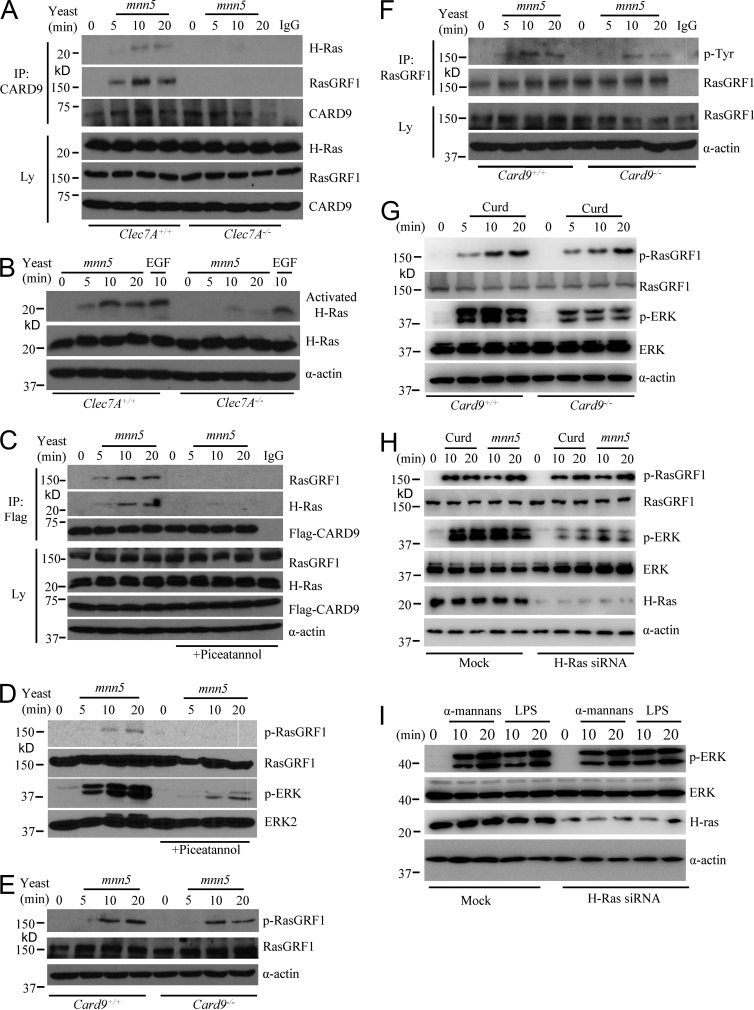
Dectin-1/Syk stimulation by C. albicans yeast induces the formation of a Ras-GRF1–CARD9–H-Ras complex. (A) WT and Dectin-1–deficient BMDMs were stimulated with UV-inactivated mnn5 yeast cells (MOI = 5) for the indicated times. Cell lysates were immunoprecipitated with anti-CARD9 antibody and immunoprecipitated (IP) and lysate (Ly) fractions were analyzed by immunoblotting using indicated antibodies. (B) WT and Dectin-1–deficient BMDMs were stimulated with UV-inactivated mnn5 yeast cells (MOI = 5) or EGF for indicated times. Ras activation was determined by pull-down assay using a Ras activation assay Biochem kit. Immunoassay of the total and activated Ras was performed for determining the Ras activation. (C) RAW264.7 cells stably expressing Flag-Card9 were pretreated with or without Syk inhibitor (piceatannol) for 30 min before stimulation with UV-inactivated mnn5 yeast cells (MOI = 5) for indicated times. Cell lysates were immunoprecipitated with anti-Flag antibody and analyzed by immunoblotting using indicated antibodies. (D) WT BMDMs were pretreated with or without piceatannol for 30 min before stimulation with UV-inactivated mnn5 yeast cells (MOI = 5) for the indicated times. (E) WT and CARD9-deficient BMDMs were stimulated with UV-inactivated mnn5 yeast cells (MOI = 5) for the indicated times. (F) WT and CARD9-deficient BMDMs were stimulated with UV-inactivated mnn5 yeast cells for indicated times. Cell lysates were immunoprecipitated with anti-Ras-GRF1 antibody and immunoprecipitated (IP) and lysate (Ly) fractions were analyzed by immunoblotting using indicated antibodies. (G) WT and CARD9-deficient BMDMs were stimulated with plate-coated curdlan (50 µg/ml) for the indicated times. (H and I) Knockdown of endogenous H-Ras by RNA interference in BMDMs, which were transfected with siRNA against murine H-Ras and nontargeting control siRNA using Trans IT-TKO transfection reagent (Mirus). Cells were cultured for 48 h after transfection and then stimulated with plate-coated curdlan (50 µg/ml), UV-inactivated mnn5 yeast cells (MOI = 5), plate-coated α-mannans (50 µg/ml), or LPS (100ng/ml) for the indicated times. Cell lysates were subjected to immunoblotting analysis using indicated antibodies. Data shown are representative of three independent and reproducible experiments.
Figure 6.
Figure 6.
CARD9-mediated H-Ras activation is critical for immune responses triggered by C. albicans yeast and curdlan. (A and B) ELISA results for cytokines TNF, IL-1β, IL-6, and IL-12p40 in supernatants of WT and CARD9-deficient BMDMs, which were stimulated for 6 h with UV-inactivated WT or mnn5 yeast (MOI = 5; A) or hyphae (MOI = 0.1; B). (C and D) ELISA results for cytokines TNF, IL-1β, IL-6, and IL-12p40 in supernatants of WT and CARD9-deficient BMDMs, which were pretreated with or without 5 µM U0126 for 30 min and then stimulated with UV-inactivated mnn5 yeast cells (MOI = 5; C) or plate-coated curdlan (50 µg/ml; D) for 6 h. (E and F) ELISA results for cytokines TNF, IL-1β, IL-6, and IL-12p40 in supernatants of WT BMDMs, which were transfected with siRNA against murine H-Ras and nontargeting control siRNA using Trans IT-TKO transfection reagent (Mirus). Cells were cultured for 48 h after transfection and then stimulated with plate-coated curdlan (50 µg/ml), UV-inactivated mnn5 yeast cells (MOI = 5), plate-coated α-mannans (50 µg/ml), or LPS (100 ng/ml) for 6 h. (G) ELISA results for cytokines TNF, IL-1β, IL-6, and IL-12p40 in supernatants of WT and CARD9-deficient BMDMs, which were pretreated with or without 5 µM U0126 for 30 min and then stimulated with plate-coated α-mannans (50 µg/ml) or LPS (100 ng/ml) for 6 h. *, P < 0.05; **, P < 0.01; ***, P < 0.001. Data are means ± SD of triplicate samples and are representative of three independent experiments.
Figure 7.
Figure 7.
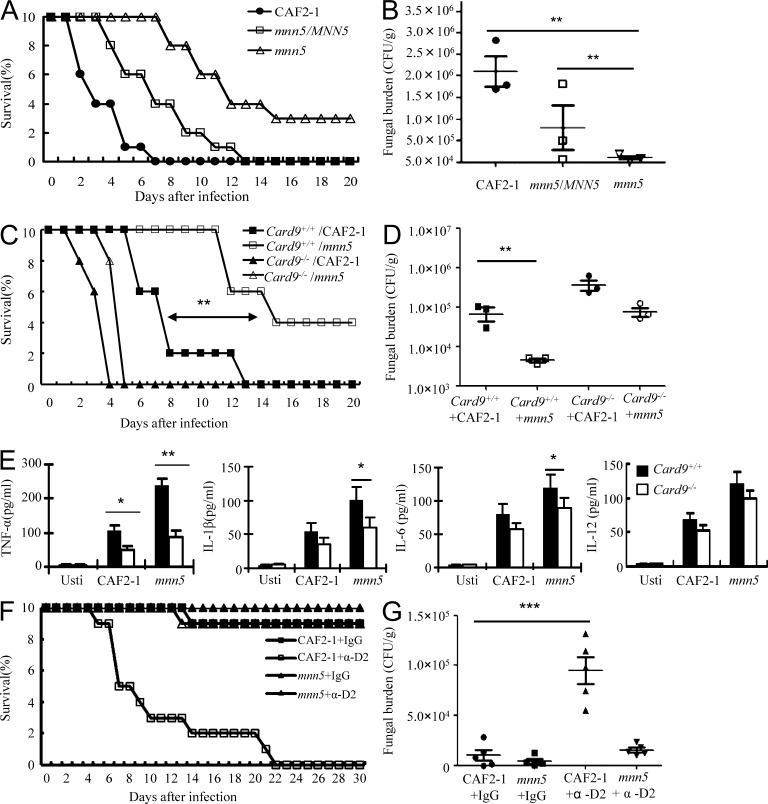
Surface β-glucans exposed on C. albicans significantly enhance CARD9-mediated proinflammation responses against systemic candidiasis. (A and B) Infected mice survival and kidney CFU assay. Groups of C57B/L6 female mice were injected via lateral tail vein with 1 × 10⁶ CFU of C. albicans WT (CAF2-1), mnn5 mutant, and its restored strain (mnn5/MNN5) in 200 µl sterile saline. Survival of these mice (n = 10 per group) was monitored and plotted (A). Kidney CFU assay (n = 5 per group) was performed at day 2 after infection (B). Shown are means and SD for n = 3. (C and D) WT (Card9+/+; squares) and CARD9-deficient mice (Card9−/−; triangles) were infected intravenously with 3 × 10⁵ CFU of C. albicans WT (CAF2-1) and mnn5 mutant strains in 200 µl sterile saline. Survival of these mice (n = 10 per group) was monitored and plotted (C). Kidney CFU assay (n = 5 per group) was performed at day 2 after infection (D). Shown are means and SD for n = 3. (E) ELISA results for TNF, IL-6, IL-1β, and IL-12p40 in mouse sera at day 2 after infection. WT (Card9+/+) and CARD9-deficient (Card9−/−) mice (n = 5 per group) were challenged with UV-inactivated C. albicans WT (CAF2-1) and mnn5 mutant yeast cells (1 × 10⁶) in 200 µl sterile saline. Data shown are representative of three independent experiments. SDs are indicated. (F and G) Infected mice survival and kidney CFU assay. Groups of C57B/L6 female mice infected with 6 × 10⁴ CFU of C. albicans WT (CAF2-1) and mnn5 mutant strains, which were treated with 200 µg anti–Dectin-2 monoclonal antibodies (α-D2) or nonspecific control IgG per mouse for four times at 6 h before or 2, 4, or 6 d after injection of C. albicans. Survival of these mice (n = 10 per group) was monitored and plotted (F). Kidney CFU assay (n = 5 per group) was performed at day 2 after infection (G). Shown are means and SD for n = 5. Two independent experiments were conducted (n = 10 in each group). *, P < 0.05; **, P < 0.01; ***, P < 0.001.
Figure 8.
Figure 8.
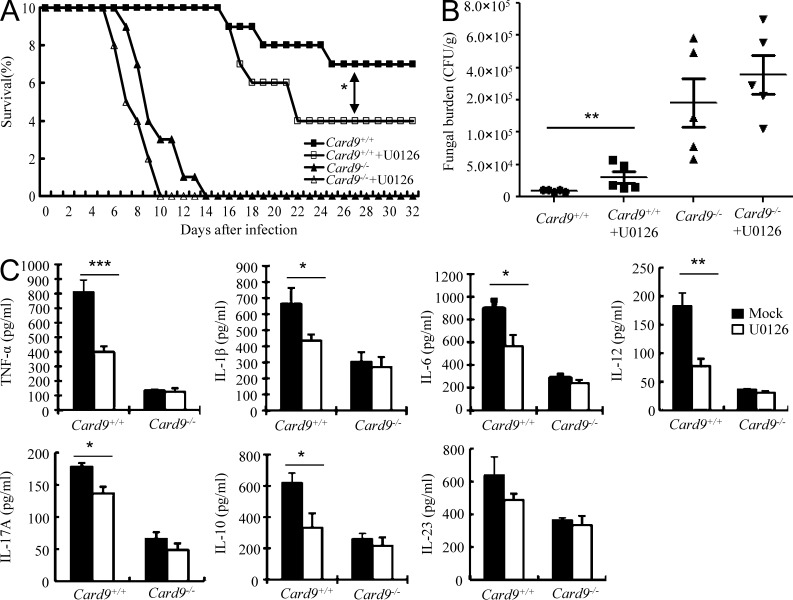
ERK activation is critical for CARD9-mediated innate immunity against C. albicans. (A and B) WT and CARD9-deficient mice were intravenously injected with 5 × 10⁴ CFU of mnn5. Infected mice were treated with or without U0126 (50 µg per mouse) at days 0, 2, 4, and 6 after infection. Survival of infected mice (n = 10 per group) was monitored (A) and kidney CFU assay (n = 5 per group) was performed at day 2 after infection (B). *, P < 0.05; **, P < 0.01. (C) ELISA results of TNF, IL-1β, IL-6, IL-12p40, IL-17A, IL-10, and IL-23 in the extracts of homogenized kidneys from WT and CARD9-deficient mice 4 d after infection with 5 × 10⁴ CFU of mnn5. Infected mice were treated with or without 50 µg U0126 per mouse at days 0 and 2 after infection. *, P < 0.05; **, P < 0.01; ***, P < 0.001, n = 5 per group. Data shown are representative of three independent experiments. SDs are indicated.

References

    1. Bai, C., Xu X.L., Chan F.Y., Lee R.T.H., and Wang Y.. 2006. MNN5 encodes an iron-regulated α-1,2-mannosyltransferase important for protein glycosylation, cell wall integrity, morphogenesis, and virulence in Candida albicans. Eukaryot. Cell. 5:238–247. 10.1128/EC.5.2.238-247.2006 - DOI - PMC - PubMed
    1. Bertin, J., Guo Y., Wang L., Srinivasula S.M., Jacobson M.D., Poyet J.-L., Merriam S., Du M.-Q., Dyer M.J., Robison K.E., et al. . 2000. CARD9 is a novel caspase recruitment domain-containing protein that interacts with BCL10/CLAP and activates NF-κB. J. Biol. Chem. 275:41082–41086. 10.1074/jbc.C000726200 - DOI - PubMed
    1. Bi, L., Gojestani S., Wu W., Hsu Y.M.S., Zhu J., Ariizumi K., and Lin X.. 2010. CARD9 mediates dectin-2-induced IκBα kinase ubiquitination leading to activation of NF-κB in response to stimulation by the hyphal form of Candida albicans. J. Biol. Chem. 285:25969–25977. 10.1074/jbc.M110.131300 - DOI - PMC - PubMed
    1. Brown, G.D.2006. Dectin-1: a signalling non-TLR pattern-recognition receptor. Nat. Rev. Immunol. 6:33–43. 10.1038/nri1745 - DOI - PubMed
    1. Brown, G.D., and Gordon S.. 2001. Immune recognition. A new receptor for β-glucans. Nature. 413:36–37. 10.1038/35092620 - DOI - PubMed

Publication types

MeSH terms