


A Longitudinal Examination of the Moderating Effects of Symptoms on the Relationship between Functional Competence and Real World Functional Performance in Schizophrenia
- PMID: 25267939
- PMCID: PMC4175398
- DOI: 10.1016/j.scog.2014.03.002
A Longitudinal Examination of the Moderating Effects of Symptoms on the Relationship between Functional Competence and Real World Functional Performance in Schizophrenia
Abstract
Background: Many individuals with schizophrenia experience remission of prominent positive symptoms but continue to experience impairments in real world functioning. Residual negative and depressive symptoms may have a direct impact on functioning and impair patients' ability to use the cognitive and functional skills that they possess (competence) in the real world (functional performance).
Methods: 136 individuals (100 men, 36 women) with schizophrenia were classified as having primarily positive symptoms, primarily negative symptoms, primarily depressive symptoms, or undifferentiated symptom profiles. Performance based measures of cognition and adaptive and interpersonal functional competence were used, along with ratings of real world behavior by high contact clinicians. Assessments were performed at baseline and at an 18-month follow-up.
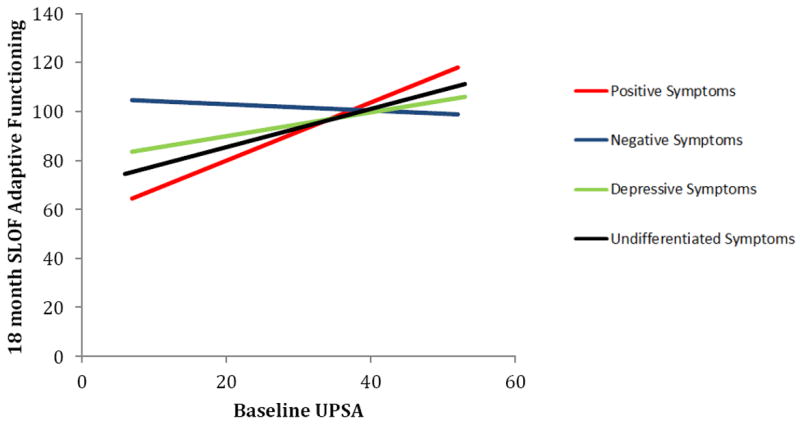
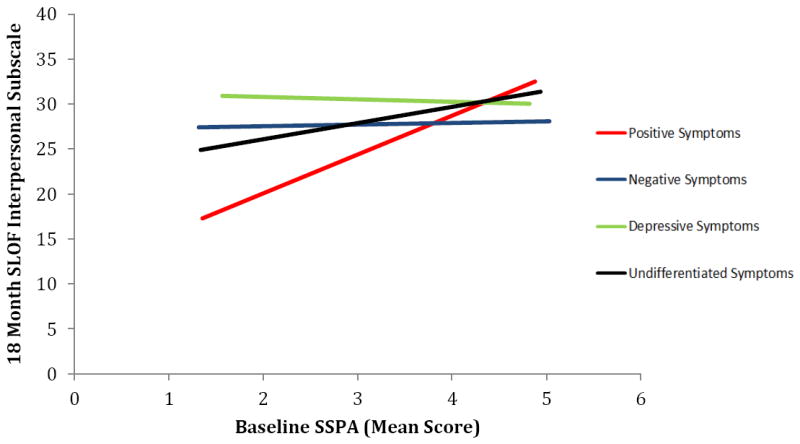
Results: The relationships between neurocognition and capacity / performance were not moderated by symptom group ps > .091; neurocognition predicted capacity and performance for all groups ps < .001. The relationship between adaptive competence and adaptive performance was moderated by symptom group, ps < .01, such that baseline competence only predicted future performance ratings for participants with primarily positive or undifferentiated symptoms, and not for individuals with primarily negative or depressive symptoms. This same moderation effect was found on the relationship between interpersonal competence and interpersonal performance, ps < .002.
Conclusions: Residual negative and depressive symptoms are distinct constructs that impede the use of functional skills in the real world. Depressive symptoms are often overlooked in schizophrenia but appear to be an important factor that limits the use of functional ability in real world environments.
Figures
References
-
- Abdallah C, Cohen CI, Sanchez-Almira M, Reyes P, Ramirez P. Community integration and associated factors among older adults with schizophrenia. Psychiatr Serv. 2009;60(12):1642–1648. - PubMed
-
- American Psychiatric Association. Diagnostic and statistical manual of mental disorders. 4. Author; Washington, DC: 1994.
-
- Andreasen NC, Flaum M, Arndt S. The comprehensive assessment of symptoms and history (CASH): An instrument for assessing psychopathology and diagnosis. Arch Gen Psychiat. 1992;49(8):615–623. - PubMed
-
- Andreasen NC, Carpenter WT, Kane JM, Lasser RA, Marder SR, Weinberger DR. Remission in schizophrenia: proposed criteria and rationale for consensus. Am J Psychiat. 2005;162(3):441–449. - PubMed
-
- an der Heiden W, Könnecke R, Maurer K, Ropeter D. Depression in the long-term course of schizophrenia. Eur Arch Psy Clin N. 2005;255(3):174–184. - PubMed
Grants and funding
LinkOut - more resources
Full Text Sources
Other Literature Sources