


Non-native (exotic) snake envenomations in the U.S., 2005-2011
- PMID: 25268980
- PMCID: PMC4210875
- DOI: 10.3390/toxins6102899
Non-native (exotic) snake envenomations in the U.S., 2005-2011
Abstract
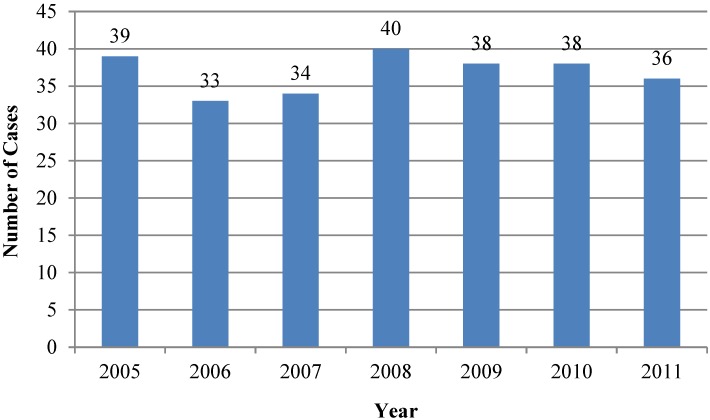
Non-native (exotic) snakes are a problematic source of envenomation worldwide. This manuscript describes the current demographics, outcomes and challenges of non-native snakebites in the United States (U.S.). We performed a retrospective case series of the National Poison Data System (NPDS) database between 2005 and 2011. There were 258 human exposures involving at least 61 unique exotic venomous species (average = 37 per year; range = 33-40). Males comprised 79% and females 21%. The average age was 33 years with 16% less than 20 years old. 70% of bites occurred in a private residence and 86% were treated at a healthcare facility. 35% of cases received antivenom and 10% were given antibiotics. This study is compared to our previous study (1994-2004) in which there was a substantial coding error rate. Software modifications significantly reduced coding errors. Identification and acquisition of appropriate antivenoms pose a number of logistical difficulties in the management of these envenomations. In the U.S., poison centers have valuable systems and clinical roles in the provision of expert consultation and in the management of these cases.
Figures
Comment in
-
Comment on Warrick, B.J., Boyer, L.V., Seifert, S.A. Non-native (exotic) snake envenomations in the U.S., 2005-2011. Toxins 2014, 6, 2899-2911.Toxins (Basel). 2014 Dec 5;6(12):3258-9. doi: 10.3390/toxins6123258. Toxins (Basel). 2014. PMID: 25490723 Free PMC article. No abstract available.
References
-
- Collis A., Fenili R. The Modern U.S. Reptile Industry. Georgetown Economic Services, LLC; Washington, DC, USA: 2011. [(accessed on 11 September 2014)]. Available online: http://www.whitehouse.gov/sites/default/ files/omb/assets/oira_1018/1018....
-
- Ivanyi C., Altimari W. Venomous reptile bites in academic research. Herp. Rev. 2004;35:49–50.
-
- Card W., Roberts D.T. Incidence of bites from venomous reptiles in North American zoos. Herpetol. Rev. 1996;27:15–16.
-
- kingsnake.com. [(accessed on 14 August 2014)]. Available online: http://www.kingsnake.com/events/index.php.
-
- kingsnake.com. [(accessed on 14 August 2014)]. Available online: http://market.kingsnake.com/index.php?cat=101.
MeSH terms
Substances
LinkOut - more resources
Full Text Sources
Other Literature Sources
