Review
. 2014 Nov;15(11):749-60.
doi: 10.1038/nrm3884. Epub 2014 Oct 1.

The structure, function and evolution of proteins that bind DNA and RNA

Affiliations
Review

The structure, function and evolution of proteins that bind DNA and RNA

William H Hudson et al. Nat Rev Mol Cell Biol. 2014 Nov.

Abstract

Proteins that bind both DNA and RNA typify the ability of a single gene product to perform multiple functions. Such DNA- and RNA-binding proteins (DRBPs) have unique functional characteristics that stem from their specific structural features; these developed early in evolution and are widely conserved. Proteins that bind RNA have typically been considered as functionally distinct from proteins that bind DNA and studied independently. This practice is becoming outdated, in partly owing to the discovery of long non-coding RNAs (lncRNAs) that target DNA-binding proteins. Consequently, DRBPs were found to regulate many cellular processes, including transcription, translation, gene silencing, microRNA biogenesis and telomere maintenance.


Figures
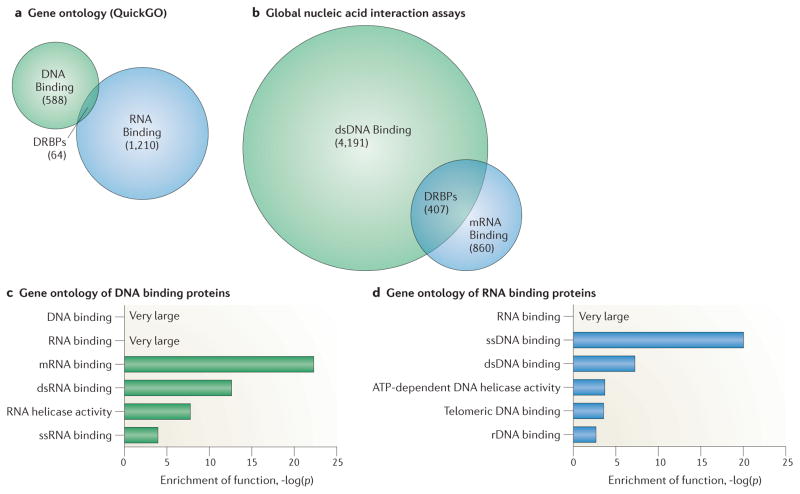
Figure 1
Figure 1. Defining human DRBPs
a. Venn diagram of DNA binding and of RNA binding proteins in the QuickGO database supported by low-throughput experimental evidence (as of July 2014). The overlap of these two sets represents human DNA and RNA interacting proteins (DRBPs), consisting of 64 proteins. b. Venn diagram of DNA binding and of RNA binding proteins identified in high-throughput studies defining the human mRNA and dsDNA interactomes,. There are 407 proteins found in both studies, indicating that they may bind both mRNA and dsDNA. c. Molecular function gene ontology analysis reveals that RNA binding is a potentially major function of the dsDNA binding proteins identified in REF . d. Gene ontology analysis reveals that DNA binding is potentially a major function of the mRNA binding proteins identified in REF . In parts a and b, circles are drawn to scale. In parts c and d, only selected molecular function attributes are shown for brevity. p-values in parts c and d indicate the probability that the over-representation of the stated ontology term in the selected 407 genes compared to all human genes is due to chance. These were calculated in the TRANSFAC + PROTEOME database (BIOBASE) using the hypergeometric distribution; “very large” indicates a p-value of less than 1 x 10−40 (−log(p) > 40).
Figure 2
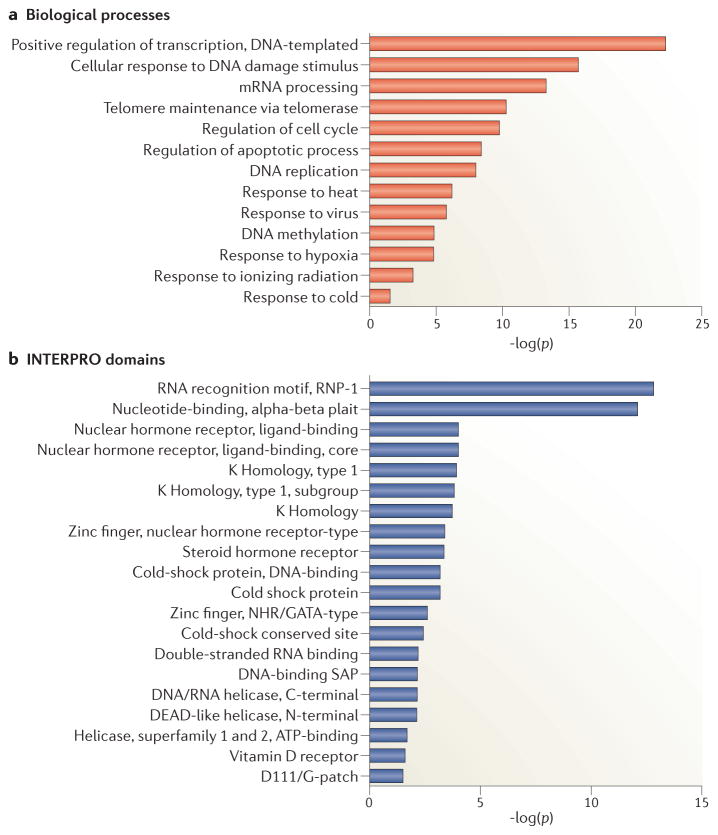
Figure 2. Functional and structural properties of DRBPs
The 149 DRBPs (Supplementary Table 1) were subjected to gene ontology enrichment of biological process (PROTEOME database, Biobase) and to INTERPRO domain enrichment (DAVID ontology,), to explore the biological functions of and protein domains commonly found in DRBPs. a. Gene ontology analysis. Biological processes such as transcriptional regulation and mRNA processing are expectedly prominent terms found enriched for DRBPs. However, unexpected functions are also enriched, including response to many cellular stresses (heat, viral, radiation, etc.). For brevity, only selected functions are shown. b. Domain enrichment analysis. All domains enriched in the set of 149 DRBPs that have p-values equal or smaller than p = 10−3 are shown. p-values in parts a and b indicate the probability that the over-representation of the stated term in the 149 DRBPs compared to all human genes is due to chance.
Figure 3
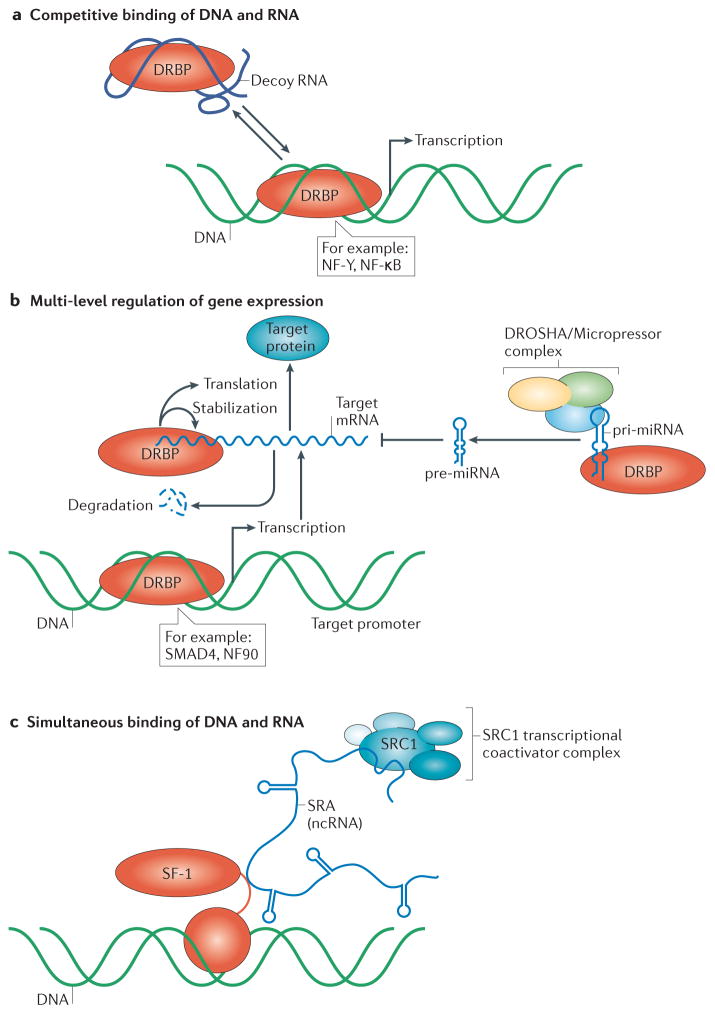
Figure 3. Three archetypes of DRBP function
a, RNA can compete with DNA for binding to DRBPs, typically at the same protein interface. In the case of transcription factors, this can reduce promoter occupancy and the transcription of target genes. b, DRBPs can regulate gene expression at multiple levels. In addition to binding to the promoters of genes to regulate their transcription, DRBPs can also affect miRNA processing and mRNA stability and translation. c, DRBPs, such as SF-1, can bind DNA and RNA simultaneously, whereby the RNA functions as scaffold to recruit other proteins to a specific DNA locus. Shown here is the DRBP, SF-1, binding to the lncRNA SRA to recruit the steroid receptor coactivator 1 (SRC-1) transcriptional complex in a ligand independent manner.
Figure 4
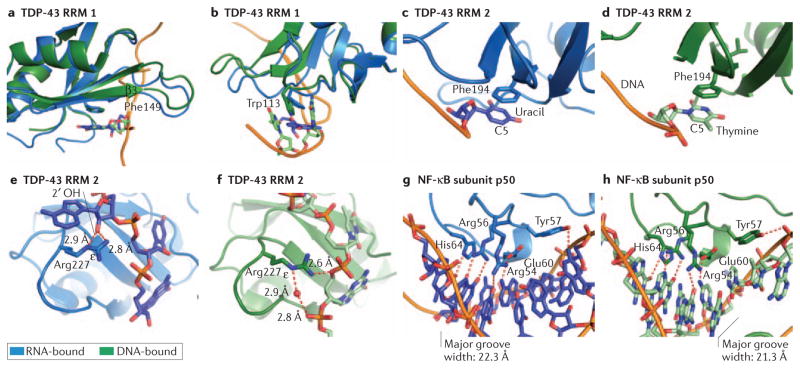
Figure 4. The structural basis for dual DNA and RNA recognition by TDP-43 and by the NF-κB subunit p50
Protein-RNA structures are shown in blue and protein-DNA structures in green, with protein in the darker shade. π-stacking interactions play a prominent role in both the ssDNA and ssRNA binding activities of TDP-43: a–d. Phe149 (a) and Trp113 (b) within the first RRM of TDP43 stack with both RNA and DNA bases. c, d. In the second RRM of TDP-43, Phe194 is capable of recognizing both uracil in RNA and thymine in DNA; the additional methyl group at C5 in thymine does not contribute to nucleic acid specificity. e. When bound to RNA, both the terminal amine and ε nitrogen of Arg227 in the second RRM of TDP-43 contact a 2′OH on the RNA backbone. f. In contrast, these same groups can also make contacts with the DNA backbone, both directly and through water mediated hydrogen bonding. g, h. The p50 subunit of NF-κB makes strikingly similar base-specific contacts when bound to double-stranded DNA (g) or an RNA aptamer (h). This is due in large part to the similar secondary structure and chemical moieties presented by the RNA and DNA. Major groove width was calculated by 3DNA using phosphate-phosphate distances.
Figure 5
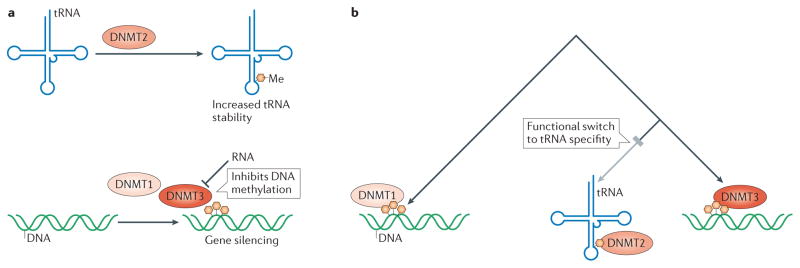
Figure 5. DNA methyltransferases target both DNA and RNA
a, Best known for their role in gene silencing, all DNA methyltransferase family members are able to interact with both RNA and DNA,,. DMNT1 and DMNT3 play a role in initiating and maintaining DNA methylation while DNMT2 methylates tRNAs. This tRNA modification is critical for maintaining tRNA stability and cell viability. b, Cladeogram depicting the evolution of the three major families of DNMTs. DNMT2 likely diverged from its ancestral DNA methyltransferase activity to perform a critical role in methylating tRNAs, a function which it performs redundantly with NUSN2. This radical change in DNMT’s substrate specificity highlights the ability of evolution to reshape a DNA-binding interface into one that preferentially recognizes RNA.

References

    1. Kino T, Hurt DE, Ichijo T, Nader N, Chrousos GP. Noncoding RNA gas5 is a growth arrest- and starvation-associated repressor of the glucocorticoid receptor. Sci Signal. 2010;3:ra8. This study showed that a widely expressed lncRNA was able to accumulate during stress and act as an RNA decoy to prevent steroid receptors from binding to their target DNA. - PMC - PubMed
    1. Ishmael FT, et al. The human glucocorticoid receptor as an RNA-binding protein: global analysis of glucocorticoid receptor-associated transcripts and identification of a target RNA motif. J Immunol. 2011;186:1189–1198. Showed that the glucocorticoid receptor binds to mRNAs involved in inflamation to accelerate their degradation. - PMC - PubMed
    1. Davis BN, Hilyard AC, Nguyen PH, Lagna G, Hata A. Smad proteins bind a conserved RNA sequence to promote microRNA maturation by Drosha. Mol Cell. 2010;39:373–384. - PMC - PubMed
    1. Shi L, et al. Dynamic binding of Ku80, Ku70 and NF90 to the IL-2 promoter in vivo in activated T-cells. Nucleic Acids Res. 2007;35:2302–10. - PMC - PubMed
    1. Shi L, Godfrey WR, Lin J, Zhao G, Kao PN. NF90 regulates inducible IL-2 gene expression in T cells. J Exp Med. 2007;204:971–7. - PMC - PubMed

Publication types

MeSH terms