


Gender differences in coronary artery diameter are not related to body habitus or left ventricular mass
- PMID: 25269657
- PMCID: PMC6649484
- DOI: 10.1002/clc.22310
Gender differences in coronary artery diameter are not related to body habitus or left ventricular mass
Abstract
Background: Smaller coronary artery diameter portends worse outcomes after coronary artery bypass grafting (CABG) and percutaneous coronary intervention (PCI). The suggestion that women have smaller coronary artery diameters than men has not been validated by a large-scale study.
Hypothesis: We sought to confirm a gender difference with respect to coronary artery diameter, even after accounting for body habitus and left ventricular mass (LVM).
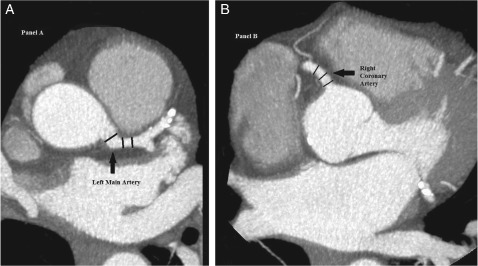
Methods: From 4200 subjects evaluated for cardiovascular disease by computed tomography angiography, we selected 710 subjects (383 males, 327 females) with coronary artery calcium (CAC) scores <100, eliminating patients with artery remodeling. Diameters of the left main (LM), left anterior descending (LAD), left circumflex (CX), and right coronary arteries (RCA), were measured. Measurements were compared using a 2-sample t test and the multiple regression model, accounting for body habitus and LVM.
Results: After adjusting for age, race, weight, height, body mass index, body surface index, LVM, and CAC, women have smaller diameters in the LM (males 4.35 mm, females 3.91 mm), LAD (males 3.54 mm, females 3.24 mm), CX (males 3.18, females 2.75 mm), and RCA (males 3.70 mm, females 3.26 mm) (P < 0.001). This difference is not related to body habitus or LVM.
Conclusions: Gender significantly influences artery diameter of the LM, LAD, CX, and RCA. This may warrant gender specific approaches during PCI and CABG. As neither body habitus nor LVM relate to the difference in coronary artery diameter, our study encourages a search for inherent differences between genders that can account for this difference.
© 2014 Wiley Periodicals, Inc.
Figures
References
-
- O'Connor NJ, Morton JR, Birkmeyer JD, et al. Effect of coronary artery diameter in patients undergoing coronary bypass surgery. Northern New England Cardiovascular Disease Study Group. Circulation. 1996;93:652–655. - PubMed
-
- Bjork VO, Ekestrom S, Henze A, et al. Early and late patency of aortocoronary vein grafts. Scand J Thorac Cardiovasc Surg. 1981;15:11–21. - PubMed
-
- Schunkert H, Harrell L, Palacios IF. Implications of small reference vessel diameter in patients undergoing percutaneous coronary revascularization. J Am Coll Cardiol. 1999;34:40–48. - PubMed
-
- Stramba‐Badiale M, Fox KM, Priori SG, et al. Cardiovascular diseases in women: a statement from the policy conference of the European Society of Cardiology. Eur Heart J. 2006;27:994–1005. - PubMed
Publication types
MeSH terms
LinkOut - more resources
Full Text Sources
Other Literature Sources
Research Materials
Miscellaneous
