


Forms, forces, and stem cell fate
- PMID: 25269668
- PMCID: PMC4252586
- DOI: 10.1016/j.ceb.2014.09.006
Forms, forces, and stem cell fate
Abstract
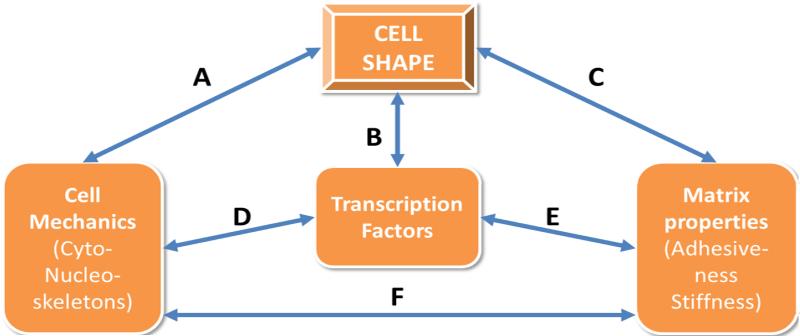
Cells change their shape and mechanics dramatically during development and tissue healing in response to morphogens, cell-cell contact, adhesion to extracellular matrix, and more. Several regulatory links have been described between cell shape, cytoskeletal tension, matrix adhesiveness and stiffness, and recent studies have begun to uncover how these mechanotransduction pathways can impact transcriptional signaling and cell fate decision. The integrated mechanisms linking cell forces, form and fate are likely critical for driving normal morphogenesis, tissue development, and healing. Dysregulation of these mechanisms may also tip the scale from normal to diseased states. Here, we highlight mechanisms that alter cell shape and mechanics, and the pathways affected by these changes.
Copyright © 2014 Elsevier Ltd. All rights reserved.
Figures
References
-
- Leptin M, Grunewald B. Cell shape changes during gastrulation in Drosophila. Development. 1990;110:73–84. - PubMed
-
- Thompson DW. On growth and form. University Press; 1942.
-
- Heisenberg C-P, Bellaïche Y. Forces in tissue morphogenesis and patterning. Cell. 2013;153:948–62. - PubMed
-
- Spiegelman BM, Farmer SR. Decreases in tubulin and actin gene expression prior to morphological differentiation of 3T3 adipocytes. Cell. 1982;29:53–60. - PubMed
-
- Ingber D. Extracellular matrix and cell shape: potential control points for inhibition of angiogenesis. J. Cell. Biochem. 1991;47:236–41. - PubMed
Publication types
MeSH terms
Grants and funding
LinkOut - more resources
Full Text Sources
Other Literature Sources
Medical
