


Magnetization transfer ratio in the delayed-release dimethyl fumarate DEFINE study
- PMID: 25270680
- PMCID: PMC4242981
- DOI: 10.1007/s00415-014-7504-7
Magnetization transfer ratio in the delayed-release dimethyl fumarate DEFINE study
Abstract
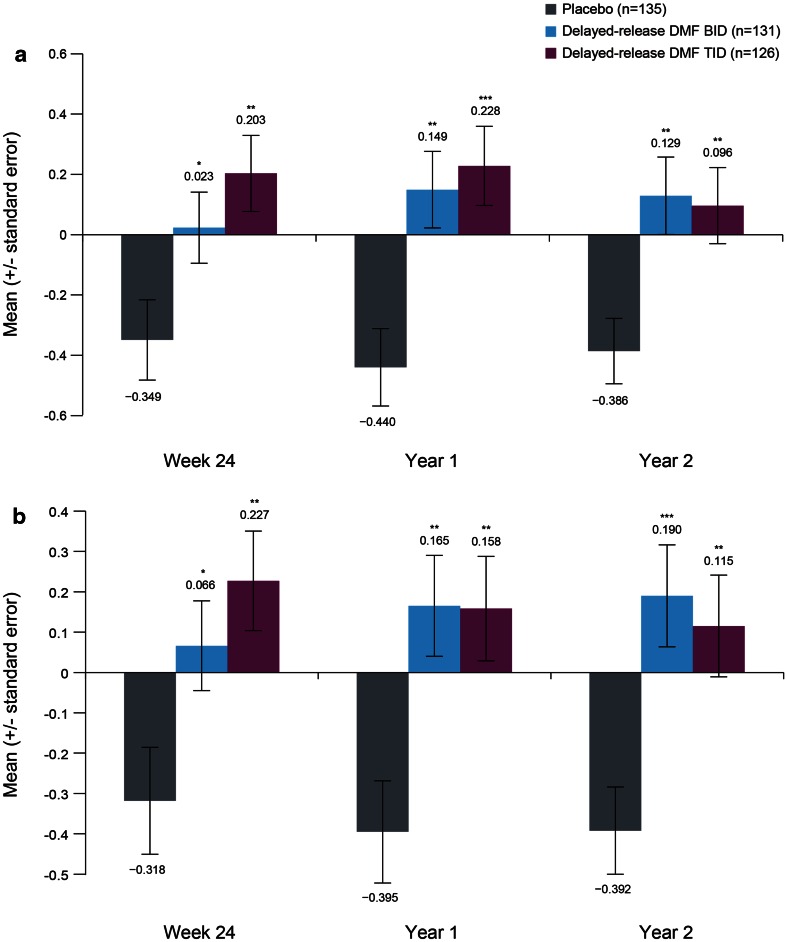
We measured changes in brain magnetization transfer ratio (MTR) as a potential indicator of myelin density in brain tissue of patients with relapsing-remitting multiple sclerosis (RRMS) treated with delayed-release dimethyl fumarate (DMF) in the Phase 3 DEFINE study. DEFINE was a randomized, double-blind, placebo-controlled study in which patients with RRMS were randomized 1:1:1 to 2 years of treatment with delayed-release DMF 240 mg twice daily (BID) or three times daily (TID) or placebo. MTR was analyzed in whole brain and normal-appearing brain tissue (NABT) at baseline, week 24, 1 year, and 2 years in a subset of patients. MTR data from 392 patients were analyzed. Mean percentage reduction from baseline to 2 years in median whole brain MTR was -0.386% in the placebo group vs increases of 0.129% (p = 0.0027) and 0.096% (p = 0.0051) in the delayed-release DMF BID and TID groups, respectively. Similarly, mean percentage reduction from baseline in median NABT MTR was -0.392% with placebo vs increases of 0.190% (p = 0.0006) and 0.115% (p = 0.0029) with delayed-release DMF BID and TID, respectively. Post hoc analysis of data from patients with no new or enlarging T2 lesions (n = 147), or who experienced no relapses (n = 238), yielded similar results. In this analysis, increases in MTR in brain tissue most likely reflect increases in myelin density in response to delayed-release DMF. These data in patients with RRMS are consistent with preclinical studies that indicate a potential for cytoprotection and remyelination with delayed-release DMF treatment.
Figures
References
-
- Lublin FD, Reingold SC. Defining the clinical course of multiple sclerosis: results of an international survey. National Multiple Sclerosis Society (USA) Advisory Committee on Clinical Trials of New Agents in Multiple Sclerosis. Neurology. 1996;46(4):907–911. doi: 10.1212/WNL.46.4.907. - DOI - PubMed
-
- Linker RA, Lee DH, Ryan S, van Dam AM, Conrad R, Bista P, Zeng W, Hronowsky X, Buko A, Chollate S, Ellrichmann G, Bruck W, Dawson K, Goelz S, Wiese S, Scannevin RH, Lukashev M, Gold R. Fumaric acid esters exert neuroprotective effects in neuroinflammation via activation of the Nrf2 antioxidant pathway. Brain. 2011;134(Pt 3):678–692. doi: 10.1093/brain/awq386. - DOI - PubMed
-
- Smith ME, Stone LA, Albert PS, Frank JA, Martin R, Armstrong M, Maloni H, McFarlin DE, McFarland HF. Clinical worsening in multiple sclerosis is associated with increased frequency and area of gadopentetate dimeglumine-enhancing magnetic resonance imaging lesions. Ann Neurol. 1993;33(5):480–489. doi: 10.1002/ana.410330511. - DOI - PubMed
Publication types
MeSH terms
Substances
LinkOut - more resources
Full Text Sources
Other Literature Sources
Medical
