


Prevention of generalized anxiety disorder using a web intervention, iChill: randomized controlled trial
- PMID: 25270886
- PMCID: PMC4211086
- DOI: 10.2196/jmir.3507
Prevention of generalized anxiety disorder using a web intervention, iChill: randomized controlled trial
Abstract
Background: Generalized Anxiety Disorder (GAD) is a high prevalence, chronic disorder. Web-based interventions are acceptable, engaging, and can be delivered at scale. Few randomized controlled trials evaluate the effectiveness of prevention programs for anxiety, or the factors that improve effectiveness and engagement.
Objective: The intent of the study was to evaluate the effectiveness of a Web-based program in preventing GAD symptoms in young adults, and to determine the role of telephone and email reminders.
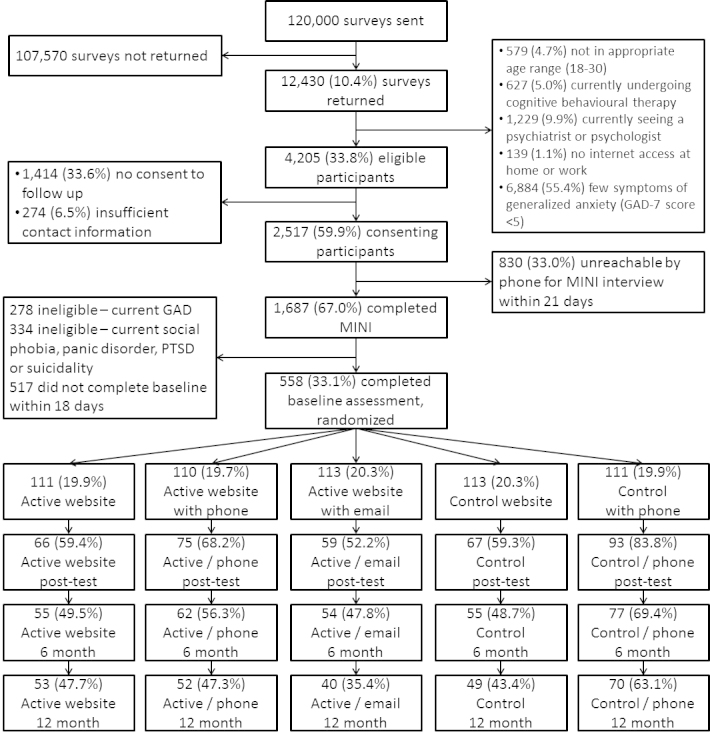
Methods: A 5-arm randomized controlled trial with 558 Internet users in the community, recruited via the Australian Electoral Roll, was conducted with 6- and 12-month follow-up. Five interventions were offered over a 10-week period. Group 1 (Active website) received a combined intervention of psycho-education, Internet-delivered Cognitive Behavioral Therapy (ICBT) for anxiety, physical activity promotion, and relaxation. Group 2 (Active website with telephone) received the identical Web program plus weekly telephone reminder calls. Group 3 (Active website with email) received the identical Web program plus weekly email reminders. Group 4 (Control) received a placebo website. Group 5 (Control with telephone) received the placebo website plus telephone calls. Main outcome measures were severity of anxiety symptoms as measured by the GAD 7-item scale (GAD-7) (at post-test, 6, and 12 months). Secondary measures were GAD caseness, measured by the Mini International Neuropsychiatric Interview (MINI) at 6 months, Centre for Epidemiologic Studies-Depression scale (CES-D), Anxiety Sensitivity Index (ASI), Penn State Worry Questionnaire (PSWQ), and Days out of Role.
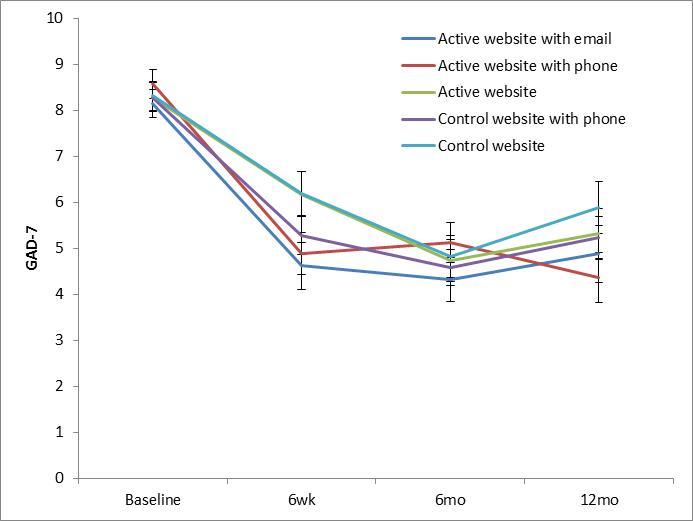
Results: GAD-7 symptoms reduced over post-test, 6-month, and 12-month follow-up. There were no significant differences between Group 4 (Control) and Groups 1 (Active website), 2 (Active website with telephone), 3 (Active website with email), or 5 (Control with telephone) at any follow-up. A total of 16 cases of GAD were identified at 6 months, comprising 6.7% (11/165) from the Active groups (1, 2, 3) and 4.5% (5/110) from the Control groups (4, 5), a difference that was not significant. CES-D, ASI, and PSWQ scores were significantly lower for the active website with email reminders at post-test, relative to the control website condition.
Conclusions: Indicated prevention of GAD was not effective in reducing anxiety levels, measured by GAD-7. There were significant secondary effects for anxiety sensitivity, worry, and depression. Challenges for indicated prevention trials are discussed.
Trial registration: International Standard Randomized Controlled Trial Number (ISRCTN): 76298775; http://www.controlled-trials.com/ISRCTN76298775 (Archived by WebCite at http://www.webcitation.org/6S9aB5MAq).
Keywords: Internet; anxiety disorders; cognitive behavioral therapy; early intervention; online systems; prevention.
Conflict of interest statement
Conflicts of Interest: Griffiths is the Director of Australian National University e-hub self-help services, which delivers the public access version of e-couch GAD and co-authored the GAD stream of e-couch; Bennett is the development manager of e-hub services. Neither derives a personal financial benefit from e-couch.
Figures
References
-
- Kessler RC, McGonagle KA, Zhao S, Nelson CB, Hughes M, Eshleman S, Wittchen HU, Kendler KS. Lifetime and 12-month prevalence of DSM-III-R psychiatric disorders in the United States. Results from the National Comorbidity Survey. Arch Gen Psychiatry. 1994 Jan;51(1):8–19. - PubMed
-
- Judd LL, Kessler RC, Paulus MP, Zeller PV, Wittchen HU, Kunovac JL. Comorbidity as a fundamental feature of generalized anxiety disorders: results from the National Comorbidity Study (NCS) Acta Psychiatr Scand Suppl. 1998;393:6–11. - PubMed
-
- Greenberg PE, Sisitsky T, Kessler RC, Finkelstein SN, Berndt ER, Davidson JR, Ballenger JC, Fyer AJ. The economic burden of anxiety disorders in the 1990s. J Clin Psychiatry. 1999 Jul;60(7):427–35. - PubMed
-
- Feldner MT, Zvolensky MJ. Prevention of anxiety psychopathology: a critical review of the empirical literature. Clinical Psychology: Science and Practice. 2004;11(4):405–24. doi: 10.1093/clipsy.bph098. - DOI
Publication types
MeSH terms
LinkOut - more resources
Full Text Sources
Other Literature Sources
Medical
