


Olfactory dysfunction predicts 5-year mortality in older adults
- PMID: 25271633
- PMCID: PMC4182669
- DOI: 10.1371/journal.pone.0107541
Olfactory dysfunction predicts 5-year mortality in older adults
Abstract
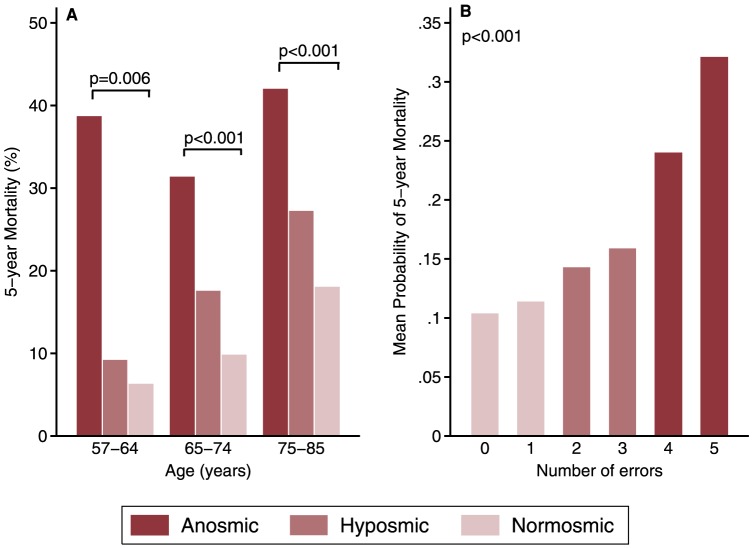
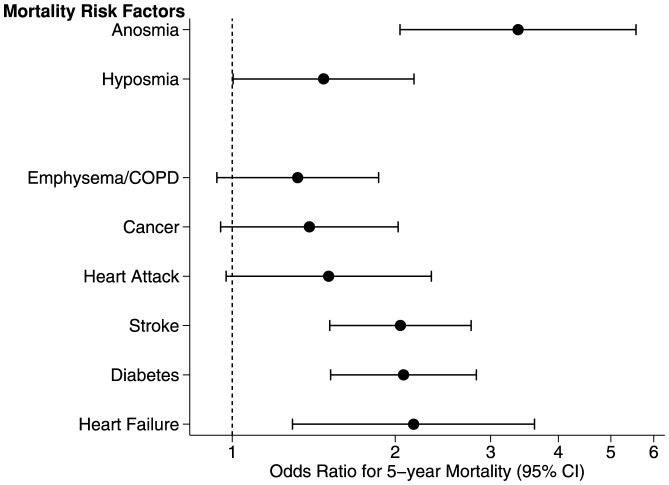
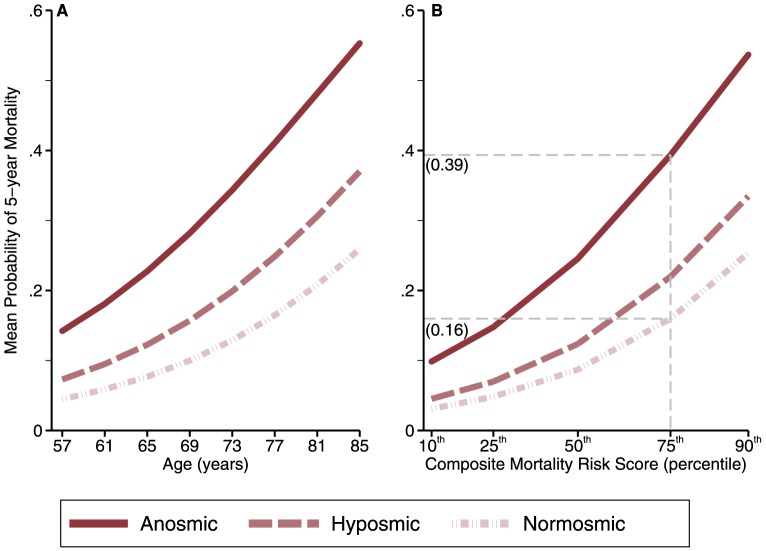
Prediction of mortality has focused on disease and frailty, although antecedent biomarkers may herald broad physiological decline. Olfaction, an ancestral chemical system, is a strong candidate biomarker because it is linked to diverse physiological processes. We sought to determine if olfactory dysfunction is a harbinger of 5-year mortality in the National Social Life, Health and Aging Project [NSHAP], a nationally representative sample of older U.S. adults. 3,005 community-dwelling adults aged 57-85 were studied in 2005-6 (Wave 1) and their mortality determined in 2010-11 (Wave 2). Olfactory dysfunction, determined objectively at Wave 1, was used to estimate the odds of 5-year, all cause mortality via logistic regression, controlling for demographics and health factors. Mortality for anosmic older adults was four times that of normosmic individuals while hyposmic individuals had intermediate mortality (p<0.001), a "dose-dependent" effect present across the age range. In a comprehensive model that included potential confounding factors, anosmic older adults had over three times the odds of death compared to normosmic individuals (OR, 3.37 [95%CI 2.04, 5.57]), higher than and independent of known leading causes of death, and did not result from the following mechanisms: nutrition, cognitive function, mental health, smoking and alcohol abuse or frailty. Olfactory function is thus one of the strongest predictors of 5-year mortality and may serve as a bellwether for slowed cellular regeneration or as a marker of cumulative toxic environmental exposures. This finding provides clues for pinpointing an underlying mechanism related to a fundamental component of the aging process.
Conflict of interest statement
Figures
References
-
- Hays NP, Roberts SB (2006) The anorexia of aging in humans. Physiol Behav 88: 257–266. - PubMed
-
- Jacob S, McClintock MK, Zelano B, Ober C (2002) Paternally inherited HLA alleles are associated with women's choice of male odor. Nat Genet 30: 175–179. - PubMed
-
- Jacob S, Garcia S, Hayreh D, McClintock MK (2002) Psychological effects of musky compounds: comparison of androstadienone with androstenol and muscone. Horm Behav 42: 274–283. - PubMed
Publication types
MeSH terms
Grants and funding
- AG029795/AG/NIA NIH HHS/United States
- R01 AG033903/AG/NIA NIH HHS/United States
- UL1 RR024999/RR/NCRR NIH HHS/United States
- AG036762/AG/NIA NIH HHS/United States
- KL2 RR025000/RR/NCRR NIH HHS/United States
- AG021487/AG/NIA NIH HHS/United States
- UL1 TR000430/TR/NCATS NIH HHS/United States
- R01 AG021487/AG/NIA NIH HHS/United States
- T35 AG029795/AG/NIA NIH HHS/United States
- T32000243/PHS HHS/United States
- KL2RR025000/RR/NCRR NIH HHS/United States
- AG030481/AG/NIA NIH HHS/United States
- R37 AG030481/AG/NIA NIH HHS/United States
- UL1RR024999/RR/NCRR NIH HHS/United States
- K23 AG036762/AG/NIA NIH HHS/United States
- AG033903-01/AG/NIA NIH HHS/United States
LinkOut - more resources
Full Text Sources
Other Literature Sources
Medical
