Case Reports
. 2014 Oct;20(10):1629-36.
doi: 10.3201/eid2010.140353.

Person-to-person household and nosocomial transmission of andes hantavirus, Southern Chile, 2011

Case Reports

Person-to-person household and nosocomial transmission of andes hantavirus, Southern Chile, 2011

Constanza Martinez-Valdebenito et al. Emerg Infect Dis. 2014 Oct.

Abstract

Andes hantavirus (ANDV) causes hantavirus cardiopulmonary syndrome in Chile and is the only hantavirus for which person-to-person transmission has been proven. We describe an outbreak of 5 human cases of ANDV infection in which symptoms developed in 2 household contacts and 2 health care workers after exposure to the index case-patient. Results of an epidemiologic investigation and sequence analysis of the virus isolates support person-to-person transmission of ANDV for the 4 secondary case-patients, including nosocomial transmission for the 2 health care workers. Health care personnel who have direct contact with ANDV case-patients or their body fluids should take precautions to prevent transmission of the virus. In addition, because the incubation period of ANDV after environmental exposure is longer than that for person-to-person exposure, all persons exposed to a confirmed ANDV case-patient or with possible environmental exposure to the virus should be monitored for 42 days for clinical symptoms.


Figures
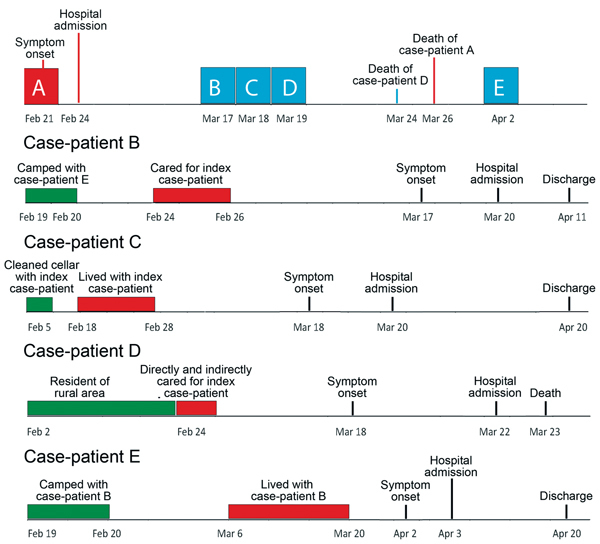
Figure 1
Figure 1
Timelines showing progression and key events related to each case-patient (A–E) in a cluster of 5 Andes hantavirus cases, southern Chile, 2011. Blue boxes along timeline for index case-patient (A) indicate date of illness onset for subsequent case-patients; green boxes indicate environmental exposures (exposure for case-patient A was the same as for case-patient C); red boxes indicate contact with other case-patients.
Figure 2
Figure 2
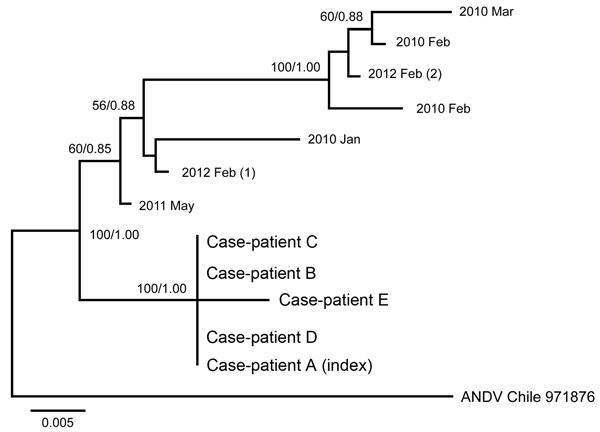
Phylogenetic analyses of the medium RNA segment (Gc and Gn) of concatenated sequences of Andes hantavirus (ANDV). Isolates from the case-patients (A–E) from the 2011 outbreak in Chile were compared with control samples from the same geographic region (indicated by year isolated; number in parentheses indicates multiple isolates from the same year) and an ANDV sequence from GenBank (bottom isolate on tree; accession no. NC_003467.2). Scale bar indicates substitutions per site.

References

    1. Pini N. Hantavirus pulmonary syndrome in Latin America. Curr Opin Infect Dis. 2004;17:427–31. 10.1097/00001432-200410000-00007 - DOI - PubMed
    1. Schmaljohn C, Hjelle B. Hantaviruses: a global disease problem. Emerg Infect Dis. 1997;3:95–104. 10.3201/eid0302.970202 - DOI - PMC - PubMed
    1. Vial PA, Valdivieso F, Mertz G, Castillo C, Belmar E, Delgado I, et al. Incubation period of hantavirus cardiopulmonary syndrome. Emerg Infect Dis. 2006;12:1271–3. 10.3201/eid1208.051127 - DOI - PMC - PubMed
    1. Chile Ministry of Health. Resumen ejecutivo de Hantavirus, semana epidemiológica 1 a 52, dic 2012. [cited 2014 Feb 28]. http://epi.minsal.cl/epi/html/bolets/reportes/Hantavirus/hantavirus_SE52...
    1. Padula P, Figueroa R, Navarrete M, Pizarro E, Cadiz R, Bellomo C, et al. Transmission study of Andes hantavirus infection in wild sigmodontine rodents. J Virol. 2004;78:11972–9. 10.1128/JVI.78.21.11972-11979.2004 - DOI - PMC - PubMed

Publication types