


Do Bolivian small holder farmers improve and retain knowledge to reduce occupational pesticide poisonings after training on Integrated Pest Management?
- PMID: 25273338
- PMCID: PMC4196016
- DOI: 10.1186/1476-069X-13-75
Do Bolivian small holder farmers improve and retain knowledge to reduce occupational pesticide poisonings after training on Integrated Pest Management?
Abstract
Background: Pesticide consumption is increasing in Bolivia as well as pest resistance, pesticide poisonings and pollution of the environment. This survey evaluates the training of small holder farmers on pesticide handling and ecological alternatives to reduce the negative pesticide effects.
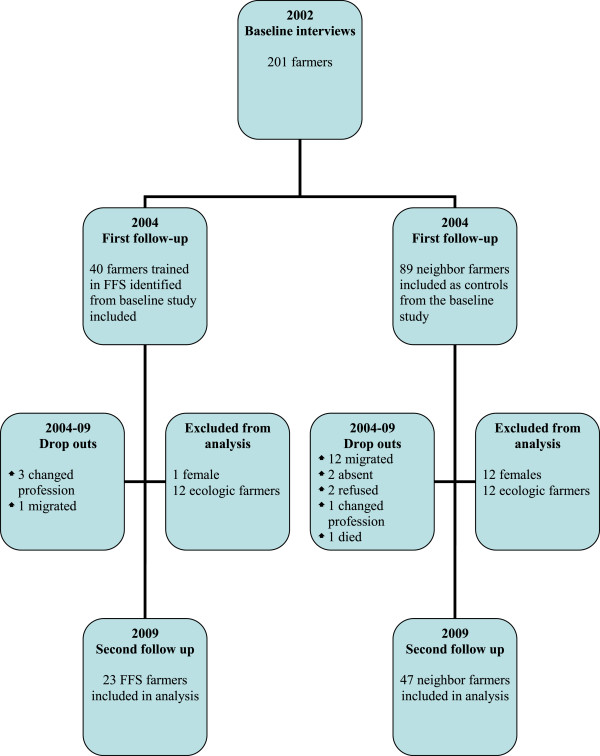
Method: A baseline survey was performed in 2002 and follow-up surveys in 2004 and 2009. Farmers were selected and trained on Integrated Pest Management (IPM) from 2002 to 2004 in Farmer Field Schools (FFS). After exclusions and drop outs, 23 FFS trained farmers could be compared to 47 neighbor farmers for changes in 'knowledge, attitude and practice' (KAP) on IPM and symptoms of poisoning when handling pesticides. Statistical analysis was performed with SPSS version 21.0 using χ2-test, Cochran's Q test and Student's T-test.
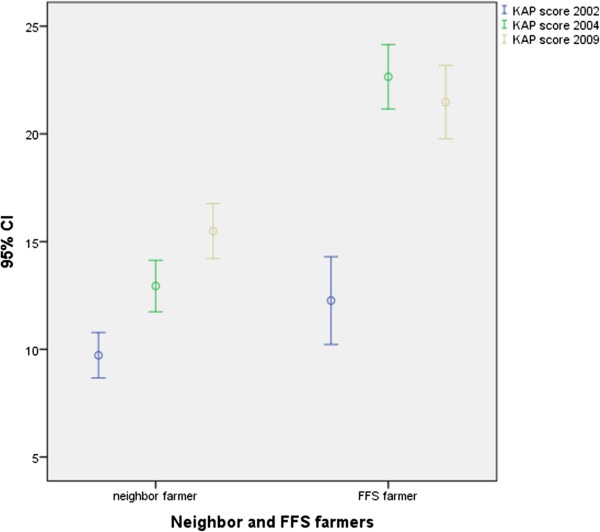
Results: Improvements were seen in both groups but most significant among the FFS farmers. At baseline no difference were seen between the two groups apart from a more frequent use of personal protection among the FFS farmers. After the training was finished significant differences were seen between FFS farmers and neighbor farmers on all KAP variables, a difference reduced to six of the KAP variables in 2009. No difference was seen in self-reported poisonings after pesticide handling. FFS farmers improved their KAP scores markedly during training and there after retained their knowledge, while neighbor farmers improved during the entire period. Ecological farming without the use of pesticides increased most among the FFS farmers.
Conclusion: The study showed a sustained improvement among Farmers Field School trained farmers on personal protection and hygiene when handling pesticides, knowledge and use of IPM and ecological alternatives and a reduction in self-reported symptoms after pesticide handling. Similar though less pronounced improvements was seen among neighbor farmers having had less training and information on pesticide handling and alternatives than the FFS trained farmers. Training of farmers on IPM and good agricultural practices has positive effects, but is scarce in Bolivia as in most low-income countries and must be encouraged to support an improved and sustainable food production and to protect the health of farmers and consumers as well as the environment.
Figures
References
-
- Braun A, Jiggins J, Röling N, Van Den Berg H, Snijders P. A Global Survey and Review of Farmer Field School Experiences. 2010.
-
- Pontius J, Dilts R, Bartlett A. From farmer field school to community IPM: ten years of IPM training in Asia. FAO Community IPM Programme. FAO Reg Office for Asia Pacific RAP. 2002;15:1–106.
-
- Peshin R, Dhawan AK. Integrated Pest Management: Dissemination and Impact. Vol 2. 2009.
-
- Van den Berg H, Jiggins J. Investing in Farmers—The Impacts of Farmer Field Schools in Relation to Integrated Pest Management. World Dev. 2007;35:663–686. doi: 10.1016/j.worlddev.2006.05.004. - DOI
-
- Davis K, Nkonya E, Kato E, Mekonnen DA, Odendo M, Miiro R, Nkuba J. Impact of Farmer Field Schools on Agricultural Productivity and Poverty in East Africa. World Dev. 2012;40:402–413. doi: 10.1016/j.worlddev.2011.05.019. - DOI
Publication types
MeSH terms
Substances
LinkOut - more resources
Full Text Sources
Other Literature Sources
Medical
