


The impact of preoperative patient characteristics on health states after total hip replacement and related satisfaction thresholds: a cohort study
- PMID: 25273621
- PMCID: PMC4159538
- DOI: 10.1186/s12955-014-0108-1
The impact of preoperative patient characteristics on health states after total hip replacement and related satisfaction thresholds: a cohort study
Abstract
Background: The aim of the study was to analyze the effect of preoperative patient characteristics on health outcomes 6 months after total hip replacement (THR), to support patient's decision making in daily practice with predicted health states and satisfaction thresholds. By giving incremental effects for different patient subgroups, we support comparative effectiveness research (CER) on osteoarthritis interventions.
Methods: In 2012, 321 patients participated in health state evaluation before and 6 months after THR. Health-related quality of life (HRQoL) was measured with the EQ-5D questionnaire. Hip-specific pain, function, and mobility were measured with the WOMAC in a prospective observation of a cohort. The predictive capability of preoperative patient characteristics - classified according to socio-demographic factors, medical factors, and health state variables - for changes in health outcomes is tested by correlation analysis and multivariate linear regressions. Related satisfaction thresholds were calculated with the patient acceptable symptom state (PASS) concept.
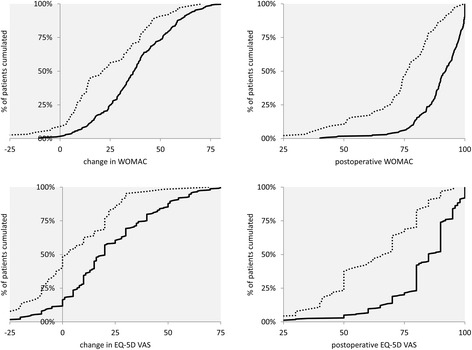
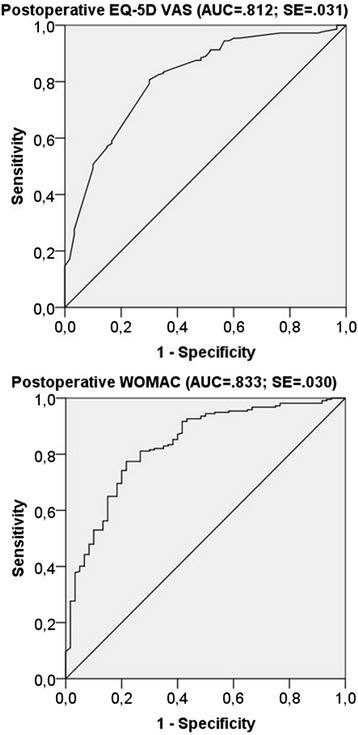
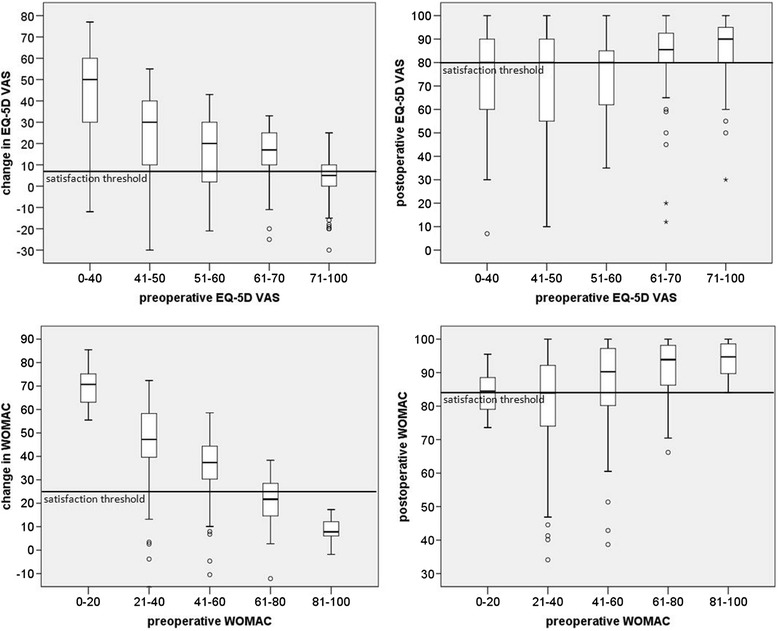
Results: The mean WOMAC and EQ-5D scores before operation were 52 and 60 respectively (0 worst, 100 best). At the 6-month follow-up, scores improved by 35 and 19 units. On average, patients reported satisfaction with the operation if postoperative (change) WOMAC scores were higher than 85 (32) and postoperative (change) EQ-5D scores were higher than 79 (14).
Conclusions: Changes in WOMAC and EQ-5D scores can mainly be explained by preoperative scores. The lower the preoperative WOMAC or EQ-5D scores, the higher the change in the scores. Very good or very poor preoperative scores lower the probability of patient satisfaction with THR. Shared decision making using a personalized risk assessment approach provides predicted health states and satisfaction thresholds.
Figures

Comment in
-
Patient-reported outcome measures in arthroplasty registries Report of the Patient-Reported Outcome Measures Working Group of the International Society of Arthroplasty Registries Part II. Recommendations for selection, administration, and analysis.Acta Orthop. 2016 Jul;87 Suppl 1(Suppl 1):9-23. doi: 10.1080/17453674.2016.1181816. Epub 2016 May 26. Acta Orthop. 2016. PMID: 27228230 Free PMC article.
References
-
- Laupacis A, Bourne R, Rorabeck C, Feeny D, Wong C, Tugwell P, Leslie K, Bullas R. The effect of elective total hip replacement on health-related quality of life. J Bone Joint Surg Am. 1993;75:1619–1626. - PubMed
-
- Ethgen O, Bruyere O, Richy F, Dardennes C, Reginster JY. Health-related quality of life in total hip and total knee arthroplasty. A qualitative and systematic review of the literature. J Bone Joint Surg Am. 2004;86-A:963–974. - PubMed
Publication types
MeSH terms
LinkOut - more resources
Full Text Sources
Other Literature Sources
Medical
