


The power of the mind: the cortex as a critical determinant of muscle strength/weakness
- PMID: 25274345
- PMCID: PMC4269707
- DOI: 10.1152/jn.00386.2014
The power of the mind: the cortex as a critical determinant of muscle strength/weakness
Abstract
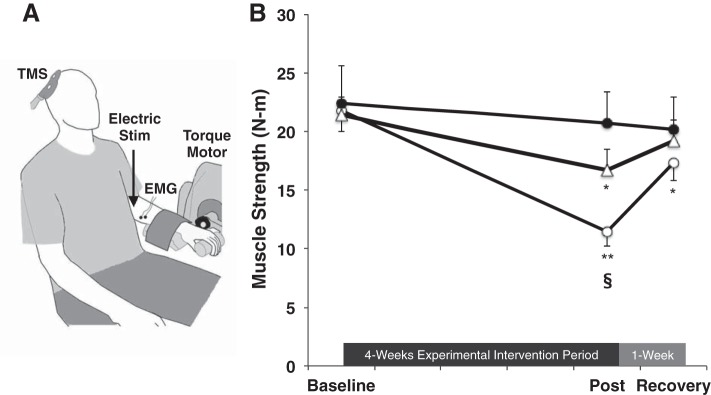
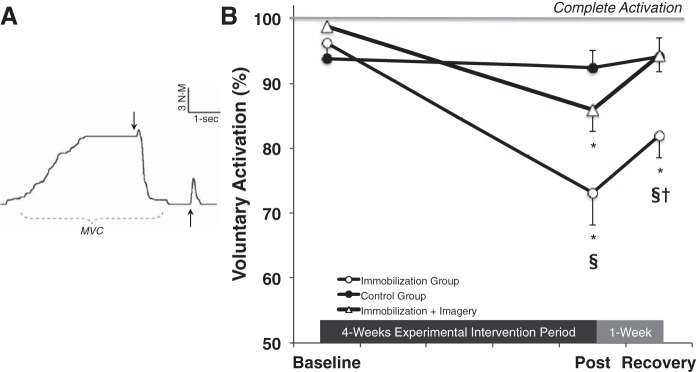
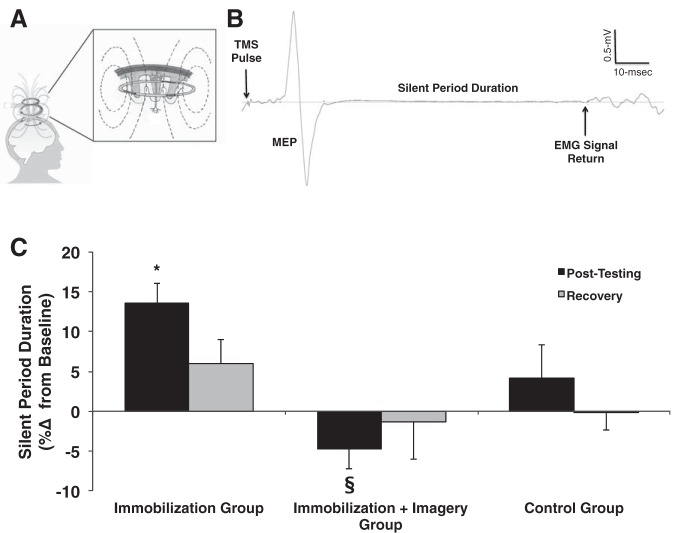
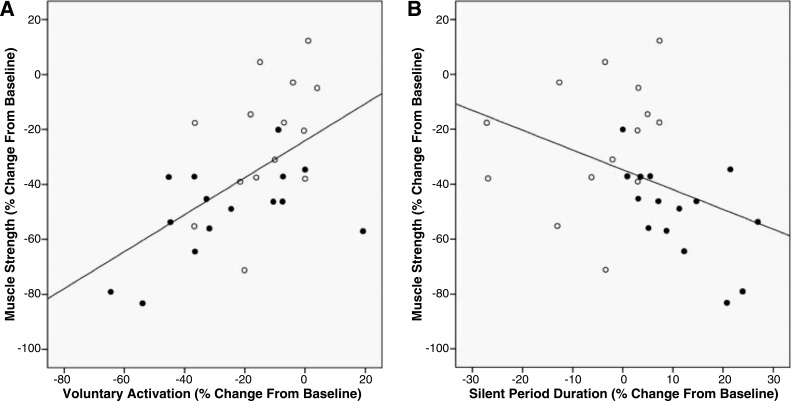
We tested the hypothesis that the nervous system, and the cortex in particular, is a critical determinant of muscle strength/weakness and that a high level of corticospinal inhibition is an important neurophysiological factor regulating force generation. A group of healthy individuals underwent 4 wk of wrist-hand immobilization to induce weakness. Another group also underwent 4 wk of immobilization, but they also performed mental imagery of strong muscle contractions 5 days/wk. Mental imagery has been shown to activate several cortical areas that are involved with actual motor behaviors, including premotor and M1 regions. A control group, who underwent no interventions, also participated in this study. Before, immediately after, and 1 wk following immobilization, we measured wrist flexor strength, voluntary activation (VA), and the cortical silent period (SP; a measure that reflect corticospinal inhibition quantified via transcranial magnetic stimulation). Immobilization decreased strength 45.1 ± 5.0%, impaired VA 23.2 ± 5.8%, and prolonged the SP 13.5 ± 2.6%. Mental imagery training, however, attenuated the loss of strength and VA by ∼50% (23.8 ± 5.6% and 12.9 ± 3.2% reductions, respectively) and eliminated prolongation of the SP (4.8 ± 2.8% reduction). Significant associations were observed between the changes in muscle strength and VA (r = 0.56) and SP (r = -0.39). These findings suggest neurological mechanisms, most likely at the cortical level, contribute significantly to disuse-induced weakness, and that regular activation of the cortical regions via imagery attenuates weakness and VA by maintaining normal levels of inhibition.
Keywords: dynapenia; imagery; immobilization; muscle; strength; weakness.
Copyright © 2014 the American Physiological Society.
Figures
References
-
- Adkins DL, Boychuk J, Remple MS, Kleim JA. Motor training induces experience-specific patterns of plasticity across motor cortex and spinal cord. J Appl Physiol 101: 1776–1782, 2006. - PubMed
-
- Aoyama T, Kaneko F. The effect of motor imagery on gain modulation of the spinal reflex. Brain Res 1372: 41–48, 2011. - PubMed
-
- Ashe J. Force and the motor cortex. Behav Brain Res 87: 255–269, 1997. - PubMed
-
- Bakker M, Overeem S, Snijders AH, Borm G, van Elswijk G, Toni I, Bloem BR. Motor imagery of foot dorsiflexion and gait: effects on corticospinal excitability. Clin Neurophysiol 119: 2519–2527, 2008. - PubMed
-
- Butler JE, Petersen NC, Herbert RD, Gandevia SC, Taylor JL. Origin of the low-level EMG during the silent period following transcranial magnetic stimulation. Clin Neurophysiol 123: 1409–1414, 2012. - PubMed
Publication types
MeSH terms
Grants and funding
LinkOut - more resources
Full Text Sources
Other Literature Sources
Medical
