


Review
doi: 10.1371/journal.ppat.1004356.
eCollection 2014 Oct.
Adaptive prediction as a strategy in microbial infections
Affiliations
- PMID: 25275642
- PMCID: PMC4183746
- DOI: 10.1371/journal.ppat.1004356
Item in Clipboard
Review
Adaptive prediction as a strategy in microbial infections
PLoS Pathog.
.
No abstract available
Conflict of interest statement
The authors have declared that no competing interests exist.
Figures
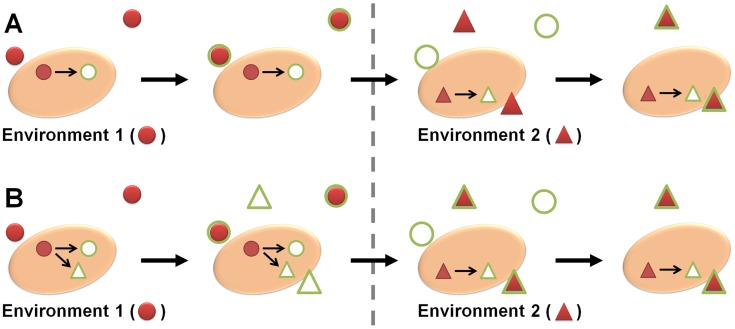
(A) The conditions in environment 1 (red circles) activate a distinct response (green circles) in a microbe. After changing to environment 2, altering, e.g., the expression pattern to respond to the new conditions (triangles) requires time, during which the microbe is not well adapted. (B) If the sequential temporal order of the two environments from (A) is kept over many generations, a new signal pathway can form. Now, the conditions in environment 1 induce responses to both the first and the second environment. When changing to environment 2, the microbe is hence already pre-adapted.
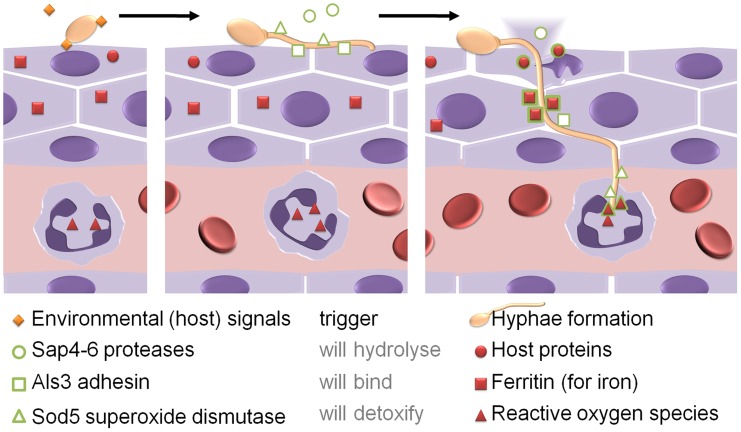
When attaching to epithelial cells, environmental signals trigger hyphae formation. The hyphae start to express a set of proteins which are not apparently beneficial for the fungus in its current situation (green symbols). Only when penetrating into the host tissue and during encounters with host immune cells like neutrophils, the stresses (red symbols) occur under which these proteins give C. albicans an advantage in survival and growth (see text for more details).
References
Publication types
MeSH terms
LinkOut - more resources
Full Text Sources
Other Literature Sources
