


Review
doi: 10.1097/IJG.0000000000000121.
Animal models of exfoliation syndrome, now and future
Affiliations
- PMID: 25275912
- PMCID: PMC4383291
- DOI: 10.1097/IJG.0000000000000121
Item in Clipboard
Review
Animal models of exfoliation syndrome, now and future
J Glaucoma.
2014 Oct-Nov.
Abstract
At present, no animal models fully embody exfoliation syndrome or exfoliation glaucoma. Both genetic and environmental factors appear critical for disease manifestation, and both must be considered when generating animal models. Because mice provide a powerful mammalian platform for modeling complex disease, this paper focuses on mouse models of exfoliation syndrome and exfoliation glaucoma.
Figures
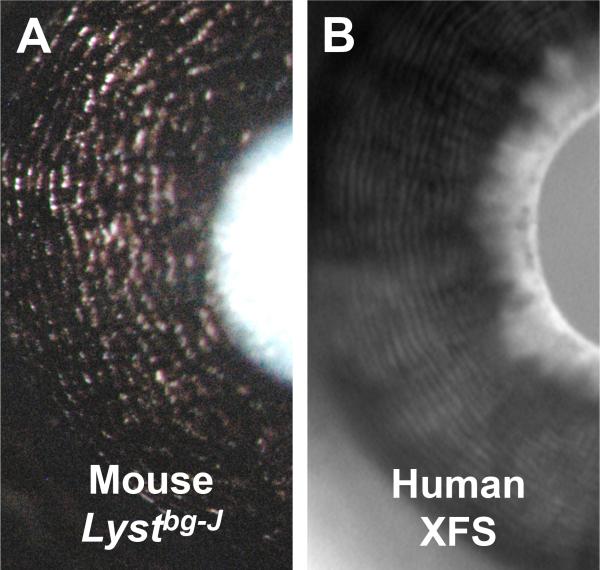
(A) Mouse homozygous for the Lystbg-J mutation imaged with standard slit-lamp illumination. Note concentric circles of transillumination defects (red). (B) Human XFS patient imaged with infrared videography showing concentric circles of transillumination defects (white). The two images have been scaled differently to promote comparison.
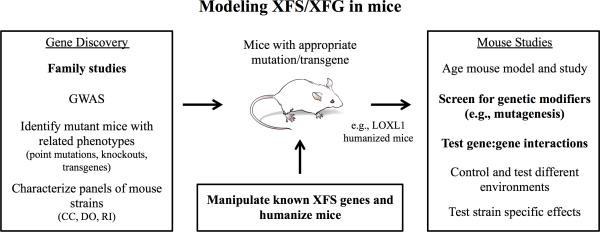
Gene Discovery: A main priority is to identify genes associated with XFS. Large families provide a rare but important resource for identifying causal genes - they may provide the most effective mode of gene discovery. Genome-wide association studies (GWAS) remain important, but gene discovery can be difficult due to complexity and very large sample sizes are needed for further progress. The characterization of mice with mutations or transgenes affecting specific genes may also identify new XFS genes. Another avenue for gene discovery is characterization of a series of mouse strains that are specifically tailored for identifying genes that underlie complex diseases like XFS, such as Collaborative Cross (CC), Diversity Outcross (DO) and Recombinant Inbred (RI) mice. Mice can be screened for XFS based on the presence of exfoliation, concentric circular iris defects, or high IOP and glaucoma. Mouse models : Once human genes are identified, mouse models can be made by targeted mutagenesis or by making transgenic mice. A top priority is to create a humanized mouse model containing a high-risk allele of LOXL1. BAC transgenic mice with a human LOXL1 allele and its regulatory elements will likely best recapitulate LOXL1-associated disease risk. Mouse studies : Humanized LOXL1 mice and other mouse models need to be studied in the context of aging, genetic modifiers, environmental conditions, and gene-environment interactions. Using chemical mutagenesis to induce random point mutations in humanized LOXL1 mice is an unbiased way to uncover genetic modifiers of LOXL1. Generating combined mutants with LOXL1 variants and Lyst, humanized CNTNAP2, or newly discovered XFS genes is also an effective strategy to understand genetic interactions. Priority areas that may provide the quickest route to useful mouse models are indicated in bold.
References
-
- Sein J, Galor A, Sheth A, et al. Exfoliation syndrome: new genetic and pathophysiologic insights. Curr Opin Ophthalmol. 2013;24:167–174. - PubMed
-
- Damji KF, Bains HS, Stefansson E, et al. Is pseudoexfoliation syndrome inherited? A review of genetic and nongenetic factors and a new observation. Ophthalmic Genet. 1998;19:175–185. - PubMed
-
- Thorleifsson G, Magnusson KP, Sulem P, et al. Common sequence variants in the LOXL1 gene confer susceptibility to exfoliation glaucoma. Science. 2007;317:1397–1400. - PubMed
Publication types
MeSH terms
Grants and funding
LinkOut - more resources
Full Text Sources
Other Literature Sources
