


Effects of open and closed kinetic chains of sling exercise therapy on the muscle activity of the vastus medialis oblique and vastus lateralis
- PMID: 25276016
- PMCID: PMC4175237
- DOI: 10.1589/jpts.26.1363
Effects of open and closed kinetic chains of sling exercise therapy on the muscle activity of the vastus medialis oblique and vastus lateralis
Abstract
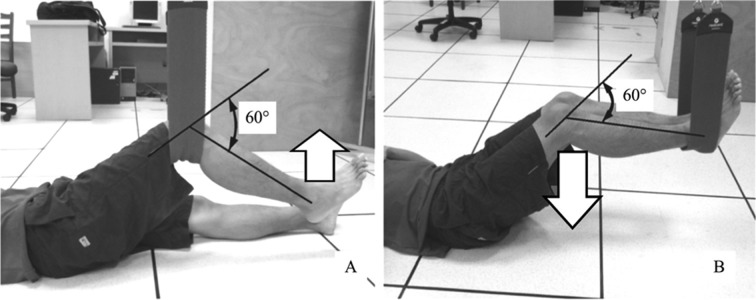
[Purpose] The muscle strength of the quadriceps muscle is critical in patellofemoral pain syndrome. The quadriceps muscle supplies the power for dynamic patellar movement, and the vastus medialis oblique (VMO) and vastus lateralis (VL) enable the patella to stabilize during tracking. We followed the theories about open and closed kinetic chain exercises to design two exercises, sling open chain knee extension (SOCKE) exercise and sling closed chain knee extension (SCCKE) exercise. The purpose of our study was to research the changes in quadriceps muscle activity during both exercises. [Methods] Electromyographic analysis was used to explore the different effects of the two exercises. The MVC% was calculated for the VMO and VL during exercise for analysis. [Results] We found that the mean MVC% values of the VMO and VL during the SOCKE exercise were higher than those during the SCCKE exercise. The ratio of the VMO to VL was 1.0 ± 0.19 during the SOCKE exercise and 1.11 ± 0.15 during the SCCKE exercise. [Conclusions] The SOCKE exercise is targeted at quadriceps muscle training and has a recruitment effect on the VMO. The beneficial effect of the SOCKE exercise is better than that of the SCCKE exercise.
Keywords: Electromyography; Patellofemoral pain syndrome; Sling exercise therapy.
References
-
- Tenforde AS, Sayres LC, McCurdy ML, et al. : Overuse injuries in high school runners: lifetime prevalence and prevention strategies. PM R, 2011, 3: 125–131, quiz 131 - PubMed
-
- Powers CM: Patellar kinematics, part I: the influence of vastus muscle activity in subjects with and without patellofemoral pain. Phys Ther, 2000, 80: 956–964 - PubMed
-
- Grelsamer RP: Patellar malalignment. J Bone Joint Surg Am, 2000, 82-A: 1639–1650 - PubMed
-
- Souza DR, Gross MT: Comparison of vastus medialis obliquus: vastus lateralis muscle integrated electromyographic ratios between healthy subjects and patients with patellofemoral pain. Phys Ther, 1991, 71: 310–316, discussion 317–320 - PubMed
LinkOut - more resources
Full Text Sources
Other Literature Sources