


Increased postoperative complications after protective ileostomy closure delay: An institutional study
- PMID: 25276286
- PMCID: PMC4176777
- DOI: 10.4240/wjgs.v6.i9.169
Increased postoperative complications after protective ileostomy closure delay: An institutional study
Abstract
Aim: To study the morbidity and complications associated to ileostomy reversal in colorectal surgery patients, and if these are related to the time of closure.
Methods: A retrospective analysis of 93 patients, who had undergone elective ileostomy closure between 2009 and 2013 was performed. Demographic, clinical and surgical variables were reviewed for analysis. All complications were recorded, and classified according to the Clavien-Dindo Classification. Statistical univariate and multivariate analysis was performed, setting a P value of 0.05 for significance.
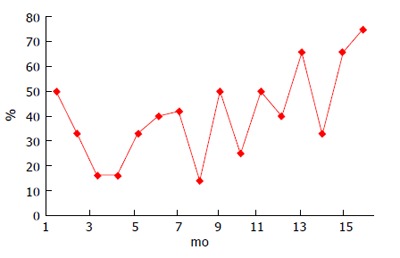
Results: The patients had a mean age of 60.3 years, 58% male. The main procedure for ileostomy creation was rectal cancer (56%), and 37% had received preoperative chemo-radiotherapy. The average delay from creation to closure of the ileostomy was 10.3 mo. Postoperative complications occurred in 40% of the patients, with 1% mortality. The most frequent were ileus (13%) and wound infection (13%). Pseudomembranous colitis appeared in 4%. Increased postoperative complications were associated with delay in ileostomy closure (P = 0.041). Male patients had more complications (P = 0.042), mainly wound infections (P = 0.007). Pseudomembranous colitis was also associated with the delay in ileostomy closure (P = 0.003). End-to-end intestinal anastomosis without resection was significantly associated with postoperative ileus (P = 0.037).
Conclusion: Although closure of a protective ileostomy is a fairly common surgical procedure, it has a high rate of complications, and this must be taken into account when the indication is made. The delay in stoma closure can increase the rate of complications in general, and specifically wound infections and colitis.
Keywords: Colorectal surgery; Protective ileostomy; Stoma-related complications; Stomas; Surgical infections.
Figures
References
-
- Bax TW, McNevin MS. The value of diverting loop ileostomy on the high-risk colon and rectal anastomosis. Am J Surg. 2007;193:585–587; discussion 587-588. - PubMed
-
- Tan WS, Tang CL, Shi L, Eu KW. Meta-analysis of defunctioning stomas in low anterior resection for rectal cancer. Br J Surg. 2009;96:462–472. - PubMed
-
- Cottam J, Richards K, Hasted A, Blackman A. Results of a nationwide prospective audit of stoma complications within 3 weeks of surgery. Colorectal Dis. 2007;9:834–838. - PubMed
-
- D’Haeninck A, Wolthuis AM, Penninckx F, D’Hondt M, D’Hoore A. Morbidity after closure of a defunctioning loop ileostomy. Acta Chir Belg. 2011;111:136–141. - PubMed
LinkOut - more resources
Full Text Sources
Other Literature Sources
Medical
