


A genome-wide pleiotropy scan for prostate cancer risk
- PMID: 25277271
- PMCID: PMC4359641
- DOI: 10.1016/j.eururo.2014.09.020
A genome-wide pleiotropy scan for prostate cancer risk
Abstract
Background: No single-nucleotide polymorphisms (SNPs) specific for aggressive prostate cancer have been identified in genome-wide association studies (GWAS).
Objective: To test if SNPs associated with other traits may also affect the risk of aggressive prostate cancer.
Design, setting, and participants: SNPs implicated in any phenotype other than prostate cancer (p≤10(-7)) were identified through the catalog of published GWAS and tested in 2891 aggressive prostate cancer cases and 4592 controls from the Breast and Prostate Cancer Cohort Consortium (BPC3). The 40 most significant SNPs were followed up in 4872 aggressive prostate cancer cases and 24,534 controls from the Prostate Cancer Association Group to Investigate Cancer Associated Alterations in the Genome (PRACTICAL) consortium.
Outcome measurements and statistical analysis: Odds ratios (ORs) and 95% confidence intervals (CIs) for aggressive prostate cancer were estimated.
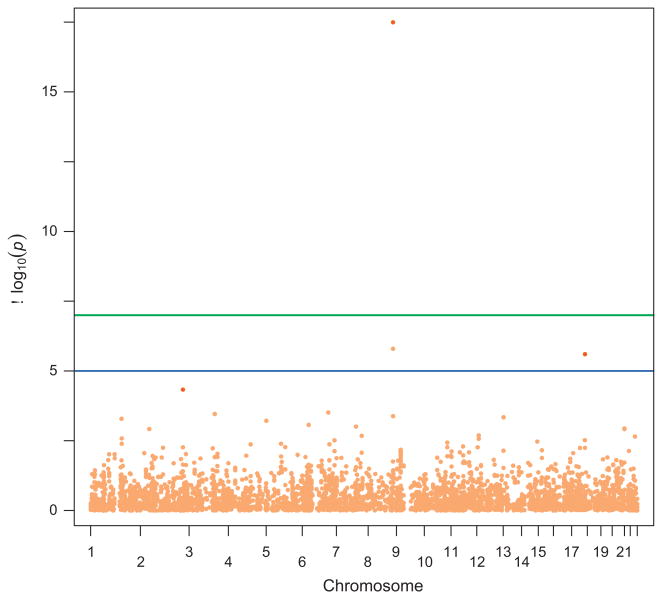
Results and limitations: A total of 4666 SNPs were evaluated by the BPC3. Two signals were seen in regions already reported for prostate cancer risk. rs7014346 at 8q24.21 was marginally associated with aggressive prostate cancer in the BPC3 trial (p=1.6×10(-6)), whereas after meta-analysis by PRACTICAL the summary OR was 1.21 (95% CI 1.16-1.27; p=3.22×10(-18)). rs9900242 at 17q24.3 was also marginally associated with aggressive disease in the meta-analysis (OR 0.90, 95% CI 0.86-0.94; p=2.5×10(-6)). Neither of these SNPs remained statistically significant when conditioning on correlated known prostate cancer SNPs. The meta-analysis by BPC3 and PRACTICAL identified a third promising signal, marked by rs16844874 at 2q34, independent of known prostate cancer loci (OR 1.12, 95% CI 1.06-1.19; p=4.67×10(-5)); it has been shown that SNPs correlated with this signal affect glycine concentrations. The main limitation is the heterogeneity in the definition of aggressive prostate cancer between BPC3 and PRACTICAL.
Conclusions: We did not identify new SNPs for aggressive prostate cancer. However, rs16844874 may provide preliminary genetic evidence on the role of the glycine pathway in prostate cancer etiology.
Patient summary: We evaluated whether genetic variants associated with several traits are linked to the risk of aggressive prostate cancer. No new such variants were identified.
Keywords: Aggressive prostate cancer; Genome-wide association study; Glycine; Pleiotropy; Single-nucleotide polymorphism.
Copyright © 2014 European Association of Urology. All rights reserved.
Conflict of interest statement
Figures
Comment in
-
Pleiotropy in aggressive prostate cancer?Eur Urol. 2015 Apr;67(4):658-9. doi: 10.1016/j.eururo.2014.11.029. Epub 2014 Nov 24. Eur Urol. 2015. PMID: 25468285 No abstract available.
References
-
- Siegel R, Naishadham D, Jemal A. Cancer statistics, 2013. CA Cancer J Clin. 2013;63:11–30. - PubMed
-
- Eeles R, Goh C, Castro E, et al. The genetic epidemiology of prostate cancer and its clinical implications. Nat Rev Urol. 2014;11:18–31. - PubMed
-
- Ioannidis JP, Tarone R, McLaughlin JK. The false-positive to false-negative ratio in epidemiologic studies. Epidemiology. 2011;22:450–6. - PubMed
-
- Wacholder S. On standards of evidence. Epidemiology. 2011;22:464–6. - PubMed
Publication types
MeSH terms
Substances
Grants and funding
- 16491/CRUK_/Cancer Research UK/United Kingdom
- CA128978/CA/NCI NIH HHS/United States
- 17528/CRUK_/Cancer Research UK/United Kingdom
- C16913/A6135/CRUK_/Cancer Research UK/United Kingdom
- C5047/A7357/CAPMC/ CIHR/Canada
- C12292/A11174/CRUK_/Cancer Research UK/United Kingdom
- G1000143/MRC_/Medical Research Council/United Kingdom
- 223175/CAPMC/ CIHR/Canada
- C1287/A 10710/CRUK_/Cancer Research UK/United Kingdom
- 14136/CRUK_/Cancer Research UK/United Kingdom
- G0401527/MRC_/Medical Research Council/United Kingdom
- U01 CA098233/CA/NCI NIH HHS/United States
- U01 CA098758/CA/NCI NIH HHS/United States
- C1287/A10118/CRUK_/Cancer Research UK/United Kingdom
- U01 CA098710/CA/NCI NIH HHS/United States
- U01-CA98233-07/CA/NCI NIH HHS/United States
- R01 CA092447/CA/NCI NIH HHS/United States
- 1 U19 CA 148537-01/CA/NCI NIH HHS/United States
- 1U19 CA148065/CA/NCI NIH HHS/United States
- C5047/A10692/CRUK_/Cancer Research UK/United Kingdom
- U01-CA98710-06/CA/NCI NIH HHS/United States
- U01-CA98216-06/CA/NCI NIH HHS/United States
- C5047/A3354/CRUK_/Cancer Research UK/United Kingdom
- 1U19 CA148537/CA/NCI NIH HHS/United States
- U01 CA098216/CA/NCI NIH HHS/United States
- C5047/A8384/CRUK_/Cancer Research UK/United Kingdom
- C5047/A15007/CRUK_/Cancer Research UK/United Kingdom
- 15007/CRUK_/Cancer Research UK/United Kingdom
- 19170/CRUK_/Cancer Research UK/United Kingdom
- 1U19 CA148112/CA/NCI NIH HHS/United States
- U01-CA98758-07/CA/NCI NIH HHS/United States
- C1281/A12014/CRUK_/Cancer Research UK/United Kingdom
LinkOut - more resources
Full Text Sources
Other Literature Sources
Medical
