


Intelligence, creativity, and cognitive control: The common and differential involvement of executive functions in intelligence and creativity
- PMID: 25278640
- PMCID: PMC4175011
- DOI: 10.1016/j.intell.2014.05.007
Intelligence, creativity, and cognitive control: The common and differential involvement of executive functions in intelligence and creativity
Abstract
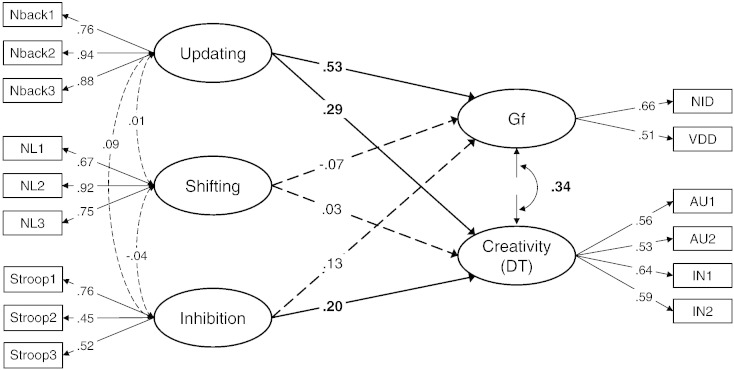
Intelligence and creativity are known to be correlated constructs suggesting that they share a common cognitive basis. The present study assessed three specific executive abilities - updating, shifting, and inhibition - and examined their common and differential relations to fluid intelligence and creativity (i.e., divergent thinking ability) within a latent variable model approach. Additionally, it was tested whether the correlation of fluid intelligence and creativity can be explained by a common executive involvement. As expected, fluid intelligence was strongly predicted by updating, but not by shifting or inhibition. Creativity was predicted by updating and inhibition, but not by shifting. Moreover, updating (and the personality factor openness) was found to explain a relevant part of the shared variance between intelligence and creativity. The findings provide direct support for the executive involvement in creative thought and shed further light on the functional relationship between intelligence and creativity.
Keywords: Creativity; Divergent thinking; Executive control; Intelligence; Working memory.
Figures
References
-
- Ackerman P.L. A theory of adult intellectual development: Process, personality, interests, and knowledge. Intelligence. 1996;22:227–257.
-
- Ackerman P.L., Beier M.E., Boyle M.O. Working memory and intelligence: The same or different constructs? Psychological Bulletin. 2005;131:30–60. - PubMed
-
- Ackerman P.L., Heggestad E.D. Intelligence, personality, and interests: Evidence for overlapping traits. Psychological Bulletin. 1997;121:219–245. - PubMed
-
- Amabile T.M. The social psychology of creativity: A componential conceptualization. Journal of Personality and Social Psychology. 1983;45:357–376.
Grants and funding
LinkOut - more resources
Full Text Sources
Other Literature Sources