. 2014 Oct;20(10):1683-90.
doi: 10.3201/eid2010.140430.

Biomarker correlates of survival in pediatric patients with Ebola virus disease

Biomarker correlates of survival in pediatric patients with Ebola virus disease

Anita K McElroy et al. Emerg Infect Dis. 2014 Oct.

Abstract

Outbreaks of Ebola virus disease (EVD) occur sporadically in Africa and are associated with high case-fatality rates. Historically, children have been less affected than adults. The 2000-2001 Sudan virus-associated EVD outbreak in the Gulu district of Uganda resulted in 55 pediatric and 161 adult laboratory-confirmed cases. We used a series of multiplex assays to measure the concentrations of 55 serum analytes in specimens from patients from that outbreak to identify biomarkers specific to pediatric disease. Pediatric patients who survived had higher levels of the chemokine regulated on activation, normal T-cell expressed and secreted marker and lower levels of plasminogen activator inhibitor 1, soluble intracellular adhesion molecule, and soluble vascular cell adhesion molecule than did pediatric patients who died. Adult patients had similar levels of these analytes regardless of outcome. Our findings suggest that children with EVD may benefit from different treatment regimens than those for adults.


Figures
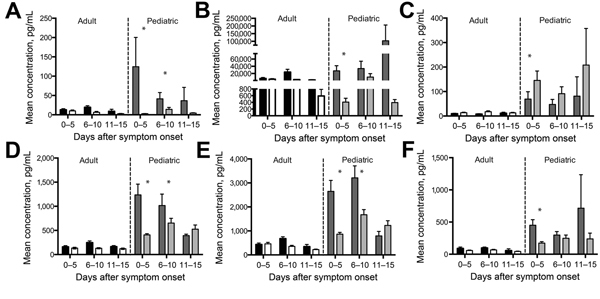
Figure 1
Figure 1
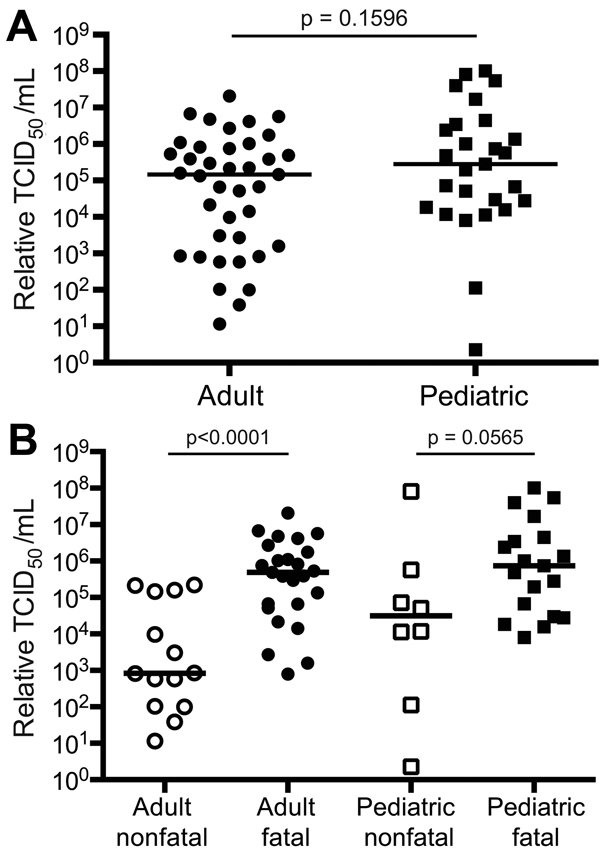
Viral loads for Ebola virus disease patients infected with Sudan virus during outbreak in Uganda, 2000–2001. A) Relative TCID50, of pediatric patients (1–21 years of age) compared with those of adult patients (22–60 years of age); B) fatal and nonfatal outcomes for pediatric versus adult patients. Viral load determination was performed on all samples and quantitated by a reverse transcription PCR curve generated from a known titer stock of Sudan virus. TCID50, 50% tissue culture infective dose.
Figure 2
Figure 2
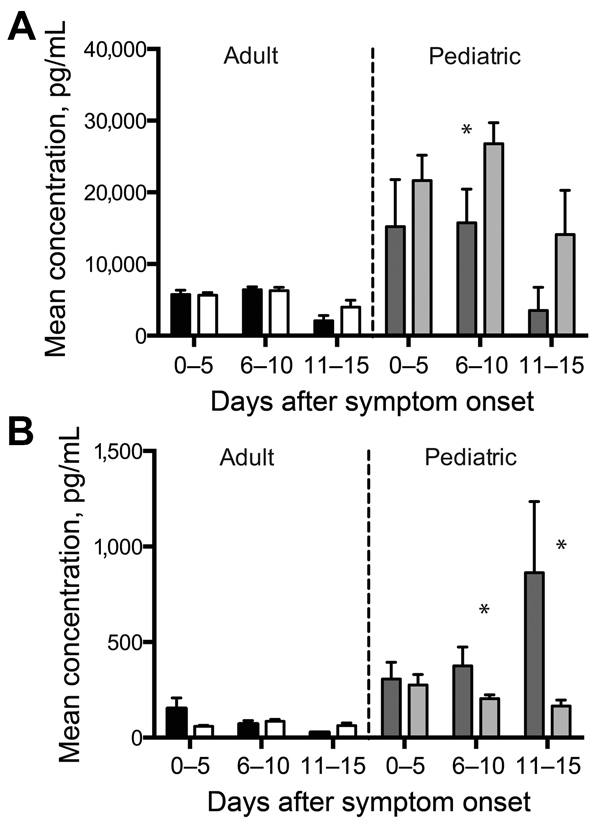
Biomarkers associated with age-dependent survival outcomes for patients with Ebola virus disease: black, adult fatal; white, adult nonfatal; dark gray, pediatric fatal; light gray, pediatric nonfatal. A) Interleukin 10; B) interferon γ–inducible protein 10; C) regulated on activation, normal T cell expressed and secreted; D) soluble intracellular adhesion molecule; E) soluble vascular cell adhesion molecule; F) plasminogen activator inhibitor 1. Mean levels are depicted in each patient group as a function of time after symptom onset. Error bars represent SE; * indicates p<0.05. Numbers of specimens included in each group are as follows: adult fatal at 0–5 days, 27; adult nonfatal at 0–5 days, 20; adult fatal at 6–10 days, 22; adult nonfatal at 6–10 days, 24; adult fatal at 11–15 days, 5; adult nonfatal at 11–15 days, 14; pediatric fatal at 0–5 days, 10; pediatric nonfatal at 0–5 days, 15; pediatric fatal at 6–10 days, 5; pediatric nonfatal at 6–10 days, 13; pediatric fatal at 11–15 days, 2; pediatric nonfatal at 11–15 days, 4.
Figure 3
Figure 3
Biomarkers associated with age-dependent hemorrhagic manifestations (heme) for patients with Ebola virus disease: black, adult heme; white, adult nonheme; dark gray, pediatric heme; light gray, pediatric nonheme. A) Serum amyloid antigen; B) plasminogen activator inhibitor 1. Mean levels are depicted in each patient group as a function of time after symptom onset. Error bars represent SE; * indicates p<0.05. Numbers of specimens included in each group are as follows: adult heme at 0–5 days, 9; adult non-heme at 0–5 days, 38; adult heme at 6–10 days, 12; adult non-heme at 6–10 days, 34; adult heme at 11–15 days, 9; adult non-heme at 11–15 days, 10; pediatric heme at 0–5 days, 7; pediatric non-heme at 0–5 days, 18; pediatric heme at 6–10 days, 6; pediatric non-heme at 6–10 days, 12; pediatric heme at 11–15 days, 2; pediatric non-heme at 11–15 days, 4.
Figure 4
Figure 4
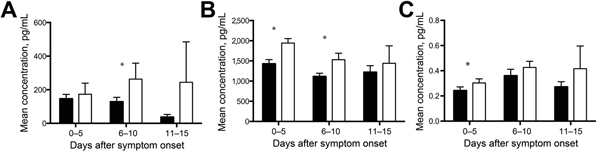
Biomarkers associated with age but not survival outcome or hemorrhage for patients with Ebola virus disease: black, adult; white, pediatric. A) Macrophage colony-stimulating factor; B) total IgG; C) tissue factor. Mean levels are depicted in each patient group as a function of time after symptom onset. Error bars represent SE; * indicates p<0.05. Numbers of specimens included in each group are as follows: adult at 0–5 days, 47; adult at 6–10 days, 46; adult at 11–15 days, 19; pediatric at 0–5 days, 25; pediatric at 6–10 days, 18; pediatric at 11–15 days, 6.

References

    1. Kortepeter MG, Bausch DG, Bray M. Basic clinical and laboratory features of filoviral hemorrhagic fever. J Infect Dis. 2011;204(Suppl 3):S810–6. 10.1093/infdis/jir299 - DOI - PubMed
    1. MacNeil A, Farnon EC, Wamala J, Okware S, Cannon DL, Reed Z, et al. Proportion of deaths and clinical features in Bundibugyo Ebola virus infection, Uganda. Emerg Infect Dis. 2010;16:1969–72. 10.3201/eid1612.100627 - DOI - PMC - PubMed
    1. Fields BN, Knipe DM, Howley PM, editors. Fields’ virology. 5th ed. Philadelphia: Lippincott Williams & Wilkins; 2007.
    1. Okware SI, Omaswa FG, Zaramba S, Opio A, Lutwama JJ, Kamugisha J, et al. An outbreak of Ebola in Uganda. Trop Med Int Health. 2002;7:1068–75. 10.1046/j.1365-3156.2002.00944.x - DOI - PubMed
    1. Centers for Disease Control and Prevention. Outbreak of Ebola hemorrhagic fever, Uganda, August 2000. –January 2001. 2001 Feb 9. Report nos. 0149–2195/0149–2195.

Publication types