. 2014 Oct 2;95(4):454-61.
doi: 10.1016/j.ajhg.2014.09.005.

Cryptic and complex chromosomal aberrations in early-onset neuropsychiatric disorders

Affiliations

Cryptic and complex chromosomal aberrations in early-onset neuropsychiatric disorders

Harrison Brand et al. Am J Hum Genet. .

Abstract

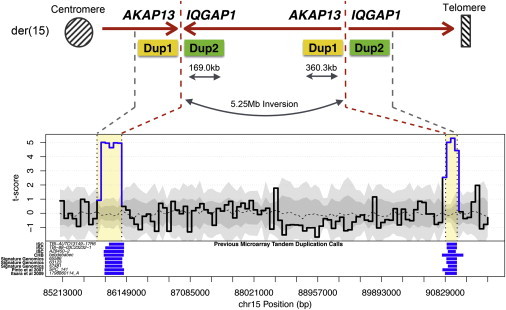
Structural variation (SV) is a significant component of the genetic etiology of both neurodevelopmental and psychiatric disorders; however, routine guidelines for clinical genetic screening have been established only in the former category. Genome-wide chromosomal microarray (CMA) can detect genomic imbalances such as copy-number variants (CNVs), but balanced chromosomal abnormalities (BCAs) still require karyotyping for clinical detection. Moreover, submicroscopic BCAs and subarray threshold CNVs are intractable, or cryptic, to both CMA and karyotyping. Here, we performed whole-genome sequencing using large-insert jumping libraries to delineate both cytogenetically visible and cryptic SVs in a single test among 30 clinically referred youth representing a range of severe neuropsychiatric conditions. We detected 96 SVs per person on average that passed filtering criteria above our highest-confidence resolution (6,305 bp) and an additional 111 SVs per genome below this resolution. These SVs rearranged 3.8 Mb of genomic sequence and resulted in 42 putative loss-of-function (LoF) or gain-of-function mutations per person. We estimate that 80% of the LoF variants were cryptic to clinical CMA. We found myriad complex and cryptic rearrangements, including a "paired" duplication (360 kb, 169 kb) that flanks a 5.25 Mb inversion that appears in 7 additional cases from clinical CNV data among 47,562 individuals. Following convergent genomic profiling of these independent clinical CNV data, we interpreted three SVs to be of potential clinical significance. These data indicate that sequence-based delineation of the full SV mutational spectrum warrants exploration in youth referred for neuropsychiatric evaluation and clinical diagnostic SV screening more broadly.


Figures

Figure 1
Figure 1
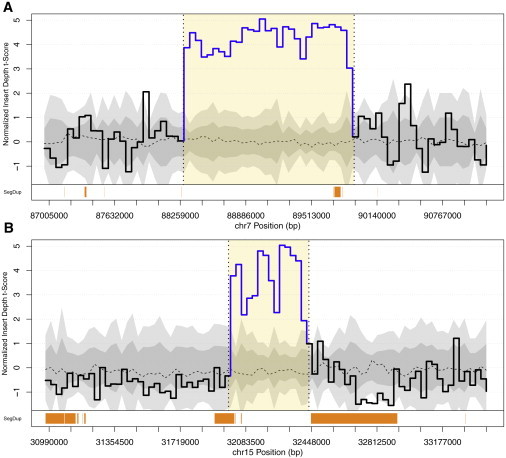
Focal Insert-Depth Comparison across All 33 Libraries Detects CNVs Mediated by Segmental Duplication Focal insert-depth analysis successfully delineated CNVs in both the presence and absence of paired-end cluster support. Shown are a 1.55 Mb duplication with paired-end clustering support (A) and a 432 kb duplication flanked by segmental duplications (B) (orange) without pair-end support. Insert depth was scaled by chromosome-specific coverage within each library before bin-wise normalization across all libraries, yielding a t-score representative of relative enrichment or depletion in insert depth for each sample as compared to the entire cohort (plotted in thick line above). Blue highlights bins that achieved nominal significance (p ≤ 0.05). Light yellow shading corresponds to a cn.MOPS duplication call. Gray shaded regions reflect variability of insert depth by position (dashed line: median t-score; dark gray: t-score MAD; light gray: 2 t-score MAD). Bins were analyzed at multiple sizes (1, 3, 10, and 30 kb).
Figure 2
Figure 2
Inversion Signature Marked by Two Tandem Duplications SV sequencing revealed clusters of inverted read-pairs 5.25 Mb apart (top). The inverted segment contains duplicated regions at each breakpoint (360 kb, 169 kb). Subsequent analysis of insert depth (at bottom) revealed a duplication signature easily detectable by CMA. We investigated a collection of CNV data from 47,562 individuals and identified 7 additional cases who display this same “paired” duplications signature (blue bars), suggesting the presence of an inverted segment between the two CNVs in these cases.

References

    1. Sebat J., Lakshmi B., Malhotra D., Troge J., Lese-Martin C., Walsh T., Yamrom B., Yoon S., Krasnitz A., Kendall J. Strong association of de novo copy number mutations with autism. Science. 2007;316:445–449. - PMC - PubMed
    1. Pinto D., Pagnamenta A.T., Klei L., Anney R., Merico D., Regan R., Conroy J., Magalhaes T.R., Correia C., Abrahams B.S. Functional impact of global rare copy number variation in autism spectrum disorders. Nature. 2010;466:368–372. - PMC - PubMed
    1. Marshall C.R., Noor A., Vincent J.B., Lionel A.C., Feuk L., Skaug J., Shago M., Moessner R., Pinto D., Ren Y. Structural variation of chromosomes in autism spectrum disorder. Am. J. Hum. Genet. 2008;82:477–488. - PMC - PubMed
    1. Cooper G.M., Coe B.P., Girirajan S., Rosenfeld J.A., Vu T.H., Baker C., Williams C., Stalker H., Hamid R., Hannig V. A copy number variation morbidity map of developmental delay. Nat. Genet. 2011;43:838–846. - PMC - PubMed
    1. Talkowski M.E., Rosenfeld J.A., Blumenthal I., Pillalamarri V., Chiang C., Heilbut A., Ernst C., Hanscom C., Rossin E., Lindgren A.M. Sequencing chromosomal abnormalities reveals neurodevelopmental loci that confer risk across diagnostic boundaries. Cell. 2012;149:525–537. - PMC - PubMed

Publication types