Comparative Study
. 2014 Oct 2;95(4):462-71.
doi: 10.1016/j.ajhg.2014.09.004.

Genome-wide association study identifies five susceptibility loci for follicular lymphoma outside the HLA region

Christine F Skibola  1 Sonja I Berndt  2 Joseph Vijai  3 Lucia Conde  4 Zhaoming Wang  5 Meredith Yeager  5 Paul I W de Bakker  6 Brenda M Birmann  7 Claire M Vajdic  8 Jia-Nee Foo  9 Paige M Bracci  10 Roel C H Vermeulen  11 Susan L Slager  12 Silvia de Sanjose  13 Sophia S Wang  14 Martha S Linet  2 Gilles Salles  15 Qing Lan  2 Gianluca Severi  16 Henrik Hjalgrim  17 Tracy Lightfoot  18 Mads Melbye  19 Jian Gu  20 Hervé Ghesquières  21 Brian K Link  22 Lindsay M Morton  2 Elizabeth A Holly  10 Alex Smith  18 Lesley F Tinker  23 Lauren R Teras  24 Anne Kricker  25 Nikolaus Becker  26 Mark P Purdue  2 John J Spinelli  27 Yawei Zhang  28 Graham G Giles  29 Paolo Vineis  30 Alain Monnereau  31 Kimberly A Bertrand  32 Demetrius Albanes  2 Anne Zeleniuch-Jacquotte  33 Attilio Gabbas  34 Charles C Chung  2 Laurie Burdett  5 Amy Hutchinson  5 Charles Lawrence  35 Rebecca Montalvan  35 Liming Liang  36 Jinyan Huang  37 Baoshan Ma  38 Jianjun Liu  9 Hans-Olov Adami  39 Bengt Glimelius  40 Yuanqing Ye  20 Grzegorz S Nowakowski  12 Ahmet Dogan  41 Carrie A Thompson  42 Thomas M Habermann  42 Anne J Novak  42 Mark Liebow  42 Thomas E Witzig  42 George J Weiner  22 Maryjean Schenk  43 Patricia Hartge  2 Anneclaire J De Roos  44 Wendy Cozen  45 Degui Zhi  46 Nicholas K Akers  47 Jacques Riby  4 Martyn T Smith  47 Mortimer Lacher  3 Danylo J Villano  3 Ann Maria  3 Eve Roman  18 Eleanor Kane  18 Rebecca D Jackson  48 Kari E North  49 W Ryan Diver  24 Jenny Turner  50 Bruce K Armstrong  25 Yolanda Benavente  13 Paolo Boffetta  51 Paul Brennan  52 Lenka Foretova  53 Marc Maynadie  54 Anthony Staines  55 James McKay  56 Angela R Brooks-Wilson  57 Tongzhang Zheng  28 Theodore R Holford  58 Saioa Chamosa  59 Rudolph Kaaks  26 Rachel S Kelly  60 Bodil Ohlsson  61 Ruth C Travis  62 Elisabete Weiderpass  63 Jacqueline Clavel  64 Edward Giovannucci  65 Peter Kraft  36 Jarmo Virtamo  66 Patrizio Mazza  67 Pierluigi Cocco  34 Maria Grazia Ennas  68 Brian C H Chiu  69 Joseph F Fraumeni Jr  2 Alexandra Nieters  70 Kenneth Offit  3 Xifeng Wu  20 James R Cerhan  12 Karin E Smedby  71 Stephen J Chanock  2 Nathaniel Rothman  2
Affiliations
Comparative Study

Genome-wide association study identifies five susceptibility loci for follicular lymphoma outside the HLA region

Christine F Skibola et al. Am J Hum Genet. .

Abstract

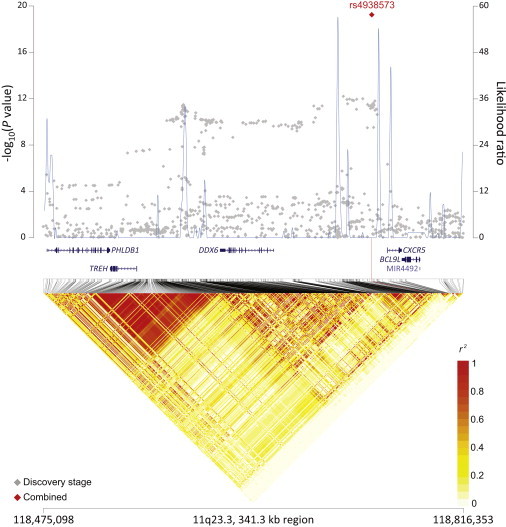
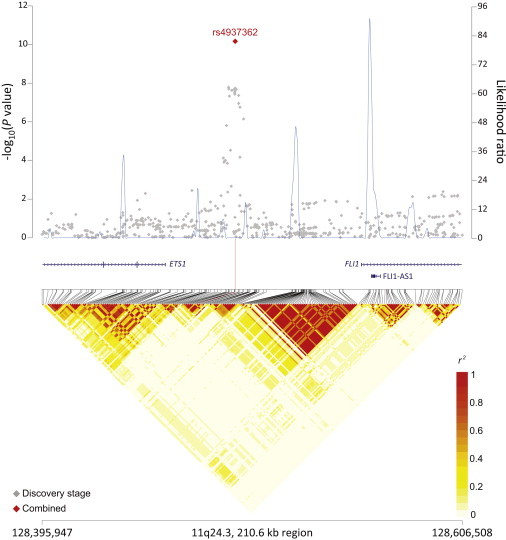
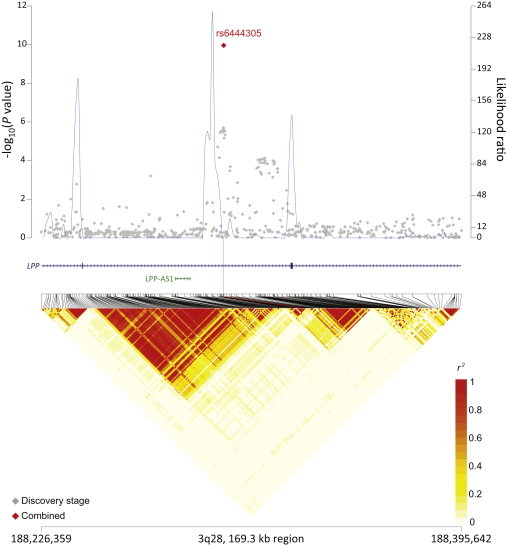
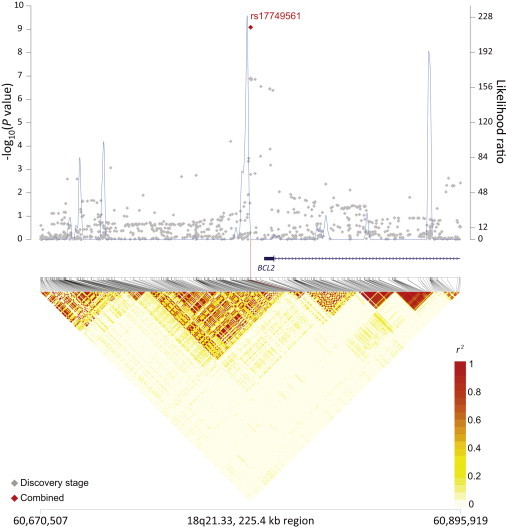
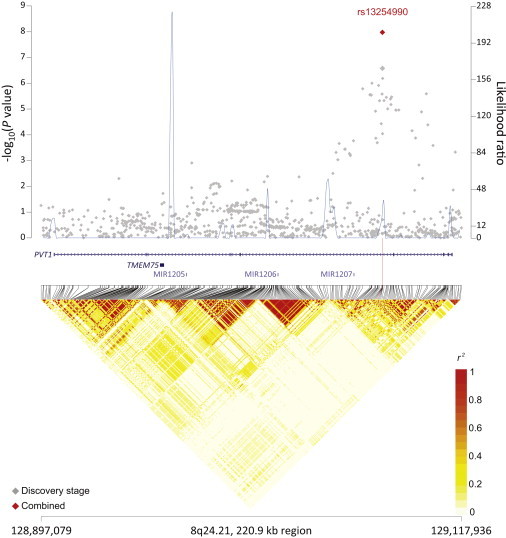
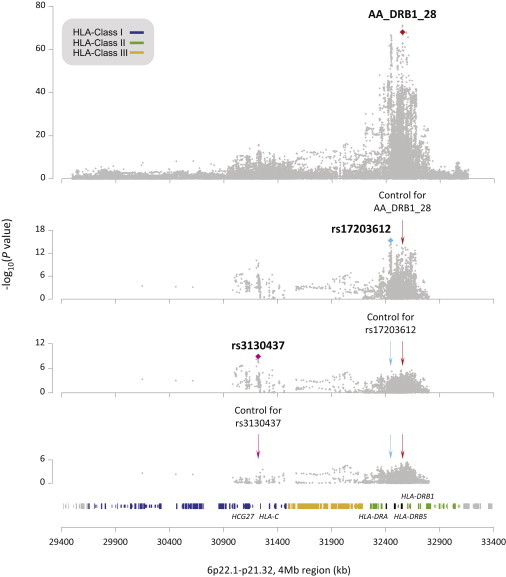
Genome-wide association studies (GWASs) of follicular lymphoma (FL) have previously identified human leukocyte antigen (HLA) gene variants. To identify additional FL susceptibility loci, we conducted a large-scale two-stage GWAS in 4,523 case subjects and 13,344 control subjects of European ancestry. Five non-HLA loci were associated with FL risk: 11q23.3 (rs4938573, p = 5.79 × 10(-20)) near CXCR5; 11q24.3 (rs4937362, p = 6.76 × 10(-11)) near ETS1; 3q28 (rs6444305, p = 1.10 × 10(-10)) in LPP; 18q21.33 (rs17749561, p = 8.28 × 10(-10)) near BCL2; and 8q24.21 (rs13254990, p = 1.06 × 10(-8)) near PVT1. In an analysis of the HLA region, we identified four linked HLA-DRβ1 multiallelic amino acids at positions 11, 13, 28, and 30 that were associated with FL risk (pomnibus = 4.20 × 10(-67) to 2.67 × 10(-70)). Additional independent signals included rs17203612 in HLA class II (odds ratio [OR(per-allele)] = 1.44; p = 4.59 × 10(-16)) and rs3130437 in HLA class I (OR(per-allele) = 1.23; p = 8.23 × 10(-9)). Our findings further expand the number of loci associated with FL and provide evidence that multiple common variants outside the HLA region make a significant contribution to FL risk.


Figures

Figure 1
Figure 1
Regional Plots of the FL-Associated Locus rs4938573 in 11q23.3 Figure shows the association results from the NCI FL GWAS and stages 1 and 2 combined (red diamond), recombination hotspots, and LD plots.
Figure 2
Figure 2
Regional Plots of the FL-Associated Locus rs4937362 in 11q24.3 Figure shows the association results from the NCI NHL GWAS and stages 1 and 2 combined (red diamond), recombination hotspots, and LD plots.
Figure 3
Figure 3
Regional Plots of the Associated Locus rs6444305 in 3q28 Figure shows the association results from the NCI FL GWAS and stages 1 and 2 combined (red diamond), recombination hotspots, and LD plots.
Figure 4
Figure 4
Regional Plots of the Associated Locus rs17749561 in 18q21.33 Figure shows the association results from the NCI FL GWAS and stages 1 and 2 combined (red diamond), recombination hotspots, and LD plots.
Figure 5
Figure 5
Regional Plots of the Associated Locus rs13254990 in 8q24.21 Figure shows the association results from the NCI FL GWAS and stages 1 and 2 combined (red diamond), recombination hotspots, and LD plots.
Figure 6
Figure 6
Sequential Conditioned Association Analysis in the HLA Region at 6p22.1-21.32: 29,400–33,400 kb Each gray diamond represents the p value from the meta-analysis of the four GWASs. Among all the AAs and HLA alleles tested, the top associated signal mapped to the AA DRβ1 at position 28 (top). After conditioning on DRβ1 28, rs17203612 in the HLA class II region was the marker with the highest association (second from top). Further analysis conditioning on both signals revealed rs3130437 in HLA class I as the most significant associated marker (second from bottom). No additional genome-wide significant signals were observed after controlling for the effects of DRβ1 28, rs17203612, and rs3130437 (bottom). Plots derived using genome assembly hg19.

References

    1. Link B.K., Maurer M.J., Nowakowski G.S., Ansell S.M., Macon W.R., Syrbu S.I., Slager S.L., Thompson C.A., Inwards D.J., Johnston P.B. Rates and outcomes of follicular lymphoma transformation in the immunochemotherapy era: a report from the University of Iowa/MayoClinic Specialized Program of Research Excellence Molecular Epidemiology Resource. J. Clin. Oncol. 2013;31:3272–3278. - PMC - PubMed
    1. Tan D., Horning S.J., Hoppe R.T., Levy R., Rosenberg S.A., Sigal B.M., Warnke R.A., Natkunam Y., Han S.S., Yuen A. Improvements in observed and relative survival in follicular grade 1-2 lymphoma during 4 decades: the Stanford University experience. Blood. 2013;122:981–987. - PMC - PubMed
    1. Smedby K.E., Foo J.N., Skibola C.F., Darabi H., Conde L., Hjalgrim H., Kumar V., Chang E.T., Rothman N., Cerhan J.R. GWAS of follicular lymphoma reveals allelic heterogeneity at 6p21.32 and suggests shared genetic susceptibility with diffuse large B-cell lymphoma. PLoS Genet. 2011;7:e1001378. - PMC - PubMed
    1. Conde L., Halperin E., Akers N.K., Brown K.M., Smedby K.E., Rothman N., Nieters A., Slager S.L., Brooks-Wilson A., Agana L. Genome-wide association study of follicular lymphoma identifies a risk locus at 6p21.32. Nat. Genet. 2010;42:661–664. - PMC - PubMed
    1. Skibola C.F., Bracci P.M., Halperin E., Conde L., Craig D.W., Agana L., Iyadurai K., Becker N., Brooks-Wilson A., Curry J.D. Genetic variants at 6p21.33 are associated with susceptibility to follicular lymphoma. Nat. Genet. 2009;41:873–875. - PMC - PubMed

Publication types