Review
. 2014 Oct 2;56(1):5-12.
doi: 10.1016/j.molcel.2014.09.001.

Dynamic RNA modifications in posttranscriptional regulation

Affiliations
Review

Dynamic RNA modifications in posttranscriptional regulation

Xiao Wang et al. Mol Cell. .

Abstract

Cellular RNAs can be chemically modified over a hundred different ways. These modifications were once thought to be static, discrete, and utilized to fine-tune RNA structure and function. However, recent studies have revealed that some modifications, like mRNA methylation, can be reversed, and these reversible modifications may play active roles in regulating diverse biological processes. In this perspective, we summarize examples of dynamic RNA modifications that affect biological functions. We further propose that reversible modifications might occur on tRNA, rRNA, and other noncoding RNAs to regulate gene expression analogous to the reversible mRNA methylation.


Figures

Figure 1
Figure 1
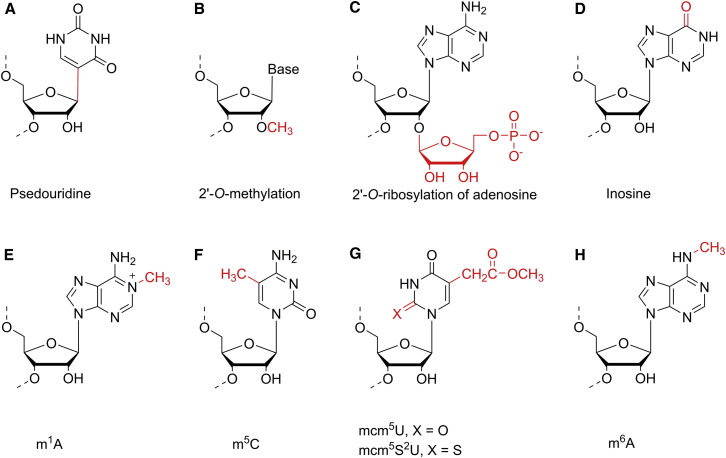
Chemical Structures of Selected RNA Modifications Chemical structures of selected RNA modifications.
Figure 2
Figure 2
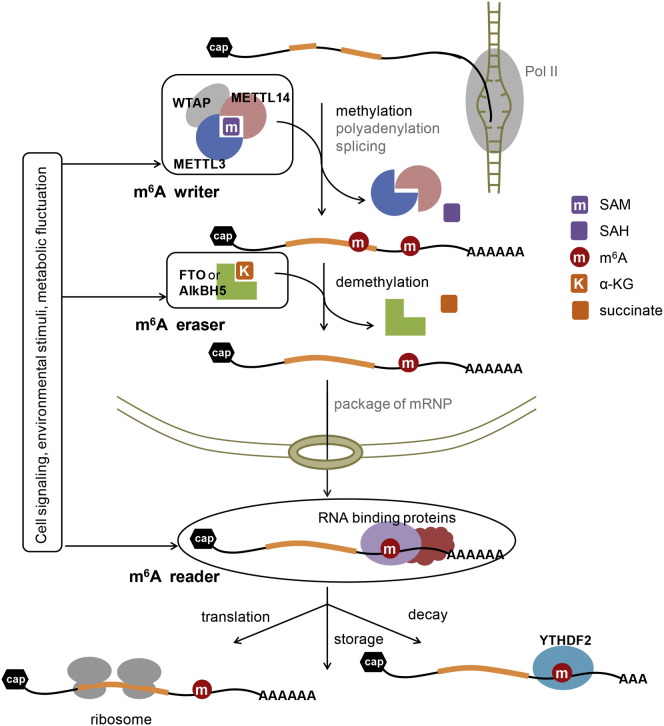
Reversible m6A Modification Affects Gene Expression Regulation in Mammalian Cells The m6A writer proteins install the m6A code on the transcriptome in coordination with RNA splicing and processing. The METTL3-METTL14 heterodimer is the enzymatic core of the m6A writer complex, while WTAP and other factors could regulate the methylation process. The m6A eraser proteins (FTO and AlkBH5) further tune the methylation stoichiometry, perhaps in a more pathway-specific manner. The m6A reader proteins (e.g., YTHDF family proteins) recognize the m6A code and execute biological functions. YTHDF2 promotes the decay of the m6A-containing RNA while other reader proteins could potentially affect the translation, storage, or nuclear export of methylated RNA. All these proteins could couple their functions with cellular signaling pathways, responses to environmental stimuli, or programmed biological transformations. S-adenosyl methionine (SAM) is the cofactor of METTL3-METTL14 with S-adenosyl homocysteine (SAH) as the product after the methylation. α-ketoglutarate (α-KG) is the cofactor of FTO and AlkBH5 with succinate as the product.
Figure 3
Figure 3
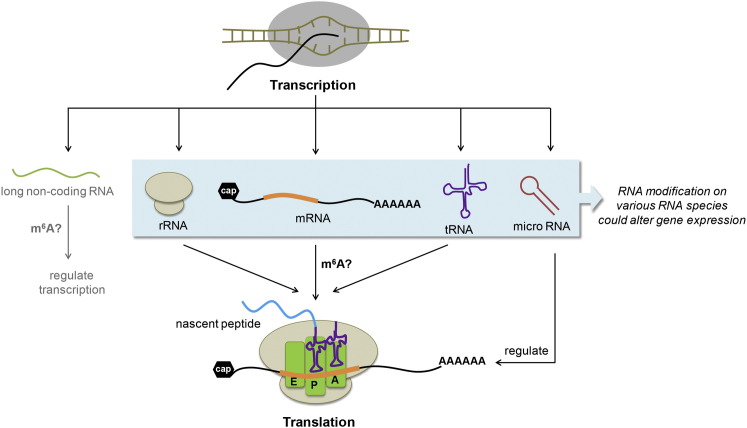
Dynamic RNA Modifications in Gene Expression Regulation RNA modifications in various RNA species (rRNA, mRNA, tRNA, lncRNA, and miRNA) could be reversible and play active roles in regulating transcription and posttranscriptional gene expression.

References

    1. Agarwala S.D., Blitzblau H.G., Hochwagen A., Fink G.R. RNA methylation by the MIS complex regulates a cell fate decision in yeast. PLoS Genet. 2012;8:e1002732. - PMC - PubMed
    1. Anantharaman V., Koonin E.V., Aravind L. Comparative genomics and evolution of proteins involved in RNA metabolism. Nucleic Acids Res. 2002;30:1427–1464. - PMC - PubMed
    1. Anderson J., Phan L., Cuesta R., Carlson B.A., Pak M., Asano K., Björk G.R., Tamame M., Hinnebusch A.G. The essential Gcd10p-Gcd14p nuclear complex is required for 1-methyladenosine modification and maturation of initiator methionyl-tRNA. Genes Dev. 1998;12:3650–3662. - PMC - PubMed
    1. Bakin A., Lane B.G., Ofengand J. Clustering of pseudouridine residues around the peptidyltransferase center of yeast cytoplasmic and mitochondrial ribosomes. Biochemistry. 1994;33:13475–13483. - PubMed
    1. Baxter-Roshek J.L., Petrov A.N., Dinman J.D. Optimization of ribosome structure and function by rRNA base modification. PLoS ONE. 2007;2:e174. - PMC - PubMed

Publication types

LinkOut - more resources