


Food store owners' and managers' perspectives on the food environment: an exploratory mixed-methods study
- PMID: 25281272
- PMCID: PMC4287570
- DOI: 10.1186/1471-2458-14-1031
Food store owners' and managers' perspectives on the food environment: an exploratory mixed-methods study
Abstract
Background: Neighborhood characteristics such as poverty and racial composition are associated with inequalities in access to food stores and in the risk of obesity, but the pathways between food environments and health are not well understood. This article extends research on consumer food environments by examining the perspectives of food-store owners and managers.
Methods: We conducted semistructured, open-ended interviews with managers and owners of 20 food stores in low-income, predominantly African American neighborhoods in Tallahassee, Florida (USA). The interviews were designed to elicit store managers' and owners' views about healthy foods, the local food environment, and the challenges and opportunities they face in creating access to healthy foods. We elicited perceptions of what constitutes "healthy foods" using two free-list questions. The study was designed and implemented in accord with principles of community-based participatory research.
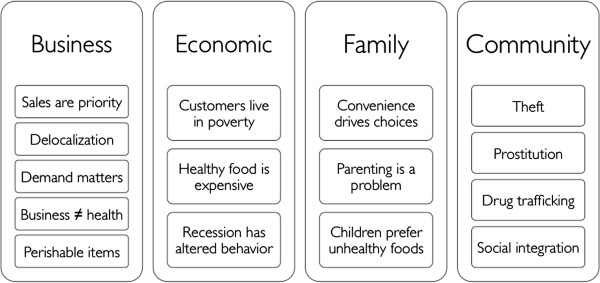
Results: Store owners' and managers' conceptions of "healthy foods" overlapped with public health messages, but (a) agreement about which foods are healthy was not widespread and (b) some retailers perceived processed foods such as snack bars and sugar-sweetened juice drinks as healthy. In semistructured interviews, store owners and managers linked the consumer food environment to factors across multiple levels of analysis, including: business practices such as the priority of making sales and the delocalization of decision-making, macroeconomic factors such as poverty and the cost of healthier foods, individual and family-level factors related to parenting and time constraints, and community-level factors such as crime and decline of social cohesion.
Conclusions: Our results link food stores to multilevel, ecological models of the food environment. Efforts to reshape the consumer food environment require attention to factors across multiple levels of analysis, including local conceptions of "healthy foods", the business priority of making sales, and policies and practices that favor the delocalization of decision making and constrain access to healthful foods.
Figures
References
-
- White House Task Force on Childhood Obesity . Solving the Problem of Childhood Obesity Within a Generation. Washington, DC: Executive Office of the President of the United States of America; 2010. - PubMed
Pre-publication history
-
- The pre-publication history for this paper can be accessed here: http://www.biomedcentral.com/1471-2458/14/1031/prepub
Publication types
MeSH terms
LinkOut - more resources
Full Text Sources
Other Literature Sources
Medical
