


Achieving cost-neutrality with long-acting reversible contraceptive methods
- PMID: 25282161
- PMCID: PMC4268022
- DOI: 10.1016/j.contraception.2014.08.011
Achieving cost-neutrality with long-acting reversible contraceptive methods
Abstract
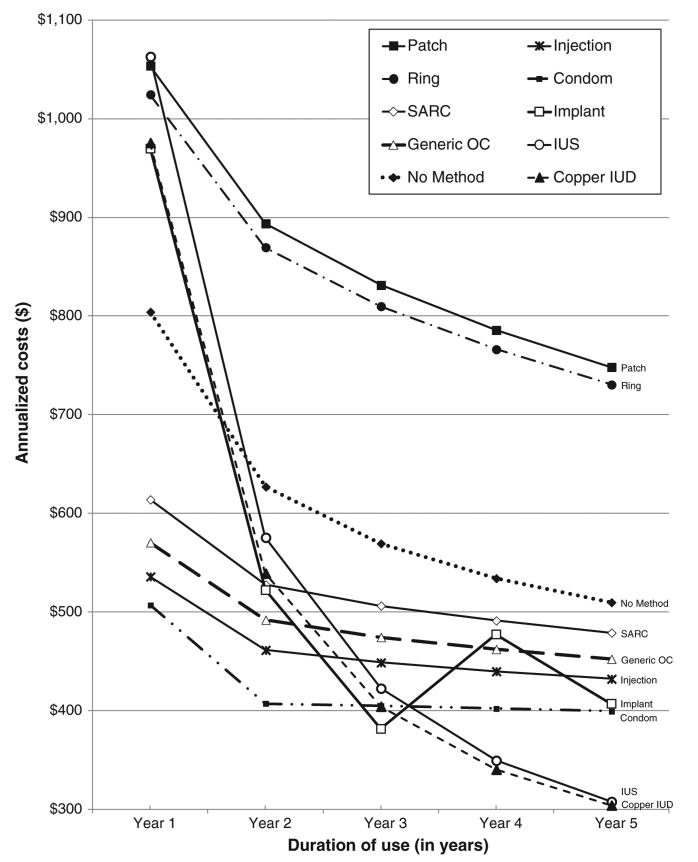
Objectives: This analysis aimed to estimate the average annual cost of available reversible contraceptive methods in the United States. In line with literature suggesting long-acting reversible contraceptive (LARC) methods become increasingly cost-saving with extended duration of use, it aimed to also quantify minimum duration of use required for LARC methods to achieve cost-neutrality relative to other reversible contraceptive methods while taking into consideration discontinuation.
Study design: A three-state economic model was developed to estimate relative costs of no method (chance), four short-acting reversible (SARC) methods (oral contraceptive, ring, patch and injection) and three LARC methods [implant, copper intrauterine device (IUD) and levonorgestrel intrauterine system (LNG-IUS) 20 mcg/24 h (total content 52 mg)]. The analysis was conducted over a 5-year time horizon in 1000 women aged 20-29 years. Method-specific failure and discontinuation rates were based on published literature. Costs associated with drug acquisition, administration and failure (defined as an unintended pregnancy) were considered. Key model outputs were annual average cost per method and minimum duration of LARC method usage to achieve cost-savings compared to SARC methods.
Results: The two least expensive methods were copper IUD ($304 per women, per year) and LNG-IUS 20 mcg/24 h ($308). Cost of SARC methods ranged between $432 (injection) and $730 (patch), per women, per year. A minimum of 2.1 years of LARC usage would result in cost-savings compared to SARC usage.
Conclusions: This analysis finds that even if LARC methods are not used for their full durations of efficacy, they become cost-saving relative to SARC methods within 3 years of use.
Implications: Previous economic arguments in support of using LARC methods have been criticized for not considering that LARC methods are not always used for their full duration of efficacy. This study calculated that cost-savings from LARC methods relative to SARC methods, with discontinuation rates considered, can be realized within 3 years.
Keywords: Cost savings; Cost study; LARC; SARC; Unintended pregnancy.
Copyright © 2014 Elsevier Inc. All rights reserved.
Figures

References
-
- Sonfield A, Gold RB. New York: Guttmacher Institute; 2012. Public funding for family planning, sterilization and abortion services, FY 1980–2010. [Available from: http://www.guttmacher.org/pubs/Public-Funding-FP-2010.pdf]
-
- Monea E, Thomas A. Unintended pregnancy and taxpayer spending. Perspect Sex Reprod Health. 2011;43(2):88–93. - PubMed
-
- Finer LB, Darroch JE, Frost JJ. US agencies providing publicly funded contraceptive services in 1999. Perspect Sex Reprod Health. 2002;34(1):15–24. - PubMed
-
- Moreau C, Cleland K, Trussell J. Contraceptive discontinuation attributed to method dissatisfaction in the United States. Contraception. 2007;76(4):267–72. - PubMed
Publication types
MeSH terms
Substances
Grants and funding
LinkOut - more resources
Full Text Sources
Other Literature Sources
Medical
