


Hypertension: an unstudied potential risk factor for adverse outcomes during continuous flow ventricular assist device support
- PMID: 25283767
- PMCID: PMC4385742
- DOI: 10.1007/s10741-014-9458-3
Hypertension: an unstudied potential risk factor for adverse outcomes during continuous flow ventricular assist device support
Abstract
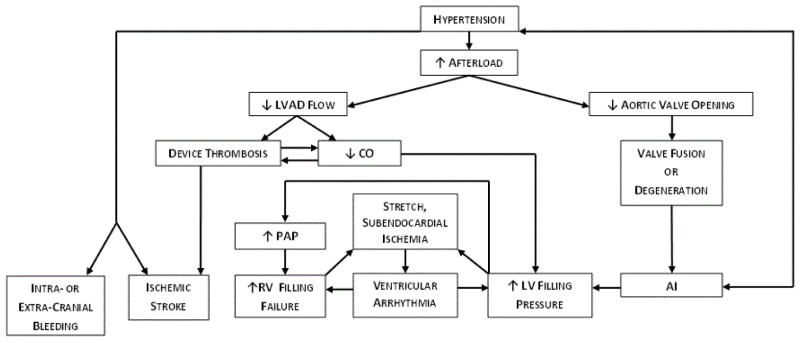
In end-stage heart failure, left ventricular assist devices (LVADs) represent an exciting new frontier in which post-device implantation survival approaches that of heart transplant. However, expansion of this technology is still limited by complications that impact morbidity and mortality. Thus, it is essential to identify and optimize modifiable predictors of poor outcomes. One such predictor may be hypertension (HTN). Not only may chronic HTN as a traditional cardiovascular risk factor be present during long-term LVAD support, but HTN may also contribute to device malfunction or device-associated complications. Although current guidelines identify blood pressure (BP) control as important to outpatient continuous flow (CF) LVAD management, there is no evidence base to support these guidelines. Indeed, our comprehensive literature search did not identify any studies that evaluated post-device implantation HTN as a potential predictor of adverse CF-LVAD outcomes. HTN among CF-LVAD patients is likely a relatively unstudied factor because of difficulties using standard noninvasive techniques to measure BP in the setting of reduced pulsatile flow. Fortunately, recent research has elucidated the meaning of Doppler BP measurements and validated a slow-cuff deflation system for BP measurements in the setting of CF-LVAD support. Therefore, CF-LVAD researchers and clinicians may (1) consider potential mechanisms relating HTN to poor outcomes, (2) realize that HTN management is a stated goal despite scarce evidence, and (3) utilize the new reliable and valid methods for outpatient BP measurement that make research and management possible. It is critical and now feasible that research on HTN in the CF-LVAD patient population move forward.
Figures
References
-
- Wilson SR, Givertz MM, Stewart GC, Mudge GH., Jr Ventricular assist devices the challenges of outpatient management. J Am Coll Cardiol. 2009;54:1647–1659. - PubMed
-
- Slaughter MS, Pagani FD, Rogers JG, Miller LW, Sun B, Russell SD, Starling RC, Chen L, Boyle AJ, Chillcott S, Adamson RM, Blood MS, Camacho MT, Idrissi KA, Petty M, Sobieski M, Wright S, Myers TJ, Farrar DJ. Clinical management of continuous-flow left ventricular assist devices in advanced heart failure. The Journal of heart and lung transplantation : the official publication of the International Society for Heart Transplantation. 2010;29:S1–39. - PubMed
-
- Stewart GC, Givertz MM. Mechanical circulatory support for advanced heart failure: Patients and technology in evolution. Circulation. 2012;125:1304–1315. - PubMed
-
- Hansen DE, Craig CS, Hondeghem LM. Stretch-induced arrhythmias in the isolated canine ventricle. Evidence for the importance of mechanoelectrical feedback. Circulation. 1990;81:1094–1105. - PubMed
Publication types
MeSH terms
Grants and funding
LinkOut - more resources
Full Text Sources
Other Literature Sources
Medical
