


Effects of breastfeeding on postpartum weight loss among U.S. women
- PMID: 25284261
- PMCID: PMC4312189
- DOI: 10.1016/j.ypmed.2014.09.018
Effects of breastfeeding on postpartum weight loss among U.S. women
Abstract
Objective: The aim of this study is to evaluate the effects of breastfeeding on maternal weight loss in the 12months postpartum among U.S. women.
Methods: Using data from a national cohort of U.S. women conducted in 2005-2007 (N=2102), we employed propensity scores to match women who breastfed exclusively and non-exclusive for at least three months to comparison women who had not breastfed or breastfed for less than three months. Outcomes included postpartum weight loss at 3, 6, 9, and 12months postpartum; and the probability of returning to pre-pregnancy body mass index (BMI) category and the probability of returning to pre-pregnancy weight.
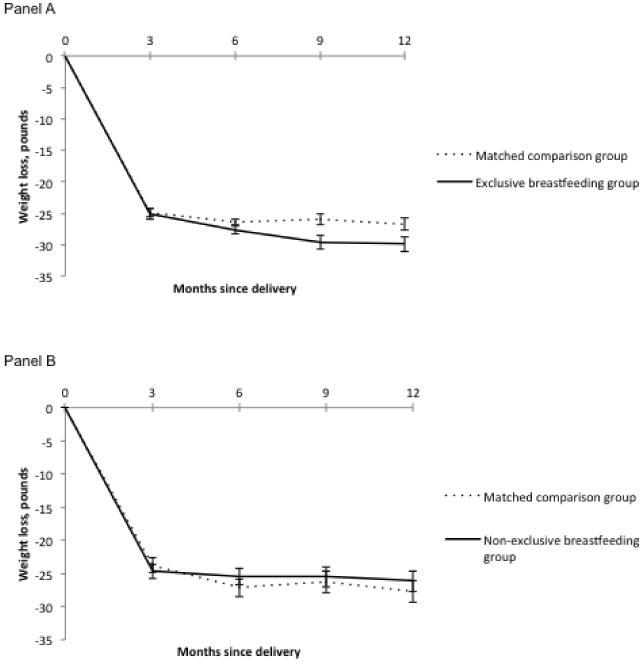
Results: Compared to women who did not breastfeed or breastfed non-exclusively, exclusive breastfeeding for at least 3months resulted in 3.2 pound (95% CI: 1.4,4.7) greater weight loss at 12months postpartum, a 6.0-percentage-point increase (95% CI: 2.3,9.7) in the probability of returning to the same or lower BMI category postpartum; and a 6.1-percentage-point increase (95% CI: 1.0,11.3) in the probability of returning to pre-pregnancy weight or lower postpartum. Non-exclusive breastfeeding did not significantly affect any outcomes.
Conclusion: Our study provides evidence that exclusive breastfeeding for at least three months has a small effect on postpartum weight loss among U.S. women.
Keywords: Breastfeeding; Infant Feeding Practices Study II; Obesity; Weight loss.
Copyright © 2014 Elsevier Inc. All rights reserved.
Conflict of interest statement
Figures
References
-
- American Academy of Pediatrics. Breastfeeding and the use of human milk. Pediatrics. 2012;129:e827–41. - PubMed
-
- Amorim AR, Rossner S, Neovius M, Lourenco PM, Linne Y. Does excess pregnancy weight gain constitute a major risk for increasing long-term BMI? Obesity. 2007;15:1278–86. - PubMed
-
- Baker JL, Gamborg M, Heitmann BL, Lissner L, Sorensen TI, Rasmussen KM. Breastfeeding reduces postpartum weight retention. The American journal of clinical nutrition. 2008;88:1543–51. - PubMed
-
- Brewer MM, Bates MR, Vannoy LP. Postpartum changes in maternal weight and body fat depots in lactating vs nonlactating women. The American journal of clinical nutrition. 1989;49:259–65. - PubMed
-
- Centers for Disease Control and Prevention. Breastfeeding Report Card: United States, 2014. Atlanta: 2014. [Accessed August 2 2014]. Online.
Publication types
MeSH terms
Grants and funding
LinkOut - more resources
Full Text Sources
Other Literature Sources
Medical
