


Luliconazole for the treatment of fungal infections: an evidence-based review
- PMID: 25285056
- PMCID: PMC4181444
- DOI: 10.2147/CE.S49629
Luliconazole for the treatment of fungal infections: an evidence-based review
Abstract
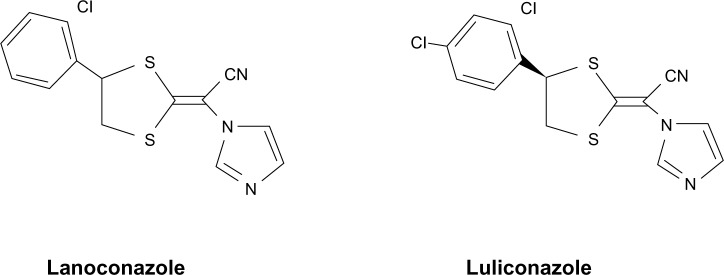
Luliconazole is an imidazole antifungal agent with a unique structure, as the imidazole moiety is incorporated into the ketene dithioacetate structure. Luliconazole is the R-enantiomer, and has more potent antifungal activity than lanoconazole, which is a racemic mixture. In this review, we summarize the in vitro data, animal studies, and clinical trial data relating to the use of topical luliconazole. Preclinical studies have demonstrated excellent activity against dermatophytes. Further, in vitro/in vivo studies have also shown favorable activity against Candida albicans, Malassezia spp., and Aspergillus fumigatus. Luliconazole, although belonging to the azole group, has strong fungicidal activity against Trichophyton spp., similar to that of terbinafine. The strong clinical antifungal activity of luliconazole is possibly attributable to a combination of strong in vitro antifungal activity and favorable pharmacokinetic properties in the skin. Clinical trials have demonstrated its superiority over placebo in dermatophytosis, and its antifungal activity to be at par or even better than that of terbinafine. Application of luliconazole 1% cream once daily is effective even in short-term use (one week for tinea corporis/cruris and 2 weeks for tinea pedis). A Phase I/IIa study has shown excellent local tolerability and a lack of systemic side effects with use of topical luliconazole solution for onychomycosis. Further studies to evaluate its efficacy in onychomycosis are underway. Luliconazole 1% cream was approved in Japan in 2005 for the treatment of tinea infections. It has recently been approved by US Food and Drug Administration for the treatment of interdigital tinea pedis, tinea cruris, and tinea corporis. Topical luliconazole has a favorable safety profile, with only mild application site reactions reported occasionally.
Keywords: NND-502; clinical trials; dermatophytes; fungal infections; luliconazole; onychomycosis; review.
Figures
References
-
- Havlickova B, Czaika VA, Friedrich M. Epidemiological trends in skin mycoses worldwide. Mycoses. 2008;51(Suppl 4):2–15. - PubMed
-
- Zaias N, Tosti A, Rebell G, et al. Autosomal dominant pattern of distal subungual onychomycosis caused by Trichophyton rubrum. J Am Acad Dermatol. 1996;34:302–334. - PubMed
-
- Hay RJ, Ashbee HR. Mycology. In: Burns T, Breathnach S, Cox N, Griffiths C, editors. Rook’s Textbook of Dermatology. 8th ed. Oxford, UK: Blackwell Science; 2010.
-
- Nishiyama Y, Asagi Y, Hiratani T, Yamaguchi H, Yamada N, Osumi M. Morphological changes associated with growth inhibition of Trichophyton mentagrophytes by amorolfine. Clin Exp Dermatol. 1992;17(Supp 1):13–17. - PubMed
-
- Nimura K, Niwano Y, Ishiduka S, Fukumoto R. Comparison of in vitro anti-fungal activities of topical antimycotics launched in 1990s in Japan. Int J Antimicrob Agents. 2001;18:173–178. - PubMed
Publication types
LinkOut - more resources
Full Text Sources
Other Literature Sources
Miscellaneous
