


Water from fruit or the river? Examining hydration strategies and gastrointestinal illness among Tsimane' adults in the Bolivian Amazon
- PMID: 25287632
- PMCID: PMC10271473
- DOI: 10.1017/S1368980014002158
Water from fruit or the river? Examining hydration strategies and gastrointestinal illness among Tsimane' adults in the Bolivian Amazon
Abstract
Objective: Water is an essential nutrient overlooked in many cross-cultural studies of human nutrition. The present article describes dietary water intake patterns among forager-horticulturalist adults in lowland Bolivia, compares daily intake with international references and examines if variation in how people acquire water relates to gastrointestinal illness.
Design: Cross-sectional observational study used survey, anthropometric and qualitative methods with Tsimane' adults selected by age and sex stratification sampling in one community.
Setting: Research occurred in one Tsimane' village in the Beni department, Bolivia with limited access to clean water. The 24 h diet and health recalls were conducted in July-August 2012 and qualitative interviews/ethnographic observation in September-October 2013.
Subjects: Forty-five Tsimane' household heads (49% men) took part in the first data collection and twenty-two Tsimane' (55% men) were included in the follow-up interviews.
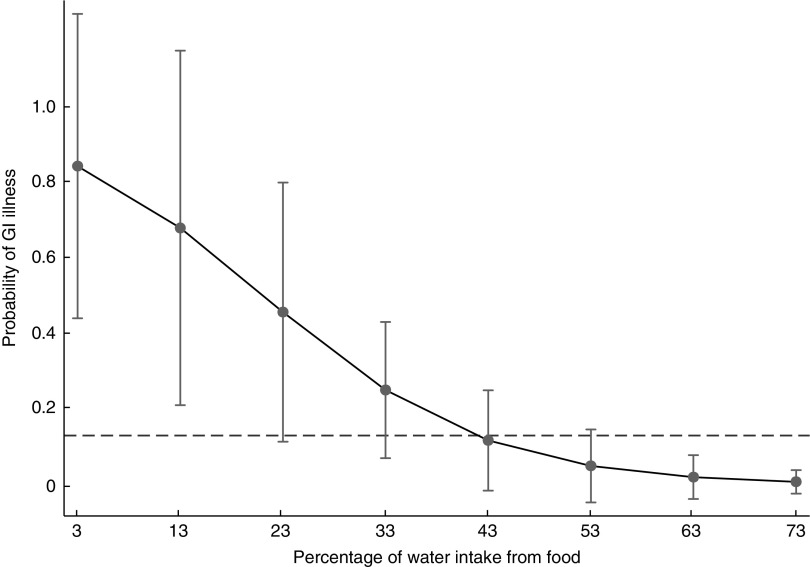
Results: Men and women reported consuming 4·9 litres and 4·4 litres of water daily from all dietary sources, respectively. On average, water from foods represented 50 % of total water intake. Thirteen per cent of participants reported symptoms of gastrointestinal illness. In a logistic regression model adjusted for age, BMI, sex and raw water consumed, each percentage increase in water obtained from foods was associated with a reduced risk of gastrointestinal illness (OR=0·92; 95% CI 0·85, 0·99).
Conclusions: Both total water intake and percentage of water from foods were higher than averages in industrialized countries. These findings suggest that people without access to clean water may rely on water-rich foods as a dietary adaptation to reduce pathogen exposures.
Keywords: Amazonia.
Figures
References
-
- World Health Organization/UNICEF Joint Monitoring Programme for Water Supply and Sanitation (2010) Progress on Sanitation and Drinking-Water: 2010 Update. Geneva: WHO and UNICEF.
-
- Vargas LA (2001) Thirst and drinking as a bio-cultural process. In Anthropology of Food and Nutrition. vol. 4: Drinking: Anthropological Approaches, pp. 11–21 [I Garine and V Garine, editors]. New York: Berghahn Books.
-
- Pelto H, Goodman A & Dufour D (2000) The biocultural perspective in nutritional anthropology. In Nutritional Anthropology: Biocultural Perspectives on Food and Nutrition, pp. 1–9 [A Goodman, D Dufour and G Pelto, editors]. Mountain View, CA: Mayfield Publishing.
-
- Stinson S (1992) Nutritional adaptation. Annu Rev Anthropol 21, 143–170.
-
- Dufour D (1995) A closer look at the nutritional implications of bitter cassava use. In Indigenous Peoples and the Future of Amazonia: An Ecological Anthropology of an Endangered World, pp. 149–165 [L Sponsel, editor]. Tucson, AZ: University of Arizona Press.
Publication types
MeSH terms
Substances
LinkOut - more resources
Full Text Sources
Other Literature Sources
Medical
