. 2015 Jan;64(1):61-73.
doi: 10.1007/s00262-014-1610-3. Epub 2014 Oct 7.

Elotuzumab enhances natural killer cell activation and myeloma cell killing through interleukin-2 and TNF-α pathways

Affiliations

Elotuzumab enhances natural killer cell activation and myeloma cell killing through interleukin-2 and TNF-α pathways

Balaji Balasa et al. Cancer Immunol Immunother. 2015 Jan.

Abstract

Elotuzumab is a humanized monoclonal antibody specific for signaling lymphocytic activation molecule-F7 (SLAMF7, also known as CS1, CD319, or CRACC) that enhances natural killer (NK) cell-mediated antibody-dependent cellular cytotoxicity (ADCC) of SLAMF7-expressing myeloma cells. This study explored the mechanisms underlying enhanced myeloma cell killing with elotuzumab as a single agent and in combination with lenalidomide, to support ongoing phase III trials in patients with relapsed/refractory or newly-diagnosed multiple myeloma (MM). An in vitro peripheral blood lymphocyte (PBL)/myeloma cell co-culture model was developed to evaluate the combination of elotuzumab and lenalidomide. Expression of activation markers and adhesion receptors was evaluated by flow cytometry, cytokine expression by Luminex and ELISPOT assays, and cytotoxicity by myeloma cell counts. Elotuzumab activated NK cells and promoted myeloma cell death in PBL/myeloma cell co-cultures. The combination of elotuzumab plus lenalidomide demonstrated superior anti-myeloma activity on established MM xenografts in vivo and in PBL/myeloma cell co-cultures in vitro than either agent alone. The combination enhanced myeloma cell killing by modulating NK cell function that coincided with the upregulation of adhesion and activation markers, including interleukin (IL)-2Rα expression, IL-2 production by CD3(+)CD56(+) lymphocytes, and tumor necrosis factor (TNF)-α production. In co-culture assays, TNF-α directly increased NK cell activation and myeloma cell death with elotuzumab or elotuzumab plus lenalidomide, and neutralizing TNF-α decreased NK cell activation and myeloma cell death with elotuzumab. These results demonstrate that elotuzumab activates NK cells and induces myeloma cell death via NK cell-mediated ADCC, which is further enhanced when combined with lenalidomide.


Conflict of interest statement

The investigational drug elotuzumab is being developed in a partnership between AbbVie Biotherapeutics Inc. and Bristol-Myers Squibb Co. Michael Robbins and Audie Rice are currently employees of Bristol-Myers Squibb. All other authors are current or former employees of AbbVie Biotherapeutics Inc.

Figures
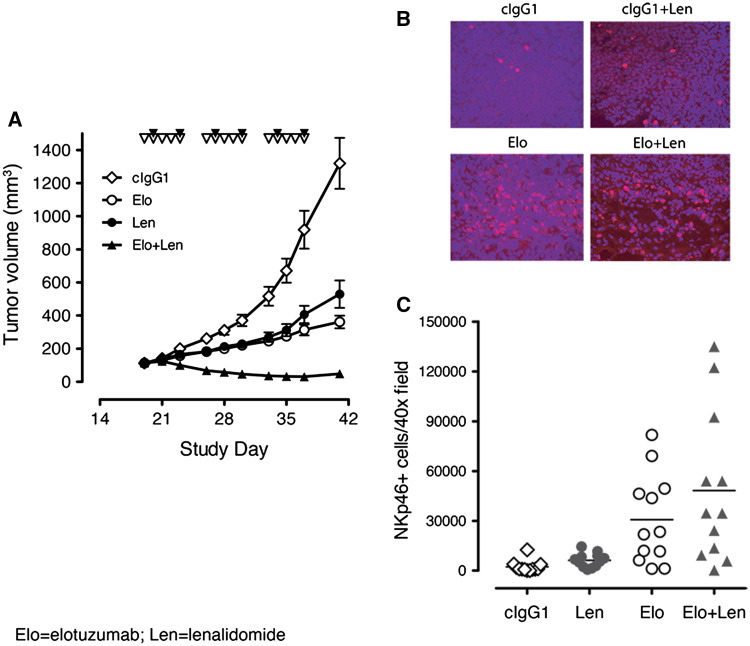
Fig. 1
Fig. 1
Elotuzumab in combination with lenalidomide enhanced anti-myeloma activity in vivo. a Mice with established OPM2 xenograft tumors (average of ~100 mm2) were randomized into groups (n = 8/group) and treated with control IgG1 (cIgG1), elotuzumab (Elo), cIgG1 plus lenalidomide (cIgG1 + Len), or Elo + Len. Inverted empty triangles depict lenalidomide dosing; inverted filled triangles depict Elo dosing. Representative data from one of four independent studies are shown. cIgG1 versus Elo, Len, or Elo + Len, P < 0.05; Len or Elo versus Elo + Len, P < 0.05; Elo versus Len P > 0.05. b Immunofluorescence staining (magnification 400×) of frozen sections of OPM2 xenograft tumors for NKp46 cell infiltration (red) on day 1 post-dosing of cIgG1, Elo, cIgG1 + Len, or Elo + Len. Infiltration of NKp46 cells in OPM2 xenograft tumors was observed in mice treated with Elo or the Elo + Len combination. c Image analysis of NKp46 cell infiltration in OPM2 xenografts on day 1 post-dosing. Total amount of NKp46+ cell infiltrate (in arbitrary units) of each tumor was measured by image analysis software (Image-Pro Plus). Each symbol represents one field of image. Three 400× fields were randomly chosen from each tumor xenograft for image analysis. cIgG1 versus Elo, P < 0.01; Elo versus Elo + Len, P > 0.05
Fig. 2
Fig. 2
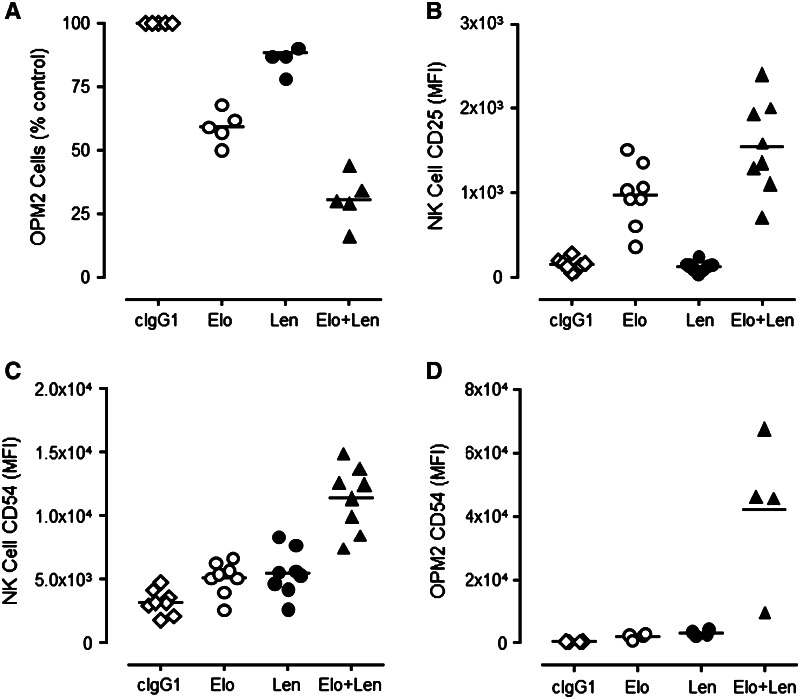
Elotuzumab plus lenalidomide combination enhanced myeloma cell killing and NK cell activation in PBL/myeloma cell co-cultures in vitro. Elotuzumab (Elo) plus lenalidomide (Len) significantly decreased myeloma cell (OPM2) counts compared with Elo (P < 0.01) or Len (P = 0.01) (n = 5) (a). Effect of Elo ± Len on CD25 (b) and ICAM-1 (c, d) expression on NK and OPM2 cells (n = 4–8). Elo + Len significantly enhanced both IL-2 Rα (P < 0.01 vs. Elo; P < 0.01 vs. Len) and ICAM-1 (P < 0.01 vs. Elo; P < 0.01 vs. Len) expression on NK and OPM2 cells more than either agent alone. Elo significantly induced IL-2 Rα (CD25) (P < 0.03) and ICAM-1 (CD54) (P < 0.01) expression on NK cells more than cIgG1-treated cultures. However, Len had little effect on IL-2 Rα expression (P > 0.05), but significantly increased ICAM-1 (P < 0.01) expression on NK cells. Neither agent alone had an effect on CD54 expression in OPM2 cells compared with cIgG1
Fig. 3
Fig. 3
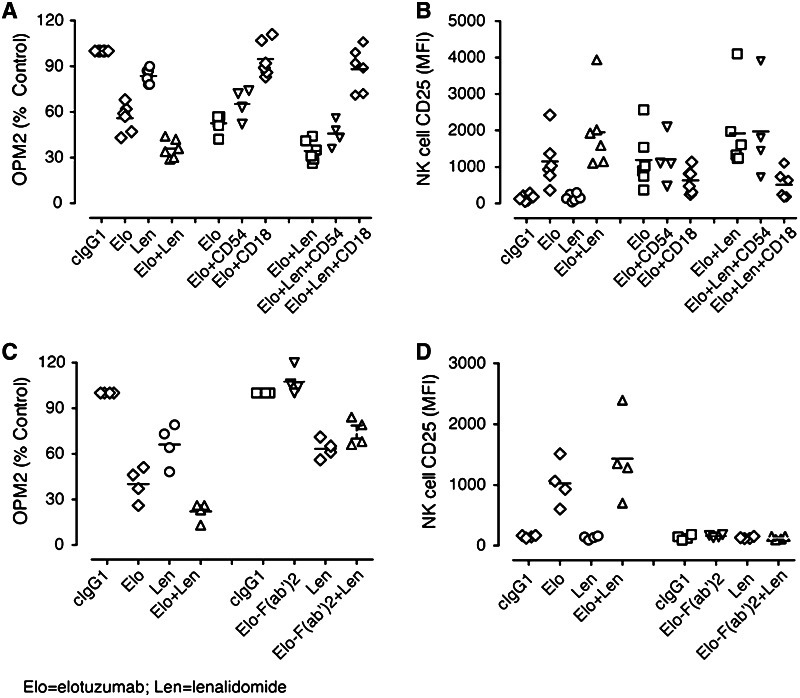
NK cell activation and myeloma killing are LFA-1 and CD16-dependent. a Inhibition of myeloma cell killing in PBL/myeloma cell co-cultures in the presence of anti-CD18 mAb (n = 6). Addition of anti-CD18 (LFA-1) mAb decreased myeloma cell killing in elotuzumab (Elo) plus lenalidomide (Len) (P < 0.01) and Elo (P = 0.01)-treated co-cultures more than control IgG1-treated cultures (labeled CD18/54). b Inhibition of CD25 upregulation on NK cells in PBL/myeloma cell co-cultures in the presence of anti-CD18 mAb (n = 6). Addition of anti-CD18 (LFA-1) mAb decreased CD25 upregulation on NK cells in Elo + Len (P < 0.01)- and Elo (P < 0.05)-treated cultures more than cIgG1-treated cultures. c Requirement of Fc–FcR interaction for Elo-mediated myeloma cell killing (n = 4). Elo-F(ab′)2 did not mediate myeloma cell killing as compared to Elo alone (P > 0.05), nor did it increase myeloma cell inhibition by Len. d Elo-mediated CD25 upregulation on NK cells requires Fc–FcR interaction. Elo-F(ab′)2 did not stimulate the upregulation of CD25 as compared with Elo alone (P > 0.05) or in combination with Len
Fig. 4
Fig. 4
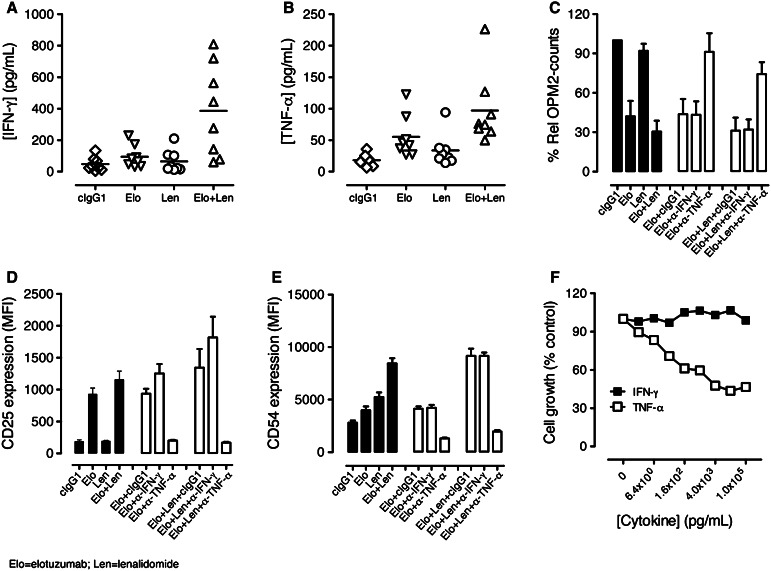
TNF-α and IFN-γ secretion induced by elotuzumab (Elo) in combination with lenalidomide (Len). TNF-α stimulated NK cell activation and myeloma cell killing. (Elo) plus (Len) enhanced a soluble IFN-γ (n = 8) and b TNF-α (n = 8) cytokines in the PBL/myeloma cell co-cultures as determined by Luminex assays. Elo + Len significantly enhanced soluble IFN-γ (P < 0.05 vs. Elo; P < 0.05 vs. Len) and TNF-α (P < 0.05 vs. Elo; P < 0.01 vs. Len) cytokines as compared with either agent alone. c Neutralization of TNF-α (n = 4), but not IFN-γ (n = 4), significantly inhibited myeloma cell killing (P < 0.02 for Elo + anti-TNF-α vs. Elo + cIgG1; P < 0.01 for Elo + Len + anti-TNF-α vs. Elo + Len + cIgG1). d Neutralization of TNF-α (n = 4), but not IFN-γ (n = 4), significantly decreased CD25 expression on NK cells (P < 0.01 for Elo + anti-TNF-α vs. Elo + cIgG1; P < 0.05 for Elo + Len + anti-TNF-α vs. Elo + Len + cIgG1). e Neutralization of TNF-α (n = 4) but not IFN-γ (n = 4) significantly affected CD54 expression on NK cells (P < 0.01 for Elo + anti-TNF-α vs. Elo + cIgG1; P < 0.01 for Elo + Len + anti-TNF-α vs. Elo + Len + cIgG1). f Dose-dependent inhibition of myeloma cell growth in the presence of titrated doses of TNF-α, but not IFN-γ, on myeloma cells as determined in Alamar blue assays on day 4 in vitro. Data are shown from one of two independent experiments
Fig. 5
Fig. 5
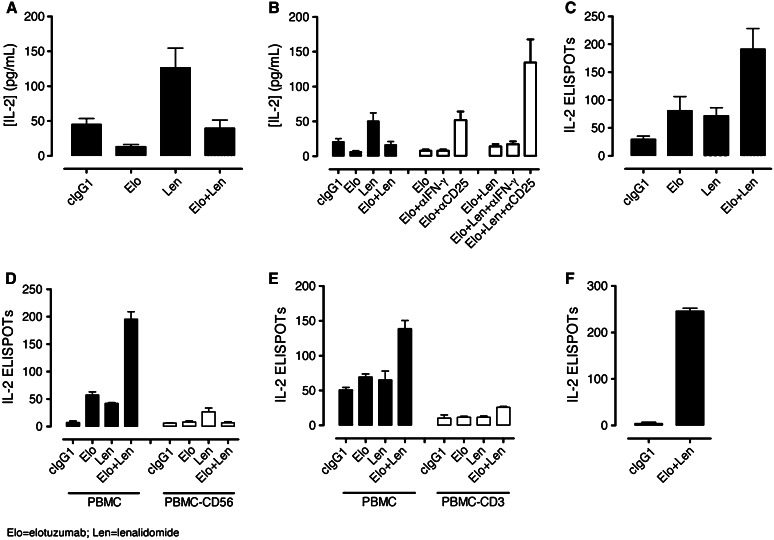
Increased production and consumption of IL-2 stimulated by the combination of elotuzumab (Elo) and lenalidomide (Len). NKT cells are the source of IL-2 in PBL/myeloma co-cultures. a Determination of soluble IL-2 levels in co-cultures by Luminex assays (n = 17). (Len) plus cIgG1 induced higher levels of IL-2 than cIgG1 cultures (P < 0.001). IL-2 levels were decreased in (Elo) (P < 0.01 vs. cIgG1) as well as Elo + Len (P < 0.01 vs. Len + cIgG1) cultures. b Addition of blocking antibodies to IL-2Rα (CD25), but not IFN-γ, increased the accumulation of soluble IL-2 levels in Elo (P < 0.01 vs. Elo + cIgG1) or Elo + Len (P < 0.01 vs. Elo + Len + cIgG1) cultures (n = 6). c Determination of IL-2 ELISPOTs in co-cultures (n = 9). A higher frequency of IL-2 ELISPOTs was observed in Elo + Len compared with Elo (P < 0.01)- or Len (P < 0.01)-treated co-cultures. Significant increase in the frequency of IL-2-secreting cells was observed in Elo (P < 0.05) and Len (P < 0.05) compared with cIgG1 co-cultures. d Depletion of CD56+ cells significantly decreased IL-2 ELISPOTs in Elo + Len co-cultures (P < 0.01 for PBMC vs. PBMC-CD56 lymphocytes) (n = 3). e Depletion of CD3+ cells significantly decreased IL-2 ELISPOTs in Elo + Len co-cultures (P < 0.01 for PBL vs. PBL-CD3 lymphocytes) (n = 3). f Detection of IL-2 ELISPOTs with FACS-sorted CD3+CD56+ cells from Elo + Len but not from cIgG1-treated co-cultures (n = 1)
Fig. 6
Fig. 6
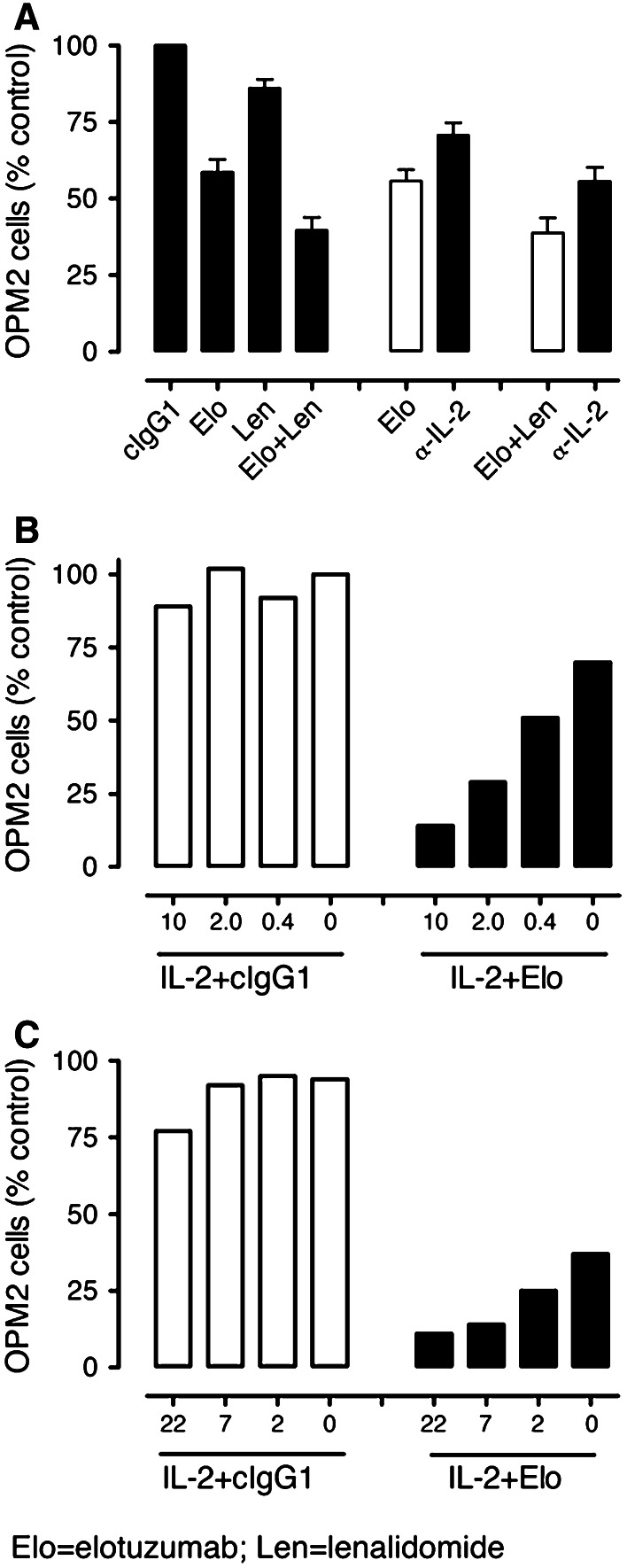
IL-2 contributes to the anti-myeloma activity of elotuzumab (Elo) in combination with lenalidomide (Len). a Neutralization of IL-2 with an anti-IL-2 mAb decreases myeloma cell killing in Elo (P < 0.05 vs. Elo + cIgG1)- or Elo + Len (P < 0.01 vs. Elo + Len + cIgG1)-treated PBL/myeloma cell co-cultures on day 3 (n = 7). Enhancement of myeloma cell killing by graded doses of IL-2 (units/mL) in myeloma cell co-cultures with b PBL or c purified NK cells at 24 h. Representative data from one of the three donors is shown b, c

References

    1. Palumbo A, Anderson K. Multiple myeloma. N Engl J Med. 2011;364:1046–1060. doi: 10.1056/NEJMra1011442. - DOI - PubMed
    1. Richardson PG, Lonial S, Jakubowiak AJ, Harousseau JL, Anderson KC. Monoclonal antibodies in the treatment of multiple myeloma. Br J Haematol. 2011;154:745–754. doi: 10.1111/j.1365-2141.2011.08790.x. - DOI - PubMed
    1. Wang M, Dimopoulos MA, Chen C, Cibeira MT, Attal M, Spencer A, Rajkumar SV, Yu Z, Olesnyckyj M, Zeldis JB, Knight RD, Weber DM. Lenalidomide plus dexamethasone is more effective than dexamethasone alone in patients with relapsed or refractory multiple myeloma regardless of prior thalidomide exposure. Blood. 2008;112:4445–4451. doi: 10.1182/blood-2008-02-141614. - DOI - PubMed
    1. Gandhi AK, Kang J, Capone L, Parton A, Wu L, Zhang LH, Mendy D, Lopez-Girona A, Tran T, Sapinosa L, Fang W, Xu S, Hampton G, Bartlett JB, Schafer P. Dexamethasone synergizes with lenalidomide to inhibit multiple myeloma tumor growth, but reduces lenalidomide-induced immunomodulation of T and NK cell function. Curr Cancer Drug Targets. 2010;10:155–167. doi: 10.2174/156800910791054239. - DOI - PubMed
    1. Dredge K, Horsfall R, Robinson SP, Zhang LH, Lu L, Tang Y, Shirley MA, Muller G, Schafer P, Stirling D, Dalgleish AG, Bartlett JB. Orally administered lenalidomide (CC-5013) is anti-angiogenic in vivo and inhibits endothelial cell migration and Akt phosphorylation in vitro. Microvasc Res. 2005;69:56–63. doi: 10.1016/j.mvr.2005.01.002. - DOI - PubMed

Publication types

MeSH terms