Review
. 2014 Oct;94(4):991-1026.
doi: 10.1152/physrev.00004.2014.

Regulation and function of adult neurogenesis: from genes to cognition

Affiliations
Review

Regulation and function of adult neurogenesis: from genes to cognition

James B Aimone et al. Physiol Rev. 2014 Oct.

Abstract

Adult neurogenesis in the hippocampus is a notable process due not only to its uniqueness and potential impact on cognition but also to its localized vertical integration of different scales of neuroscience, ranging from molecular and cellular biology to behavior. This review summarizes the recent research regarding the process of adult neurogenesis from these different perspectives, with particular emphasis on the differentiation and development of new neurons, the regulation of the process by extrinsic and intrinsic factors, and their ultimate function in the hippocampus circuit. Arising from a local neural stem cell population, new neurons progress through several stages of maturation, ultimately integrating into the adult dentate gyrus network. The increased appreciation of the full neurogenesis process, from genes and cells to behavior and cognition, makes neurogenesis both a unique case study for how scales in neuroscience can link together and suggests neurogenesis as a potential target for therapeutic intervention for a number of disorders.


Figures

FIGURE 1.
FIGURE 1.
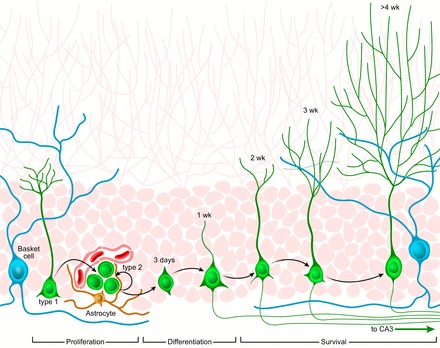
Illustration of the development of dentate gyrus granule cells from stem cells to fully mature neurons. New neurons arise from two populations of primitive cells, the slowly dividing type 1 cells, also known as radial glial cells, and the more rapidly amplifying type 2 neural progenitor cells. Over the next few weeks, cells differentiate into neurons, slowly developing dendritic arborizations and axonal projections. Between 2 and 3 wk of age, new neurons begin to receive excitatory input from cortical perforant path axons, and by 4–8 wk, their physiology and anatomy begin to approach those of fully mature neurons.
FIGURE 2.
FIGURE 2.
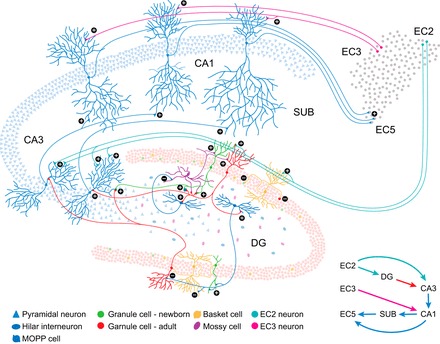
Anatomy of hippocampal circuit into which new neurons integrate. Neurogenesis is localized to the dentate gyrus (DG) region, where only excitatory granule cells are continually produced throughout life. The DG has a complex local circuitry, with both inhibitory interneurons and excitatory feedback neurons (mossy cells) participating in the network's behavior. Granule cells in the DG project to the CA3 region, which in addition to a robust recurrent connection then projects to the CA1 region. The CA1 then projects back to the entorhinal cortex and subiculum regions, closing the “hippocampal loop.”
FIGURE 3.
FIGURE 3.
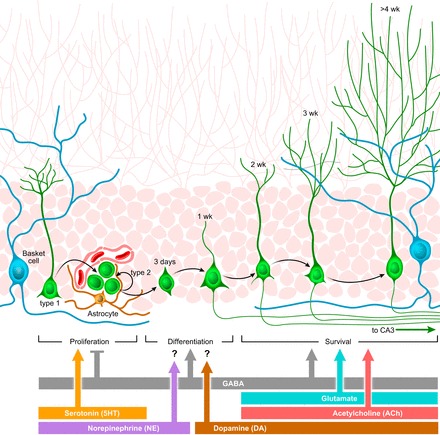
Regulation of neurogenesis by local circuit factors. Each of the three stages of neurogenesis–proliferation, differentiation, and survival–is a target of regulation by network factors. Local GABA, the primary inhibitory neurotransmitter in the brain, appears to suppress proliferation while inducing differentiation and survival. Glutamate, the primary excitatory neurotransmitter, is necessary for proper survival as well. Modulatory neurotransmitters, which have been implicated in numerous mental health conditions, appear to regulate different parts of the process; for instance, serotonin induces proliferation, whereas acetylcholine is necessary for proper maturation and survival.
FIGURE 4.
FIGURE 4.
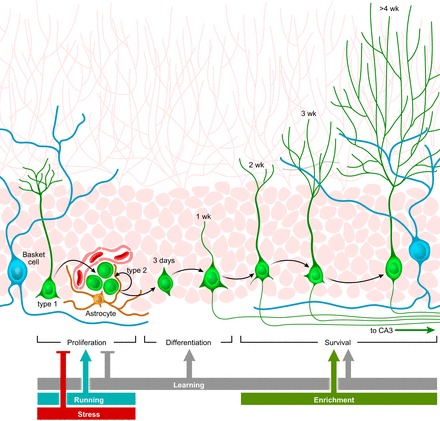
Regulation of neurogenesis by behaviors. Neurogenesis is regulated by many behavioral factors as well. Running is one of the most potent inducers of neurogenesis, targeting the proliferation of neural progenitor cells. Enrichment has a complementary effect, increasing the survival of neurons at a critical stage of their maturation. In contrast, stress is a severe negative regulator of new neuron birth, suppressing proliferation. The effects of learning are more complex, suppressing the neurogenesis process at some stages while increasing it at other stages.
FIGURE 5.
FIGURE 5.
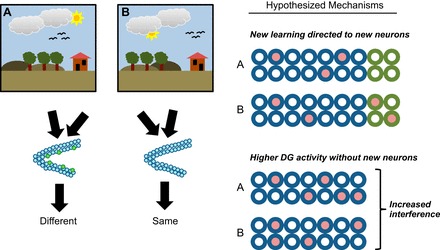
Pattern separation theory for the neurogenic dentate gyrus. Left: illustration of the cognitive phenomenon of pattern separation. Two events, consisting of highly similar objects and configurations, can be learned to be different if neurogenesis is present in the DG, whereas without neurogenesis the memories will be the same. Right: potential mechanisms for how neurogenesis may improve pattern separation. Top right: having new neurons available can permit the second event to utilize new neurons instead of the same old neurons to encode the differences in contexts. Bottom right: an alternative mechanism is that reducing neurogenesis increases the baseline activity of mature granule cells, leading to higher statistical overlap (and thus interference) between representations.
FIGURE 6.
FIGURE 6.
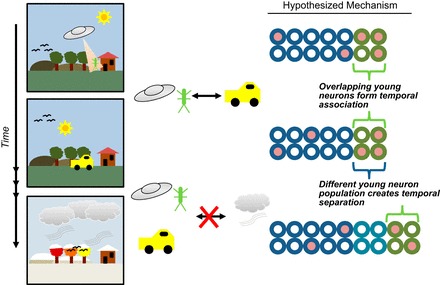
Temporal coding theory for the neurogenic dentate gyrus. Left: illustration of the cognitive phenomenon of temporal episodic coding. Two events with very little similarity occur within a few days of each other (an unexpected “visitor” coming and buying a new truck). The temporal proximity of these events is sufficient to lead to a relationship in their long-term episodic memories. In contrast, another event several months later (a major snow storm) would not be associated due to the time elapsed. Right: mechanism for temporal coding by new neurons. The two temporally close events would activate separate populations of mature granule cells (pattern separation) but would use overlapping populations of immature neurons (pattern integration). This overlap is time dependent; as time passes, the immature neuron population matures and another set of young neurons appears to encode future events. This effectively increases separation for events far apart in time.
FIGURE 7.
FIGURE 7.
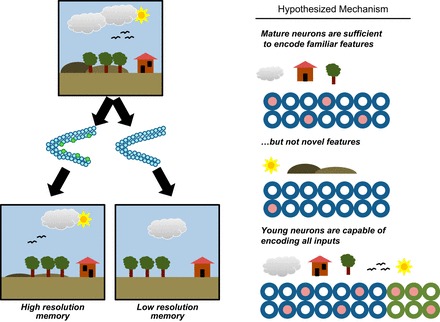
Memory resolution theory for the neurogenic dentate gyrus. Left: illustration of different resolution memories. All events that are remembered have a number of features that are not encoded. In a “high-resolution” memory, more details about the event are remembered; while the memory may not be perfect, it is much higher fidelity. In a “low-resolution” memory, less about the original event is encoded within memory, perhaps focusing on a lower number of features or coarse representations (“tree” instead of “maple tree”). Right: mechanism for increasing memory resolution by neurogenesis. Mature neurons and young neurons encode different types of information; mature neurons are powerful at representing what they have encoded in the past, whereas young neurons are capable of encoding novel events. The combination of both populations facilitates the encoding of more features robustly within memories.

References

    1. Abrous DN, Adriani W, Montaron MF, Aurousseau C, Rougon G, Le Moal M, Piazza PV. Nicotine self-administration impairs hippocampal plasticity. J Neurosci 22: 3656–3662, 2002. - PMC - PubMed
    1. Aimone JB, Deng W, Gage FH. Adult neurogenesis: integrating theories and separating functions. Trends Cogn Sci 14: 325–337, 2010. - PMC - PubMed
    1. Aimone JB, Deng W, Gage FH. Put them out to pasture? What are old granule cells good for, anyway? Hippocampus 20: 1124–1125, 2010. - PubMed
    1. Aimone JB, Deng W, Gage FH. Resolving new memories: a critical look at the dentate gyrus, adult neurogenesis, and pattern separation. Neuron 70: 589–596, 2011. - PMC - PubMed
    1. Aimone JB, Gage FH. Modeling new neuron function: a history of using computational neuroscience to study adult neurogenesis. Eur J Neurosci 33: 1160–1169, 2011. - PubMed

Publication types

LinkOut - more resources