


Are multifaceted interventions more effective than single-component interventions in changing health-care professionals' behaviours? An overview of systematic reviews
- PMID: 25287951
- PMCID: PMC4194373
- DOI: 10.1186/s13012-014-0152-6
Are multifaceted interventions more effective than single-component interventions in changing health-care professionals' behaviours? An overview of systematic reviews
Abstract
Background: One of the greatest challenges in healthcare is how to best translate research evidence into clinical practice, which includes how to change health-care professionals' behaviours. A commonly held view is that multifaceted interventions are more effective than single-component interventions. The purpose of this study was to conduct an overview of systematic reviews to evaluate the effectiveness of multifaceted interventions in comparison to single-component interventions in changing health-care professionals' behaviour in clinical settings.
Methods: The Rx for Change database, which consists of quality-appraised systematic reviews of interventions to change health-care professional behaviour, was used to identify systematic reviews for the overview. Dual, independent screening and data extraction was conducted. Included reviews used three different approaches (of varying methodological robustness) to evaluate the effectiveness of multifaceted interventions: (1) effect size/dose-response statistical analyses, (2) direct (non-statistical) comparisons of multifaceted to single interventions and (3) indirect comparisons of multifaceted to single interventions.
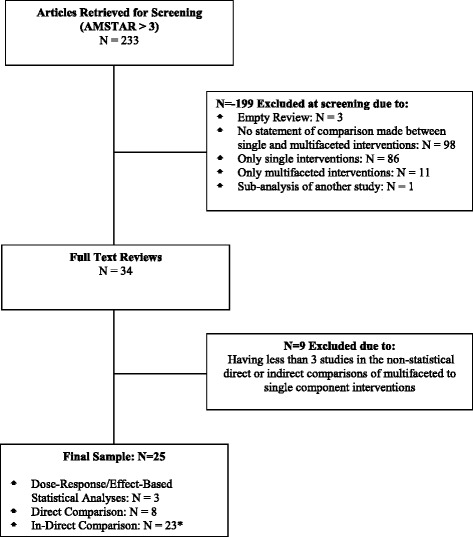
Results: Twenty-five reviews were included in the overview. Three reviews provided effect size/dose-response statistical analyses of the effectiveness of multifaceted interventions; no statistical evidence of a relationship between the number of intervention components and the effect size was found. Eight reviews reported direct (non-statistical) comparisons of multifaceted to single-component interventions; four of these reviews found multifaceted interventions to be generally effective compared to single interventions, while the remaining four reviews found that multifaceted interventions had either mixed effects or were generally ineffective compared to single interventions. Twenty-three reviews indirectly compared the effectiveness of multifaceted to single interventions; nine of which also reported either a statistical (dose-response) analysis (N = 2) or a non-statistical direct comparison (N = 7). The majority (N = 15) of reviews reporting indirect comparisons of multifaceted to single interventions showed similar effectiveness for multifaceted and single interventions when compared to controls. Of the remaining eight reviews, six found single interventions to be generally effective while multifaceted had mixed effectiveness.
Conclusion: This overview of systematic reviews offers no compelling evidence that multifaceted interventions are more effective than single-component interventions.
Figures
References
-
- IOM (Institute of Medicine) Clinical Practice Guidelines We Can Trust. Washington, D.C: The National Academies Press; 2011.
-
- Davies H, Powell A, Rushmer R. Healthcare Professionals’ Views on Clinician Engagement in Quality Improvement: a Literature Review. London: The Health Foundation; 2007.
-
- Grol R, Wensing M, Eccels M, Davis D. Improving Patient Care: the Implementation of Change in Health Care. 2. Boston: Wiley; 2013.
Publication types
MeSH terms
Grants and funding
LinkOut - more resources
Full Text Sources
Other Literature Sources
