


A randomized controlled trial of gonadotropin-releasing hormone agonist versus gonadotropin-releasing hormone antagonist in Iranian infertile couples: oocyte gene expression
- PMID: 25288473
- PMCID: PMC4197229
- DOI: 10.1186/s40199-014-0067-4
A randomized controlled trial of gonadotropin-releasing hormone agonist versus gonadotropin-releasing hormone antagonist in Iranian infertile couples: oocyte gene expression
Abstract
Background: The main objective of the present work was to compare the effects of the gonadotropin-releasing hormone agonist (GnRH-a) and GnRH antagonist (GnRH-ant) on the gene expression profiles of oocytes obtained from Iranian infertile couples undergoing in vitro fertilization (IVF).
Methods: Fifty infertile couples who underwent IVF between June 2012 and November 2013 at the Infertility Center of Tehran Women General Hospital, Tehran University of Medical Sciences, were included in this study. We included women that had undergone IVF treatment because of male factor, tubal factor, or unexplained infertility. The women randomly underwent controlled ovarian stimulation (COS) with either the GnRH-a (n = 26) or the GnRH-ant (n = 24). We obtained 50 germinal vesicle (GV) oocytes donated by women in each group. After the sampling, pool of 50 GV oocytes for each group was separately analyzed by quantitative polymerase chain reaction (qPCR).
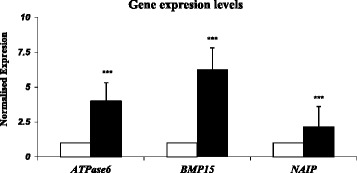
Result: The expression levels of Adenosine triphosphatase 6 (ATPase 6), Bone morphogenetic protein 15 (BMP15), and Neuronal apoptosis inhibitory protein (NAIP) genes were significantly upregulated in the GnRH-ant group compared to the GnRH-a group, with the fold change of 3.990 (SD ± 1.325), 6.274 (SD ± 1.542), and 2.156 (SD ± 1.443), respectively, (P < 0.001). Growth differentiation factor 9 (GDF9) mRNA did not have any expression in the GnRH-a group; however, GDF9 mRNA was expressed in the GnRH-ant group. Finally, it was found that the genes involved in the DNA repairing and cell cycle checkpoint did not have any expression in either group.
Conclusion: The present study showed, for the first time, the expression levels of genes involved in the cytoplasmic maturity (BMP15, GDF9), adenosine triphosphate production (ATPase 6), and antiapoptotic process (NAIP), in human GV oocytes were significantly higher in the GnRH-anta group than in the GnRH-a group in COS. Higher expression level of these genes when GnRH-ant protocol is applied, this protocol seems to be a more appropriate choice for women with poly cystic ovarian syndrome, because it can probably improve the expression of the aforementioned genes.
Trial registration: Current Controlled Trials: IRCT 2014031112307 N3.
Figures
References
-
- Marci R, Graziano A, Lo Monte G, Piva I, Soave I, Marra E, Lisi F, Moscarini M, Caserta D. GnRH antagonists in assisted reproductive techniques: a review on the Italian experience. Eur Rev Med Pharmacol Sci. 2013;17:853–873. - PubMed
-
- Johnston-MacAnanny EB, DiLuigi AJ, Engmann LL, Maier DB, Benadiva CA, Nulsen JC. Selection of first in vitro fertilization cycle stimulation protocol for good prognosis patients: gonadotropin releasing hormone antagonist versus agonist protocols. J Reprod Med. 2011;56:12–16. - PubMed
Publication types
MeSH terms
Substances
Associated data
LinkOut - more resources
Full Text Sources
Other Literature Sources
Medical
