. 2014 Oct 21;111(42):15202-7.
doi: 10.1073/pnas.1409836111. Epub 2014 Oct 6.

Bloom of resident antibiotic-resistant bacteria in soil following manure fertilization

Affiliations

Bloom of resident antibiotic-resistant bacteria in soil following manure fertilization

Nikolina Udikovic-Kolic et al. Proc Natl Acad Sci U S A. .

Abstract

The increasing prevalence of antibiotic-resistant bacteria is a global threat to public health. Agricultural use of antibiotics is believed to contribute to the spread of antibiotic resistance, but the mechanisms by which many agricultural practices influence resistance remain obscure. Although manure from dairy farms is a common soil amendment in crop production, its impact on the soil microbiome and resistome is not known. To gain insight into this impact, we cultured bacteria from soil before and at 10 time points after application of manure from cows that had not received antibiotic treatment. Soil treated with manure contained a higher abundance of β-lactam-resistant bacteria than soil treated with inorganic fertilizer. Functional metagenomics identified β-lactam-resistance genes in treated and untreated soil, and indicated that the higher frequency of resistant bacteria in manure-amended soil was attributable to enrichment of resident soil bacteria that harbor β-lactamases. Quantitative PCR indicated that manure treatment enriched the blaCEP-04 gene, which is highly similar (96%) to a gene found previously in a Pseudomonas sp. Analysis of 16S rRNA genes indicated that the abundance of Pseudomonas spp. increased in manure-amended soil. Populations of other soil bacteria that commonly harbor β-lactamases, including Janthinobacterium sp. and Psychrobacter pulmonis, also increased in response to manure treatment. These results indicate that manure amendment induced a bloom of certain antibiotic-resistant bacteria in soil that was independent of antibiotic exposure of the cows from which the manure was derived. Our data illustrate the unintended consequences that can result from agricultural practices, and demonstrate the need for empirical analysis of the agroecosystem.

Keywords: dairy cow manure; β-lactam antibiotics.


Conflict of interest statement

The authors declare no conflict of interest.

Figures
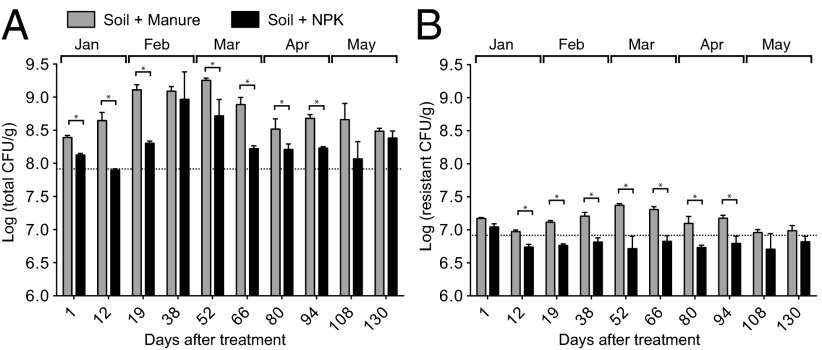
Fig. 1.
Fig. 1.
Effects of manure on the abundances of culturable soil bacteria. Dynamics of total (A) and cephalothin-resistant (B) culturable bacteria in soil after treatment with manure or inorganic fertilizer (NPK). Each value is the mean ± SD of three replicates. All time points, except day 38, revealed significantly more culturable CFU in manure-treated soil until day 94 after treatment (*P < 0.05, multiple t test). Dotted line indicates the average populations of total and resistant soil bacteria before treatment.
Fig. 2.
Fig. 2.
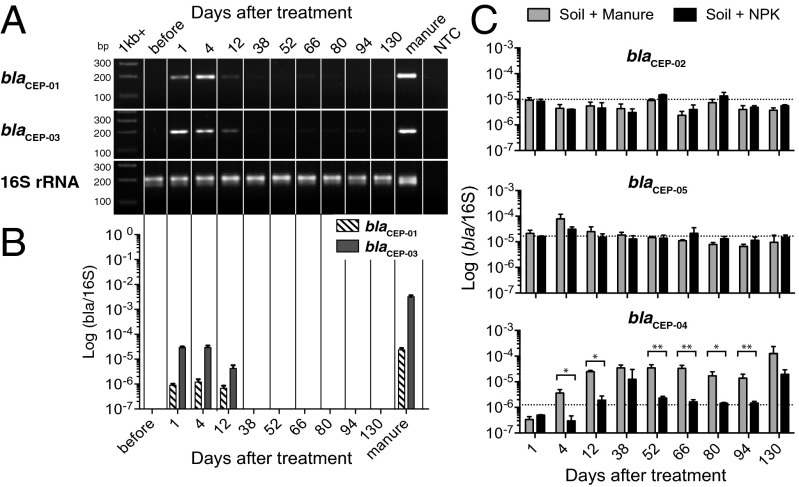
Dynamics of manure-derived and soil-derived β-lactamases in soil after treatment with manure or NPK. (A and B) End-point PCR amplification (A) and qPCR amplification (B) of β-lactamases blaCEP-01 and blaCEP-03 identified from manure in soil. (C) Dynamics of the relative abundance of the β-lactamases blaCEP-02, blaCEP-05, and blaCEP-04 in soil after treatment with manure or inorganic fertilizer (NPK) measured by qPCR. Each value is the mean ± SD of three biological replicates calculated from three technical replicates of each. The dotted line indicates the average number of gene copies before treatment. Significance (P < 0.05) indicated by one-way ANOVA is indicated with asterisks. None of the genes presented here were detected in manure samples.
Fig. 3.
Fig. 3.
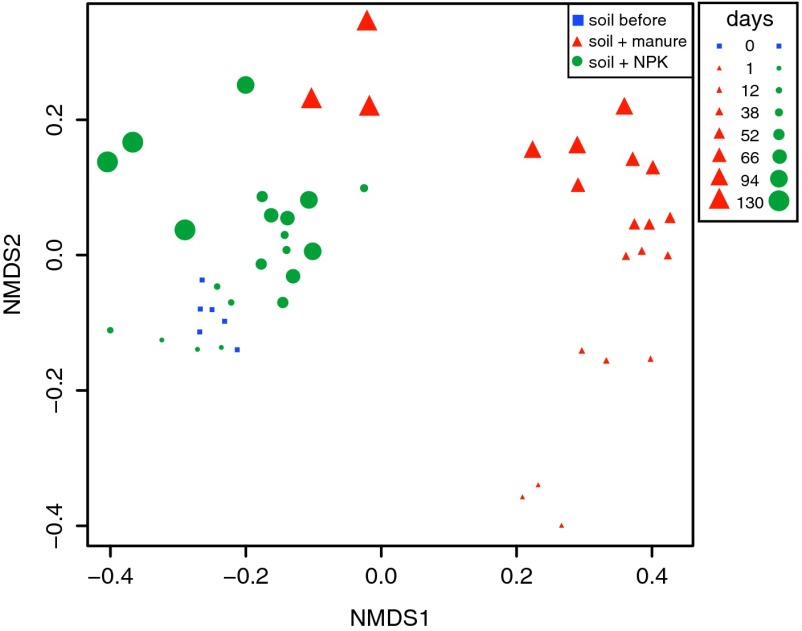
Temporal changes in soil community structures before treatment and after treatment with manure or NPK. Bray–Curtis similarity coefficients were calculated from relative OTU abundances of bacterial soil communities across three biological replicates of soil before treatment, treated with manure or treated with inorganic fertilizer (NPK), and plotted on a nonmetric multidimensional scaling (NMDS) graph. The 2D stress was 0.12. Increasing symbol size indicates time since manure treatment. Treatment effects were significant in all adonis combinations (P < 0.001; soil and manure-treated communities, R2 = 13%; soil before treatment and manure-treated communities, R2 = 15%; soil before and NPK-treated communities, R2 = 6%).
Fig. 4.
Fig. 4.
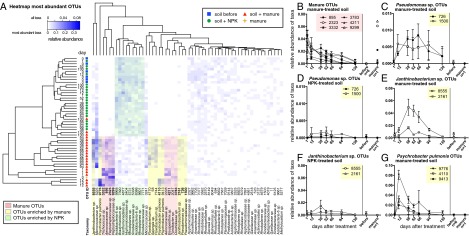
Dynamics of the most abundant OTUs and β-lactamase harboring OTUs in response to treatment with manure or NPK. (A) Heat map of the relative abundance of the 59 most abundant OTUs composing more than 10% across all 49 samples. OTUs with similar occurrence patterns are highlighted with the same colors. The OTUs in bold type were inspected more closely. (B) Relative abundance of manure OTUs found in soil. (C) Relative abundance of three P. pulmonis OTUs enriched in manure-treated soil. (D) Relative abundance of two Pseudomonadaceae OTUs enriched in soil after manure treatment. (E) Relative abundance of two Pseudomonadaceae OTUs in soil treated with inorganic fertilizer (NPK). (F) Relative abundance of two Janthinobacterium OTUs enriched in soil after manure treatment. (G) Relative abundance of two Janthinobacterium OTUs in soil treated with NPK. P. pulmonis OTUs were not detected in NPK-treated soils, nor were they found in manure. Unless stated otherwise, all means and SDs were calculated from three biological replicates.

References

    1. 65. Federal Register 246 (2000), pp 80548–80596.
    1. Heuer H, Smalla K. Manure and sulfadiazine synergistically increased bacterial antibiotic resistance in soil over at least two months. Environ Microbiol. 2007;9(3):657–666. - PubMed
    1. Heuer H, et al. Accumulation of sulfonamide resistance genes in arable soils due to repeated application of manure containing sulfadiazine. Appl Environ Microbiol. 2011;77(7):2527–2530. - PMC - PubMed
    1. Jechalke S, et al. Increased abundance and transferability of resistance genes after field application of manure from sulfadiazine-treated pigs. Appl Environ Microbiol. 2013;79(5):1704–1711. - PMC - PubMed
    1. Marti R, et al. Impact of manure fertilization on the abundance of antibiotic-resistant bacteria and frequency of detection of antibiotic resistance genes in soil and on vegetables at harvest. Appl Environ Microbiol. 2013;79(18):5701–5709. - PMC - PubMed

Publication types

LinkOut - more resources