


Clinical significance of mismatch repair gene expression in sporadic colorectal cancer
- PMID: 25289032
- PMCID: PMC4186363
- DOI: 10.3892/etm.2014.1927
Clinical significance of mismatch repair gene expression in sporadic colorectal cancer
Abstract
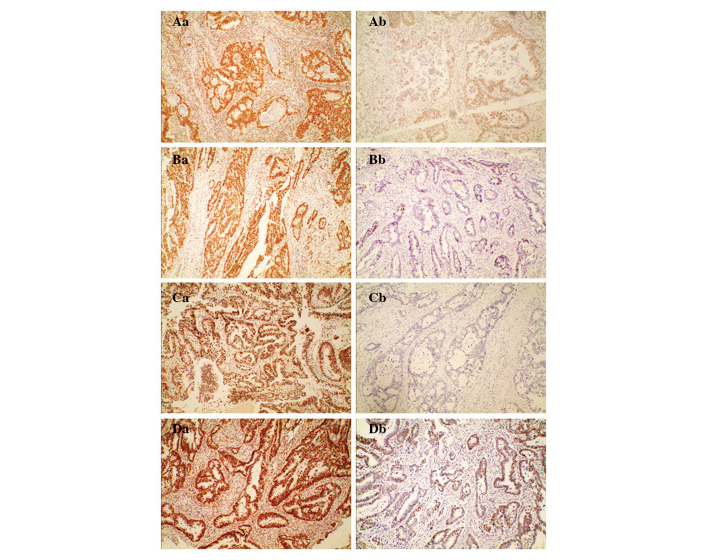
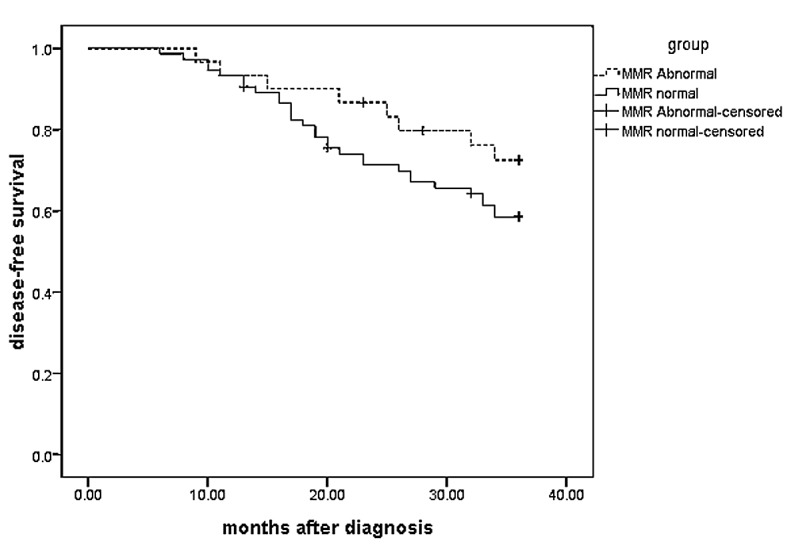
Mismatch repair (MMR) genes play an important role in the occurrence and development of sporadic colorectal cancer; however, the effect of MMR genes on clinicopathological features and prognosis remains unclear. The aim of the present study was to observe the clinical significance of MMR gene expression in sporadic colorectal cancer. Clinicopathological data and postoperative samples from 404 patients with sporadic colorectal cancer were obtained from the Affiliated Tumor Hospital of Xinjiang Medical University. The immunohistochemistry PV-9000 two-step method was performed to measure the protein expression of human mutL homolog 1 (hMLH1), human mutS homolog (hMSH) 2, human postmeiotic segregation increased 2 (hPSM2) and hMSH6. Differences in clinicopathological features, family history and survival time subsequent to surgery between groups with normal and aberrant MMR protein (MMRP) expression were compared. A total of 27.23% of all patients showed aberrant nuclear staining of MMRP. Among the patients with aberrant MMRP expression, a higher proportion of patients showed aberrant expression of more than one type of MMRP than aberrant expression of only one type of MMRP. Aberrant expression of hMLH1/hPSM2 was most commonly observed (29/404). In addition, aberrant MMRP expression in colorectal cancer was indicated predominantly in the right hemicolon. Histological type primarily showed mucinous adenocarcinoma. In addition, with increasing body mass index (BMI), the MMRP deficiency rate was also shown to increase gradually. There was a close association between MMRP expression deficiency and family history of cancer (P<0.05). For TNM stage III patients, the Kaplan-Meier survival curve showed that the aberrant MMRP expression group had a three-year disease-free survival (DFS) rate of 66.67%, which was longer than the DFS rate of the normal group (55.41%), with no statistical difference (P>0.05). In conclusion, the immunohistochemistry PV-9000 two-step method can be used to measure MMRP expression in colorectal cancer. Aberrant MMRP expression is closely correlated with tumor location, histological type, BMI and tumor family history in sporadic colorectal cancer. Aberrant MMRP expression may have an effect on the prognosis of stage III patients.
Keywords: clinicopathological parameters; immunohistochemistry; mismatch repair genes; prognosis; sporadic colorectal cancer.
Figures
References
-
- Adib SM, Tabbal N, Hamadeh R, Ammar W. Geographic epidemiology in a small area: cancer incidence in Baakline, Lebanon, 2000–2008. East Mediterr Health J. 2013;19:320–326. - PubMed
-
- Van Engeland M, Derks S, Smits KM, et al. Colorectal cancer epigenetics: complex simplicity. J Clin Oncol. 2011;29:1382–1391. - PubMed
-
- Blokhuis MM, Pietersen GE, Goldberg PA, et al. Lynch syndrome: the influence of environmental factors on extracolonic cancer risk in hMLH1 c. C1528T mutation carriers and their mutation-negative sisters. Fam Cancer. 2010;9:357–363. - PubMed
-
- Fishel R, Lescoe MK, Rao MR, et al. The human mutator gene homolog MSH2 and its association with hereditary nonpolyposis colon cancer. Cell. 1993;75:1027–1038. - PubMed
-
- Aaltonen LA, Salovaara R, Kristo P, et al. Incidence of hereditary nonpolyposis colorectal cancer and the feasibility of molecular screening for the disease. N Engl J Med. 1998;338:1481–1487. - PubMed
LinkOut - more resources
Full Text Sources
Other Literature Sources