


MHC class I loss is a frequent mechanism of immune escape in papillary thyroid cancer that is reversed by interferon and selumetinib treatment in vitro
- PMID: 25294906
- PMCID: PMC4252612
- DOI: 10.1158/1078-0432.CCR-14-0879
MHC class I loss is a frequent mechanism of immune escape in papillary thyroid cancer that is reversed by interferon and selumetinib treatment in vitro
Abstract
Purpose: To evaluate MHC class I expression on papillary thyroid cancer (PTC) and analyze changes in MHC expression and associated immune activation with current and experimental treatments for thyroid cancer using in vitro PTC cell lines.
Experimental design: MHC class I expression and assessment of tumor-infiltrating leukocyte populations were evaluated by immunohistochemistry. PTC cell lines were analyzed for HLA-ABC expression by flow cytometry following tyrosine kinase inhibitor, IFNα or IFNγ, or radiation treatment. Functional changes in antigenicity were assessed by coculture of allogeneic donor peripheral blood leukocytes (PBL) with pretreated or untreated PTC cell lines and measurement of T-cell activation and cytokine production.
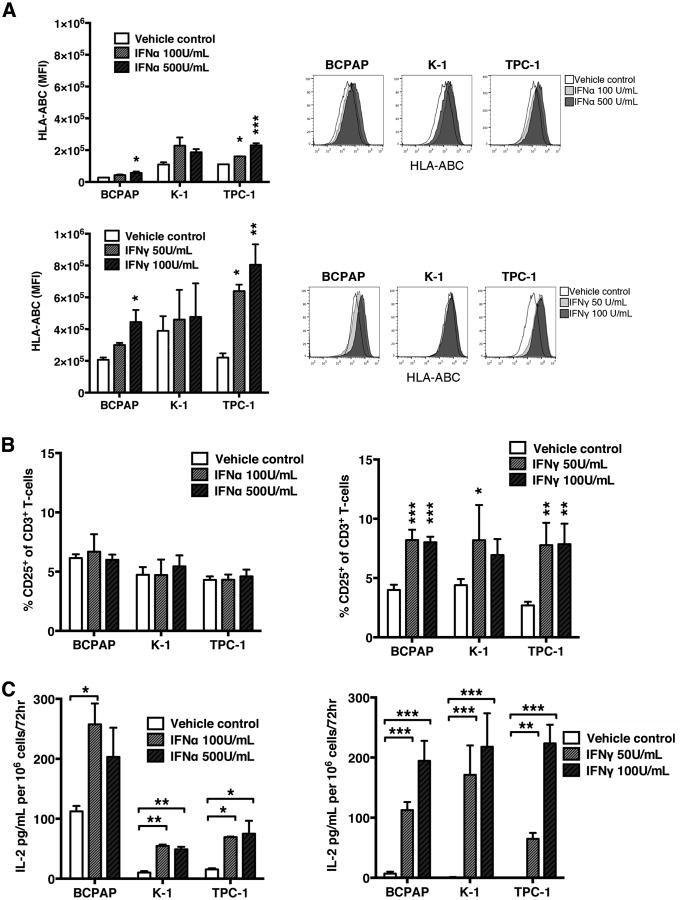
Results: Both MHC class I and β2-microglobulin expression was reduced or absent in 76% of PTC specimens and was associated with reduced tumor-infiltrating immune cells, including effector (CD3(+), CD8(+), CD16(+)) and suppressor (FoxP3(+)) populations. Treatment of PTC cell lines with the MEK1/2 inhibitor selumetinib or IFN increased HLA-ABC expression. This phenotypic change was associated with increased T-cell activation (%CD25(+) of CD3(+)) and IL2 production by PBL cocultured with treated PTC cell lines. Additive effects were seen with combination selumetinib and IFN treatment.
Conclusions: MHC class I expression loss is frequent in human PTC specimens and represents a significant mechanism of immune escape. Increased antigenicity following selumetinib and IFN treatment warrants further study for immunotherapy of progressive PTC.
©2014 American Association for Cancer Research.
Conflict of interest statement
All other authors have no conflicts of interest to declare.
Figures



References
-
- Siegel R, Naishadham D, Jemal A. Cancer statistics, 2013. CA Cancer J Clin. 2013;63:11–30. - PubMed
-
- Chen AY, Jemal A, Ward EM. Increasing incidence of differentiated thyroid cancer in the United States, 1988-2005. Cancer. 2009;115:3801–7. - PubMed
-
- Hay ID, Thompson GB, Grant CS, Bergstralh EJ, Dvorak CE, Gorman CA, et al. Papillary thyroid carcinoma managed at the Mayo Clinic during six decades (1940-1999): temporal trends in initial therapy and long-term outcome in 2444 consecutively treated patients. World J Surg. 2003;26:879–85. - PubMed
-
- American Thyroid Association (ATA) Guidelines Taskforce on Thyroid Nodules and Differentiated Thyroid Cancer. Cooper DS, Doherty GM, Haugen BR, Kloos RT, Lee SL, Mandel SJ, et al. Revised American Thyroid Association management guidelines for patients with thyroid nodules and differentiated thyroid cancer. Thyroid. 2009;19:1167–1214. - PubMed
Publication types
MeSH terms
Substances
Grants and funding
LinkOut - more resources
Full Text Sources
Other Literature Sources
Medical
Research Materials
Miscellaneous
