


Association between maternal exposure to di(2-ethylhexyl) phthalate and reproductive hormone levels in fetal blood: the Hokkaido study on environment and children's health
- PMID: 25296284
- PMCID: PMC4189794
- DOI: 10.1371/journal.pone.0109039
Association between maternal exposure to di(2-ethylhexyl) phthalate and reproductive hormone levels in fetal blood: the Hokkaido study on environment and children's health
Abstract
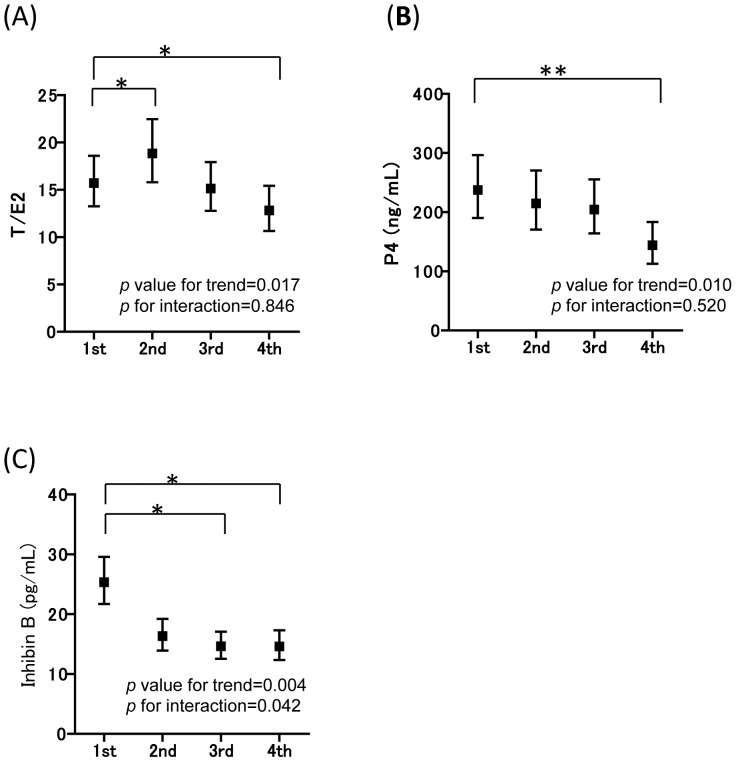
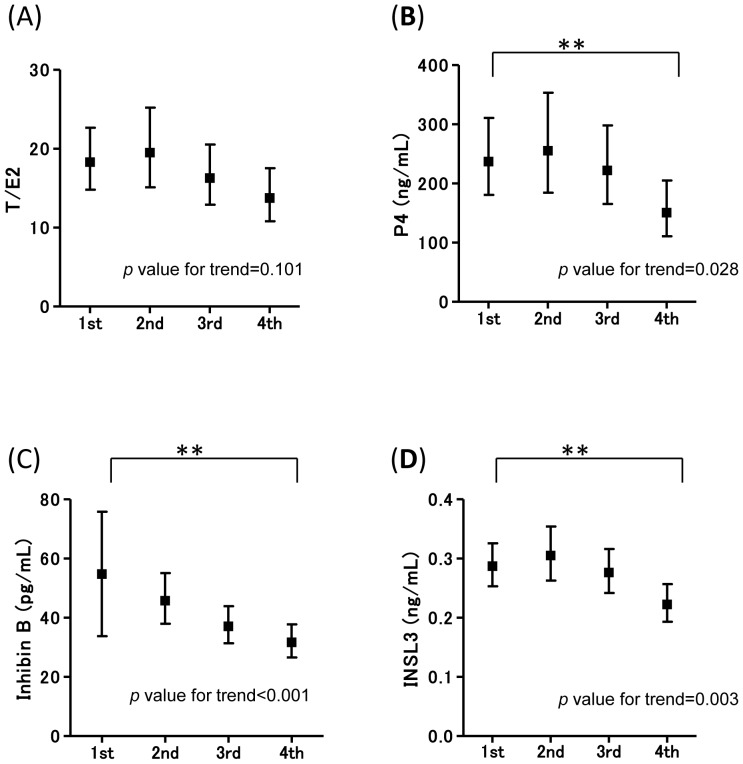
Prenatal di(2-ethylhexyl) phthalate (DEHP) exposure can produce reproductive toxicity in animal models. Only limited data exist from human studies on maternal DEHP exposure and its effects on infants. We aimed to examine the associations between DEHP exposure in utero and reproductive hormone levels in cord blood. Between 2002 and 2005, 514 pregnant women agreed to participate in the Hokkaido Study Sapporo Cohort. Maternal blood samples were taken from 23-35 weeks of gestation and the concentration of the primary metabolite of DEHP, mono(2-ethylhexyl) phthalate (MEHP), was measured. Concentrations of infant reproductive hormones including estradiol (E2), total testosterone (T), and progesterone (P4), inhibin B, insulin-like factor 3 (INSL3), steroid hormone binding globulin, follicle-stimulating hormone, and luteinizing hormone were measured from cord blood. Two hundred and two samples with both MEHP and hormones' data were included in statistical analysis. The participants completed a self-administered questionnaire regarding information on maternal characteristics. Gestational age, birth weight and infant sex were obtained from birth records. In an adjusted linear regression analysis fit to all study participants, maternal MEHP levels were found to be associated with reduced levels of T/E2, P4, and inhibin B. For the stratified analyses for sex, inverse associations between maternal MEHP levels T/E2, P4, inhibin B, and INSL3 were statistically significant for males only. In addition, the MEHP quartile model showed a significant p-value trend for P4, inhibin B, and INSL3 decrease in males. Since inhibin B and INSL3 are major secretory products of Sertoli and Leydig cell, respectively, the results of this study suggest that DEHP exposure in utero may have adverse effects on both Sertoli and Leydig cell development in males, which agrees with the results obtained from animal studies. Comprehensive studies investigating phthalates' exposure in humans, as well as their long-term effects on reproductive development are needed.
Conflict of interest statement
Figures
References
-
- Fromme H, Bolte G, Koch HM, Angerer J, Boehmer S, et al. (2007) Occurrence and daily variation of phthalate metabolites in the urine of an adult population. Int J Hyg Environ Health 210: 21–33. - PubMed
-
- Jonsson BA, Richthoff J, Rylander L, Giwercman A, Hagmar L (2005) Urinary phthalate metabolites and biomarkers of reproductive function in young men. Epidemiology 16: 487–493. - PubMed
-
- Koch HM, Drexler H, Angerer J (2004) Internal exposure of nursery-school children and their parents and teachers to di(2-ethylhexyl)phthalate (DEHP). Int J Hyg Environ Health 207: 15–22. - PubMed
-
- Wittassek M, Heger W, Koch HM, Becker K, Angerer J, et al. (2007) Daily intake of di(2-ethylhexyl)phthalate (DEHP) by german children - a comparison of two estimation models based on urinary DEHP metabolite levels. Int J Hyg Environ Health 210: 35–42. - PubMed
-
- Japan Plasticizer Industry Association and Ministry of Economy Trade and Industry (2012) Information of Japan plastizicer industies.
Publication types
MeSH terms
Substances
LinkOut - more resources
Full Text Sources
Other Literature Sources
Medical
