


Disparities in obesity among rural and urban residents in a health disparate region
- PMID: 25297840
- PMCID: PMC4198673
- DOI: 10.1186/1471-2458-14-1051
Disparities in obesity among rural and urban residents in a health disparate region
Abstract
Background: The burden of obesity and obesity-related conditions is not borne equally and disparities in prevalence are well documented for low-income, minority and rural adults in the United States. The current literature on rural versus urban disparities is largely derived from national surveillance data which may not reflect regional nuances. There is little practical research that supports the reality of local service providers such as county health departments that may serve both urban and rural residents in a given area. Conducted through a community-academic partnership, the primary aim of this study is to quantify the current levels of obesity (BMI), fruit and vegetable (FV) intake and physical activity (PA) in a predominately rural health disparate region. Secondary aims are to determine if a gradient exists within the region in which rural residents have poorer outcomes on these indicators compared to urban residents.
Methods: Conducted as part of a larger ongoing community-based participatory research (CBPR) initiative, data were gathered through a random digit dial telephone survey using previously validated measures (n = 784). Linear, logistic and quantile regression models are used to determine if residency (i.e. rural, urban) predicts outcomes of FV intake, PA and BMI.
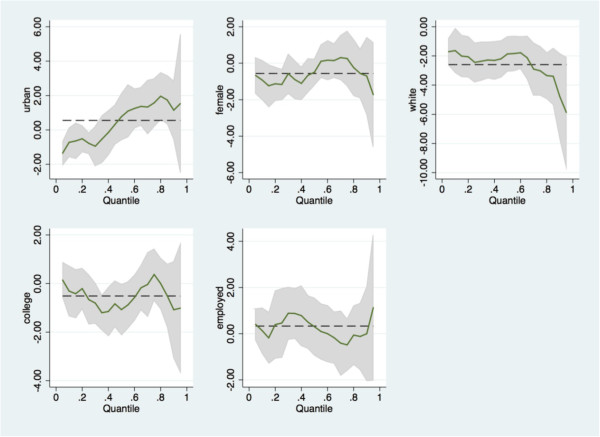
Results: The majority (72%) of respondents were overweight (BMI = 29 ± 6 kg/m2), with 29% being obese. Only 9% of residents met recommendations for FV intake and 38% met recommendations for PA. Statistically significant gradients between urban and rural and race exist at the upper end of the BMI distribution. In other words, the severity of obesity is worse among black compared to white and for urban residents compared to rural residents.
Conclusions: These results will be used by the community-academic partnership to guide the development of culturally relevant and sustainable interventions to increase PA, increase FV intake and reduce obesity within this health disparate region. In particular, local stakeholders may wish to address disparities in BMI by allocating resources to the vulnerable groups identified.
Figures
References
-
- U.S. Department of Health and Human Services. Office of Disease Prevention and Health Promotion: Healthy People 2020. Washington, DC;http://www.healthypeople.gov/2020/default.aspx - PubMed
Pre-publication history
-
- The pre-publication history for this paper can be accessed here:http://www.biomedcentral.com/1471-2458/14/1051/prepub
Publication types
MeSH terms
LinkOut - more resources
Full Text Sources
Other Literature Sources
Medical
Miscellaneous
