


Germ cell specification and pluripotency in mammals: a perspective from early embryogenesis
- PMID: 25298745
- PMCID: PMC4182624
- DOI: 10.1007/s12522-014-0184-2
Germ cell specification and pluripotency in mammals: a perspective from early embryogenesis
Abstract
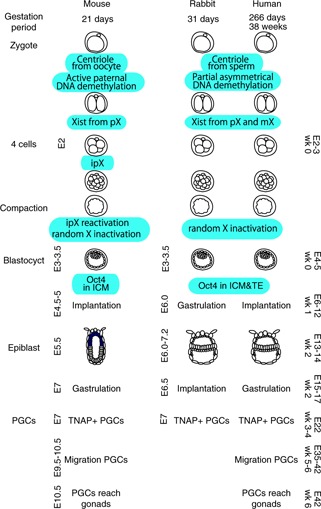
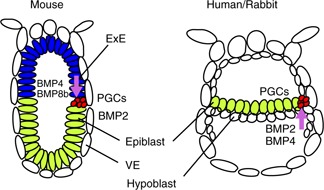
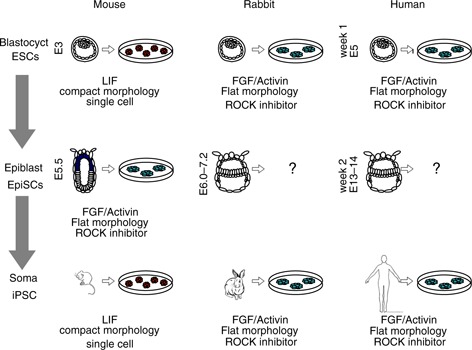
Germ cells are unique cell types that generate a totipotent zygote upon fertilization, giving rise to the next generation in mammals and many other multicellular organisms. How germ cells acquire this ability has been of considerable interest. In mammals, primordial germ cells (PGCs), the precursors of sperm and oocytes, are specified around the time of gastrulation. PGCs are induced by signals from the surrounding extra-embryonic tissues to the equipotent epiblast cells that give rise to all cell types. Currently, the mechanism of PGC specification in mammals is best understood from studies in mice. Following implantation, the epiblast cells develop as an egg cylinder while the extra-embryonic ectoderm cells which are the source of important signals for PGC specification are located over the egg cylinder. However, in most cases, including humans, the epiblast cells develop as a planar disc, which alters the organization and the source of the signaling for cell fates. This, in turn, might have an effect on the precise mechanism of PGC specification in vivo as well as in vitro using pluripotent embryonic stem cells. Here, we discuss how the key early embryonic differences between rodents and other mammals may affect the establishment of the pluripotency network in vivo and in vitro, and consequently the basis for PGC specification, particularly from pluripotent embryonic stem cells in vitro.
Keywords: Epiblast; Human; Mouse; Pluripotent stem cells; Primordial germ cells.
Conflict of interest statement
Naoko Irie, Walfred W.C. Tang and M. Azim Surani declare that they have no conflict of interest.
Figures
References
-
- Lawson KA, Meneses JJ, Pedersen RA. Clonal analysis of epiblast fate during germ layer formation in the mouse embryo. Development, 1991, 113, 891–911 - PubMed
-
- Lawson KA, Hage WJ. Clonal analysis of the origin of primordial germ cells in the mouse. Ciba Found Symp, 1994, 182, 68–84 - PubMed
-
- Ginsburg M, Snow MH, McLaren A. Primordial germ cells in the mouse embryo during gastrulation. Development, 1990, 110, 521–528 - PubMed
-
- Buehr M. The primordial germ cells of mammals: some current perspectives. Exp Cell Res, 1997, 232, 194–207 - PubMed
-
- Chiquoine AD. The identification, origin, and migration of the primordial germ cells in the mouse embryo. Anat Rec, 1954, 118, 135–146 - PubMed
Grants and funding
LinkOut - more resources
Full Text Sources
Other Literature Sources