. 2014 Oct 9;10(10):e1004432.
doi: 10.1371/journal.ppat.1004432. eCollection 2014 Oct.

Systematic analysis of Zn2Cys6 transcription factors required for development and pathogenicity by high-throughput gene knockout in the rice blast fungus

Affiliations

Systematic analysis of Zn2Cys6 transcription factors required for development and pathogenicity by high-throughput gene knockout in the rice blast fungus

Jianping Lu et al. PLoS Pathog. .

Abstract

Because of great challenges and workload in deleting genes on a large scale, the functions of most genes in pathogenic fungi are still unclear. In this study, we developed a high-throughput gene knockout system using a novel yeast-Escherichia-Agrobacterium shuttle vector, pKO1B, in the rice blast fungus Magnaporthe oryzae. Using this method, we deleted 104 fungal-specific Zn(2)Cys(6) transcription factor (TF) genes in M. oryzae. We then analyzed the phenotypes of these mutants with regard to growth, asexual and infection-related development, pathogenesis, and 9 abiotic stresses. The resulting data provide new insights into how this rice pathogen of global significance regulates important traits in the infection cycle through Zn(2)Cys(6)TF genes. A large variation in biological functions of Zn(2)Cys(6)TF genes was observed under the conditions tested. Sixty-one of 104 Zn(2)Cys(6) TF genes were found to be required for fungal development. In-depth analysis of TF genes revealed that TF genes involved in pathogenicity frequently tend to function in multiple development stages, and disclosed many highly conserved but unidentified functional TF genes of importance in the fungal kingdom. We further found that the virulence-required TF genes GPF1 and CNF2 have similar regulation mechanisms in the gene expression involved in pathogenicity. These experimental validations clearly demonstrated the value of a high-throughput gene knockout system in understanding the biological functions of genes on a genome scale in fungi, and provided a solid foundation for elucidating the gene expression network that regulates the development and pathogenicity of M. oryzae.


Conflict of interest statement

The authors have declared that no competing interests exist.

Figures
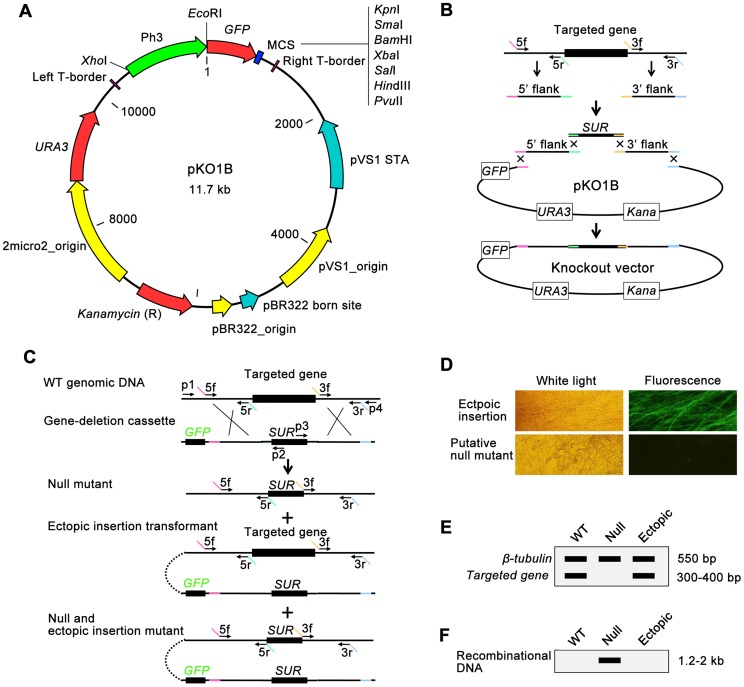
Figure 1
Figure 1. Overview of the high-throughput gene knockout system in fungus.
(A) Features of a new binary yeast-Escherichia-Agrobacterium shuttle vector, pKO1B. (B) Building of gene-deletion cassettes in pKO1B by yeast recombinational cloning. The 5′ and 3′ flanking fragments of the targeted genes were separately amplified from genomic DNA with primers 5f/5r and 3f/3r. Primers 5r and 3f have 5′ tails homologous to the SUR cassette, whereas those for 5f and 3r are homologous to the vector. The two flanks were cotransformed into yeast along with the SUR cassette and gapped pKO1B. Homologous recombination created the circular knockout vector, and the final knockout vector was subsequently transformed into A. tumefaciens. (C) Deletion of the targeted gene. The gene-deletion cassette was transformed into the fungal cells via ATMT. Homologous recombination created three types of transformants: null mutants, ectopic insertion transformants, and null and ectopic insertion mutants. The GFP gene was discarded in the null mutants. Primers p1/p2 or p3/p4 were used to identify the unique recombinational DNA fragment, indicating a knockout event. (D) The transformants are screened for GFP fluorescence under a microscope. Putative null mutants do have not GFP fluorescence, but ectopic transformants do. (E) The transformants are screened by double PCR for the targeted gene using the β-tubulin gene as a positive control. The wild-type strain or ectopic transformants produced a characteristic band, indicating the targeted gene, while the null mutants did not. (F) The transformants are screened by PCR for a unique recombinational DNA fragment marked as a knockout event. The null mutants have a 1.2–2.0 kb band on an electrophoretic gel, while the wild-type strain and the ectopic transformants do not.
Figure 2
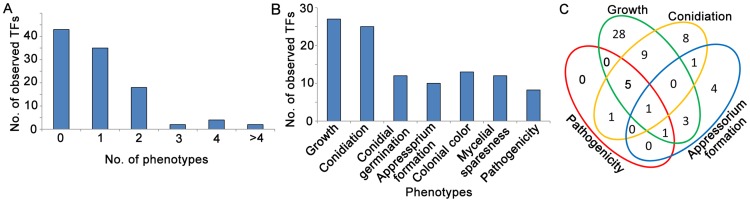
Figure 2. Analysis of Zn2Cys6 transcription factor mutant phenotypes in fungal development stages.
(A) Number of TFs showing multiple mutant phenotypes. (B) Number of mutants showing mutant phenotypes in each developmental stage. (C) Venn diagram showing the number of mutant phenotypes. The phenotypes included vegetative growth (conidial germination, colony growth, pigmentation and mycelial appearance), conidiation (asexual reproduction), appressorium formation and pathogenicity to rice and barley.
Figure 3
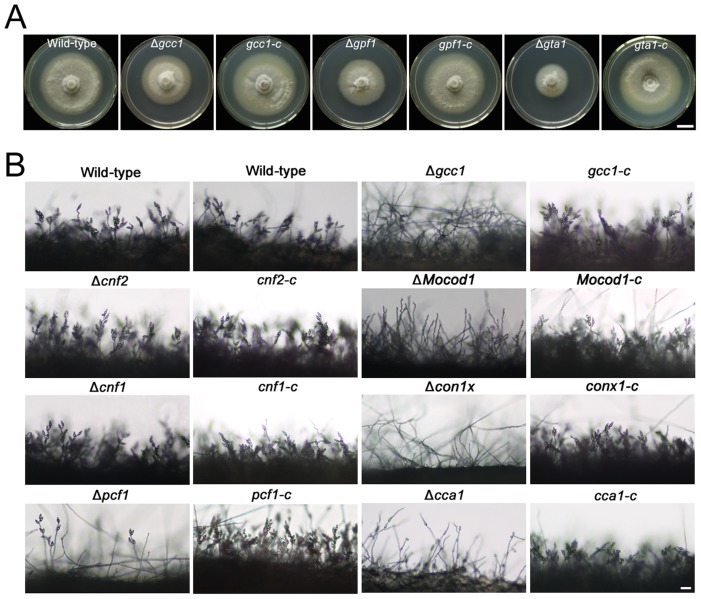
Figure 3. Colony growth and conidiophores of M. oryzae strains.
(A) Colony growth of the wild-type strain 70-15, mutants (Δgcc1, Δgpf1 and Δgta1), and complemented strains (gcc1-c, gta1-c, gta1-c) on CM medium for 8 days. Bar = 1 cm. (B) Conidiophores of the wild-type, mutants (Δcnf1, Δcnf2, Δpcf1, Δcca1, Δconx1, Δgcc1 and ΔMocod1), and complemented strains (cnf1-c, cnf2-c, pcf1-c, cca1-c, conx1-c, gcc1-c and Mocod1-c). Bar = 20 µm.
Figure 4
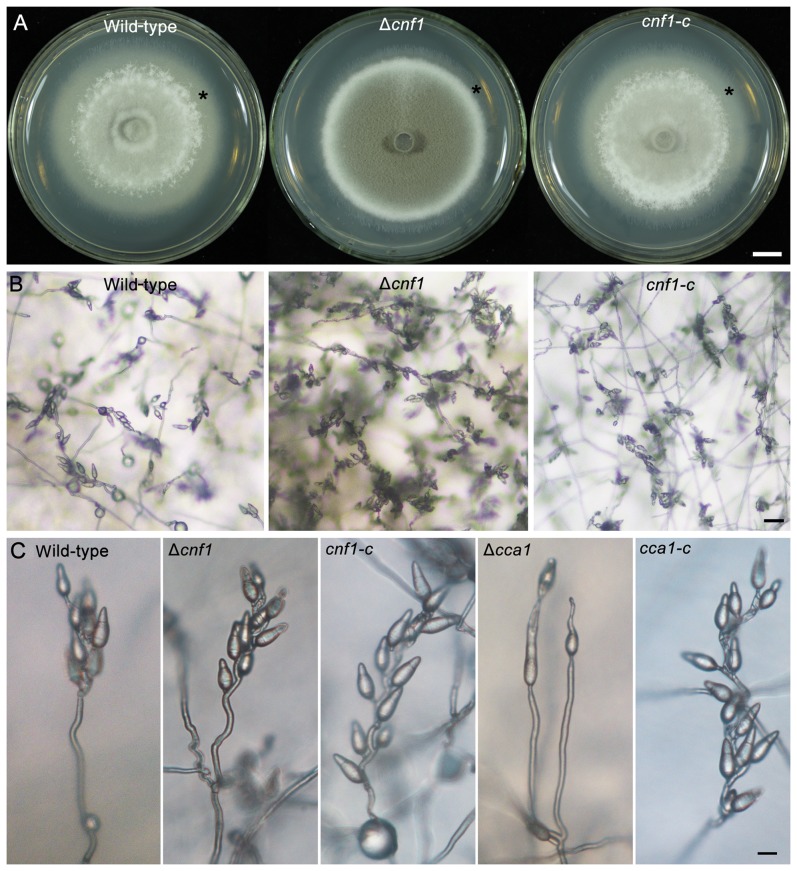
Figure 4. Mycelial appearance and spore-bearing aerial hyphae of the M. oryzae strains.
(A) The mycelial appearance of the wild-type strain, Δcnf1 and its complemented strain cnf1-c. Stars indicate non-sporulating hyphae. Bar = 1 cm. (B) Spore-bearing aerial hyphae of the wild-type strain, Δcnf1 and its complemented strain cnf1-c on CM medium. Bar = 20 µm. (C) Conidial development on conidiophores of the M. oryzae strains Δcnf1 and Δcca1. The conidiophore pictures of the wild-type, mutants (Δcnf1 and Δcca1), and their complemented strains (cnf1-c and cca1-c) were taken on the strains grown on CM medium on microscope slides for 1 day. Bar = 40 µm.
Figure 5
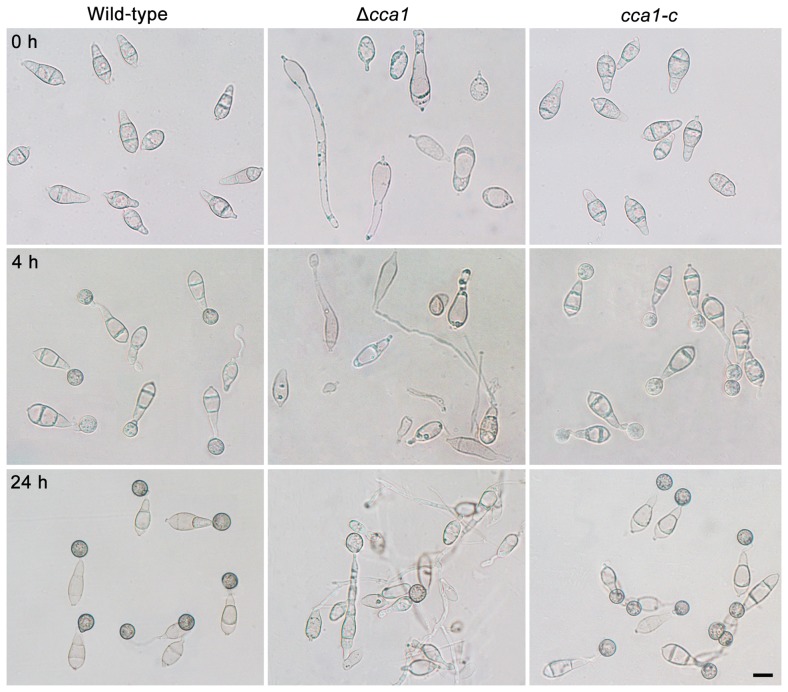
Figure 5. Conidia, conidial germination and appressorium formation of the M. oryzae strain Δcca1.
The conidia (0 h) of the wild-type strain, mutant Δcca1, and its complemented strain cca1-c were grown in H2O on plastic cover slides for 4 h (conidial germination) and 24 h (appressorium formation). Bar = 10 µm.
Figure 6
Figure 6. Pathogenicity assay of the M. oryzae strains.
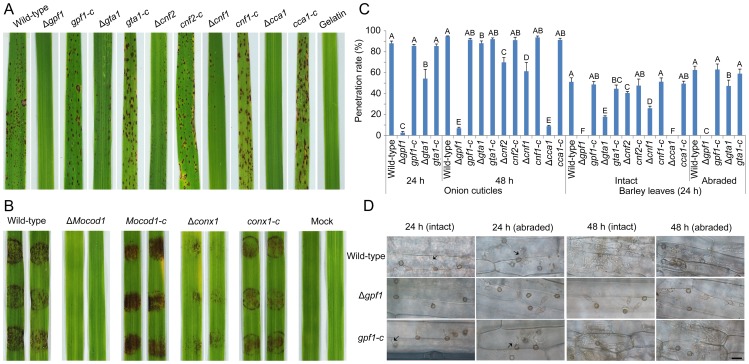
(A) Pathogenicity assay of 5 mutants and their complementation strains on rice. These 5 mutants are Δgpf1, Δgta1, Δcnf2, Δcnf1, Δcca1 and their complementation strains gpf1-c, gta1-c, cnf2-c, cnf1-c, and cca1-c. The rice seedlings were sprayed with a conidial suspension of M. oryzae strains and cultured for 7 days. (B) Pathogenicity assay of the mutants on rice leaf explants. The mycelial agar plugs of the mutants ΔMocod1 and Δconx1, their complementation strains Mocod1-c and conx1-c, and the wild-type strain 70-15 were placed on intact rice leaves for 4 days. (C) Penetration assay. 10-or 20-µl (5×10⁴ conidia/ml) conidial suspensions were inoculated on onion cuticle or barley leaves (intact or abraded) and incubated for 24 or 48 h. The experimental strains were the wild-type strain 70-15, mutants (Δgpf1, Δgta1, Δcnf2, Δcnf1 and Δcca1) and complemented strains (gpf1-c, gta1-c, cnf2-c, cnf1-c and cca1-c). Same capital letters in same treatment item indicate non-significant difference estimated by Duncan's test (P≤0.05). (D) Penetration of Δgpf1. 20 µl (5×10⁴ conidia/ml) conidial suspensions of Δgpf1, complemented strain gpf1-c or wild-type strain were inoculated on barley leaf explants (intact or abraded) and incubated for 24 or 48 h. Arrows indicate the in planta hyphae invaded. Bar = 25 µm.
Figure 7
Figure 7. Growth of the M. oryzae strains under stress conditions.
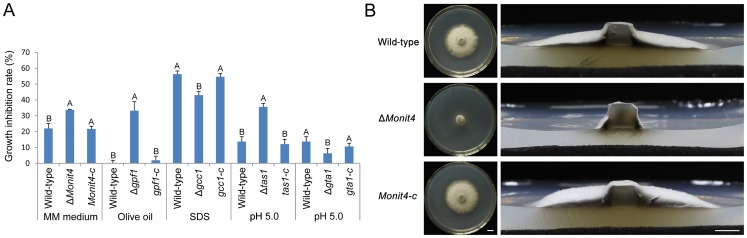
(A) Growth inhibition rate. 5-mm mycelial blocks of M. oryzae strains were inoculated on CM medium and medium with stress conditions for 8 days, and the diameter of colonies was then measured to calculate the growth inhibition rate. The experimental strains were the wild-type strain, mutants (ΔMonit4, Δgpf1, Δgcc1, Δtas1 and Δgta1), and complemented strains (Monit4-c, gpf1-c, gcc1-c, tas1-c and gta1-c). Same capital letters in same stress item indicate non-significant difference estimated by Duncan's test (P≤0.05). (B) Mycelial growth of ΔMonit4 on MM medium. The wild-type strain, ΔMonit4, and complemented strain Monit4-c were grown on MM medium at 25°C for 8 days. Bar = 5 mm.
Figure 8
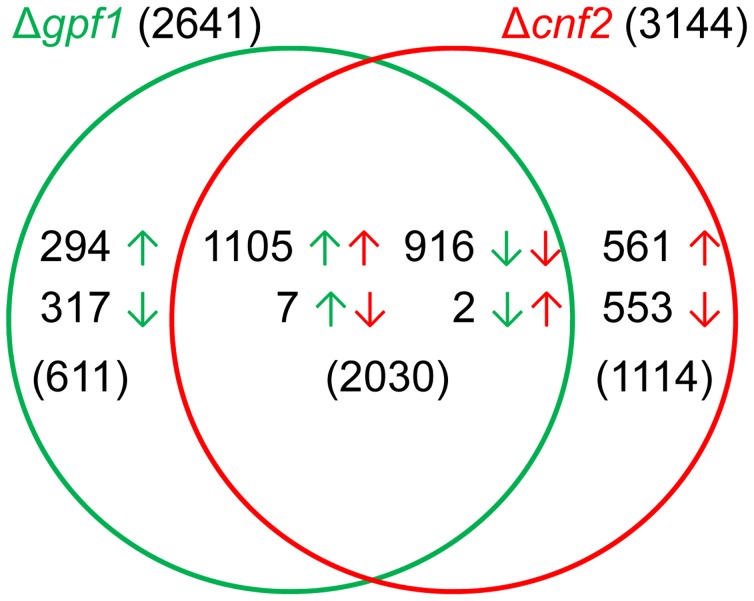
Figure 8. Comparison of differentially expressed genes between Δgpf1 and Δcnf2.
Green or red arrows are the directions of gene expression regulation in Δgpf1 or Δcnf2.

References

    1. Dean R, Van Kan JA, Pretorius ZA, Hammond-Kosack KE, Di Pietro A, et al. (2012) The Top 10 fungal pathogens in molecular plant pathology. Mol Plant Pathol 13: 414–430. - PMC - PubMed
    1. Ou SH (1980) Pathogen variability and host resistance in rice blast disease. Annu Rev Phytopathol 18: 167–187.
    1. Dean RA, Talbot NJ, Ebbole DJ, Farman ML, Mitchell TK, et al. (2005) The genome sequence of the rice blast fungus Magnaporthe grisea . Nature 434: 980–986. - PubMed
    1. Valent B, Chumley FG (1991) Molecular genetic analysis of the rice blast fungus, Magnaporthe grisea . Annu Rev Phytopathol 29: 443–467. - PubMed
    1. Talbot NJ (2003) On the trail of a cereal killer: Exploring the biology of Magnaporthe grisea . Annu Rev Microbiol 57: 177–202. - PubMed

Publication types

MeSH terms

Associated data