Detection of Rickettsia felis, Rickettsia typhi, Bartonella Species and Yersinia pestis in Fleas (Siphonaptera) from Africa
- PMID: 25299702
- PMCID: PMC4191943
- DOI: 10.1371/journal.pntd.0003152
Detection of Rickettsia felis, Rickettsia typhi, Bartonella Species and Yersinia pestis in Fleas (Siphonaptera) from Africa
Abstract
Little is known about the presence/absence and prevalence of Rickettsia spp, Bartonella spp. and Yersinia pestis in domestic and urban flea populations in tropical and subtropical African countries.
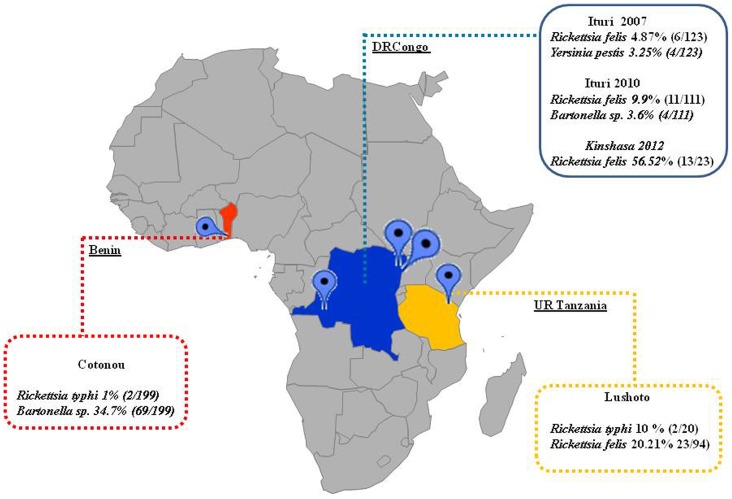
Methodology/principal findings: Fleas collected in Benin, the United Republic of Tanzania and the Democratic Republic of the Congo were investigated for the presence and identity of Rickettsia spp., Bartonella spp. and Yersinia pestis using two qPCR systems or qPCR and standard PCR. In Xenopsylla cheopis fleas collected from Cotonou (Benin), Rickettsia typhi was detected in 1% (2/199), and an uncultured Bartonella sp. was detected in 34.7% (69/199). In the Lushoto district (United Republic of Tanzania), R. typhi DNA was detected in 10% (2/20) of Xenopsylla brasiliensis, and Rickettsia felis was detected in 65% (13/20) of Ctenocephalides felis strongylus, 71.4% (5/7) of Ctenocephalides canis and 25% (5/20) of Ctenophthalmus calceatus calceatus. In the Democratic Republic of the Congo, R. felis was detected in 56.5% (13/23) of Ct. f. felis from Kinshasa, in 26.3% (10/38) of Ct. f. felis and 9% (1/11) of Leptopsylla aethiopica aethiopica from Ituri district and in 19.2% (5/26) of Ct. f. strongylus and 4.7% (1/21) of Echidnophaga gallinacea. Bartonella sp. was also detected in 36.3% (4/11) of L. a. aethiopica. Finally, in Ituri, Y. pestis DNA was detected in 3.8% (1/26) of Ct. f. strongylus and 10% (3/30) of Pulex irritans from the villages of Wanyale and Zaa.
Conclusion: Most flea-borne infections are neglected diseases which should be monitored systematically in domestic rural and urban human populations to assess their epidemiological and clinical relevance. Finally, the presence of Y. pestis DNA in fleas captured in households was unexpected and raises a series of questions regarding the role of free fleas in the transmission of plague in rural Africa, especially in remote areas where the flea density in houses is high.
Conflict of interest statement
The authors have declared that no competing interests exist.
References
MeSH terms
Substances
Associated data
- Actions
- Actions
LinkOut - more resources
Full Text Sources
Other Literature Sources
Molecular Biology Databases
Miscellaneous