


Phytoestrogens and prevention of breast cancer: The contentious debate
- PMID: 25302172
- PMCID: PMC4129534
- DOI: 10.5306/wjco.v5.i4.705
Phytoestrogens and prevention of breast cancer: The contentious debate
Abstract
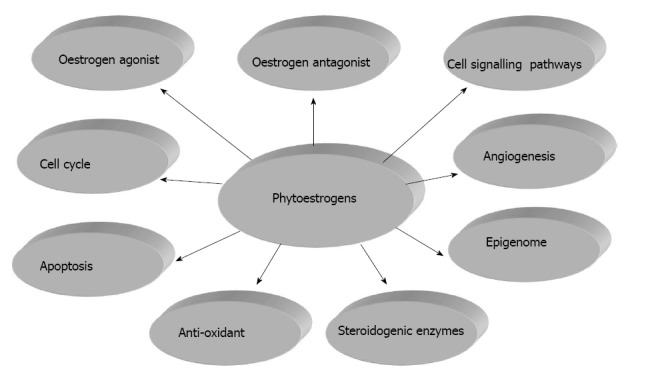
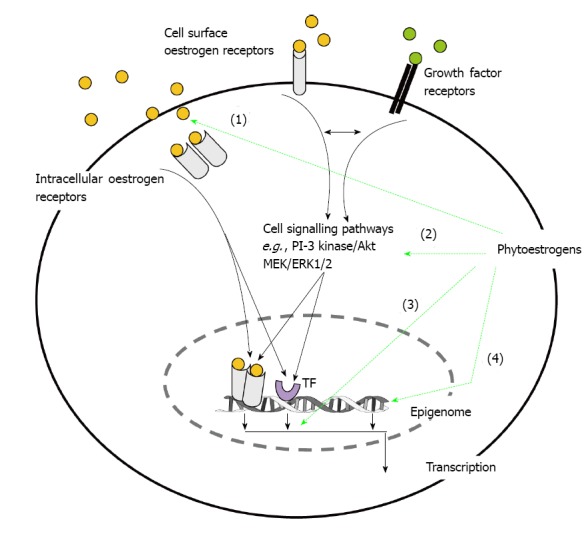
Phytoestrogens have multiple actions within target cells, including the epigenome, which could be beneficial to the development and progression of breast cancer. In this brief review the action of phytoestrogens on oestrogen receptors, cell signalling pathways, regulation of the cell cycle, apoptosis, steroid synthesis and epigenetic events in relation to breast cancer are discussed. Phytoestrogens can bind weakly to oestrogen receptors (ERs) and some have a preferential affinity for ERβ which can inhibit the transcriptional growth-promoting activity of ERα. However only saturating doses of phytoestrogens, stimulating both ERα and β, exert growth inhibitory effects. Such effects on growth may be through phytoestrogens inhibiting cell signalling pathways. Phytoestrogens have also been shown to inhibit cyclin D1 expression but increase the expression of cyclin-dependent kinase inhibitors (p21 and p27) and the tumour suppressor gene p53. Again these effects are only observed at high (> 10) µmol/L doses of phytoestrogens. Finally the effects of phytoestrogens on breast cancer may be mediated by their ability to inhibit local oestrogen synthesis and induce epigenetic changes. There are, though, difficulties in reconciling epidemiological and experimental data due to the fact experimental doses, both in vivo and in vitro, far exceed the circulating concentrations of "free" unbound phytoestrogens measured in women on a high phytoestrogen diet or those taking phytoestrogen supplements.
Keywords: Breast cancer; Cell cycle; Cell signalling; Epigenomics; Phytoestrogens.
Figures
References
-
- Miller PE, Snyder DC. Phytochemicals and cancer risk: a review of the epidemiological evidence. Nutr Clin Pract. 2012;27:599–612. - PubMed
-
- Gikas PD, Mokbel K. Phytoestrogens and the risk of breast cancer: a review of the literature. Int J Fertil Womens Med. 2005;50:250–258. - PubMed
-
- Pelekanou V, Leclercq G. Recent insights into the effect of natural and environmental estrogens on mammary development and carcinogenesis. Int J Dev Biol. 2011;55:869–878. - PubMed
-
- Velentzis LS, Woodside JV, Cantwell MM, Leathem AJ, Keshtgar MR. Do phytoestrogens reduce the risk of breast cancer and breast cancer recurrence? What clinicians need to know. Eur J Cancer. 2008;44:1799–1806. - PubMed
Publication types
LinkOut - more resources
Full Text Sources
Other Literature Sources
Research Materials
Miscellaneous
