


Importance of pH homeostasis in metabolic health and diseases: crucial role of membrane proton transport
- PMID: 25302301
- PMCID: PMC4180894
- DOI: 10.1155/2014/598986
Importance of pH homeostasis in metabolic health and diseases: crucial role of membrane proton transport
Abstract
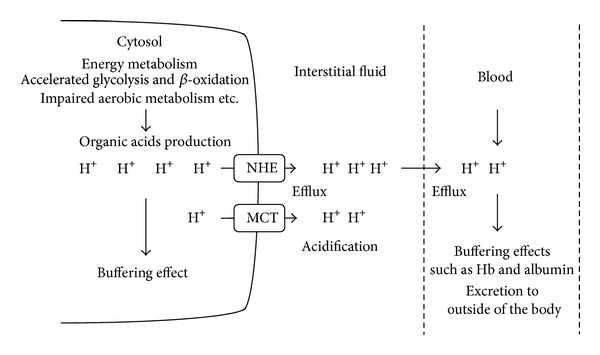
Protons dissociated from organic acids in cells are partly buffered. If not, they are transported to the extracellular fluid through the plasma membrane and buffered in circulation or excreted in urine and expiration gas. Several transporters including monocarboxylate transporters and Na(+)/H(+) exchanger play an important role in uptake and output of protons across plasma membranes in cells of metabolic tissues including skeletal muscle and the liver. They also contribute to maintenance of the physiological pH of body fluid. Therefore, impairment of these transporters causes dysfunction of cells, diseases, and a decrease in physical performance associated with abnormal pH. Additionally, it is known that fluid pH in the interstitial space of metabolic tissues is easily changed due to little pH buffering capacitance in interstitial fluids and a reduction in the interstitial fluid pH may mediate the onset of insulin resistance unlike blood containing pH buffers such as Hb (hemoglobin) and albumin. In contrast, habitual exercise and dietary intervention regulate expression/activity of transporters and maintain body fluid pH, which could partly explain the positive effect of healthy lifestyle on disease prognosis.
Figures
References
-
- Garcia CK, Goldstein JL, Pathak RK, Anderson RGW, Brown MS. Molecular characterization of a membrane transporter for lactate, pyruvate, and other monocarboxylates: implications for the Cori cycle. Cell. 1994;76(5):865–873. - PubMed
-
- Halestrap AP. The monocarboxylate transporter family-structure and functional characterization. IUBMB Life. 2012;64(1):1–9. - PubMed
-
- Poole RC, Halestrap AP. Transport of lactate and other monocarboxylates across mammalian plasma membranes. The American Journal of Physiology—Cell Physiology. 1993;264(4, part 1):C761–C782. - PubMed
-
- Burckhardt G, Di Sole F, Helmle-Kolb C. The Na+/H+ exchanger gene family. Journal of Nephrology. 2002;15, supplement 5:S3–S21. - PubMed
-
- Loh S-H, Chen W-H, Chiang C-H, et al. Intracellular pH regulatory mechanism in human atrial myocardium: Functional evidence for Na+/H+ exchanger and Na+/HCO3 − symporter. Journal of Biomedical Science. 2002;9(3):198–205. - PubMed
Publication types
MeSH terms
Substances
LinkOut - more resources
Full Text Sources
Other Literature Sources
Medical
