


Estimating orientation using magnetic and inertial sensors and different sensor fusion approaches: accuracy assessment in manual and locomotion tasks
- PMID: 25302810
- PMCID: PMC4239903
- DOI: 10.3390/s141018625
Estimating orientation using magnetic and inertial sensors and different sensor fusion approaches: accuracy assessment in manual and locomotion tasks
Abstract
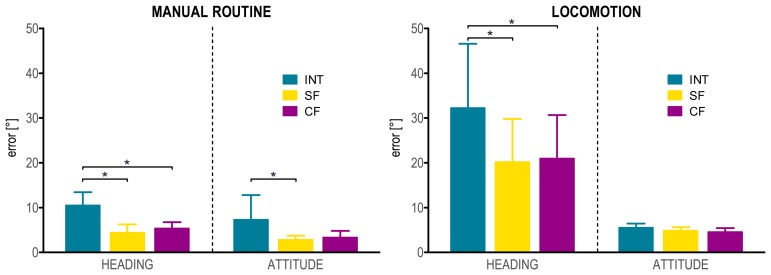
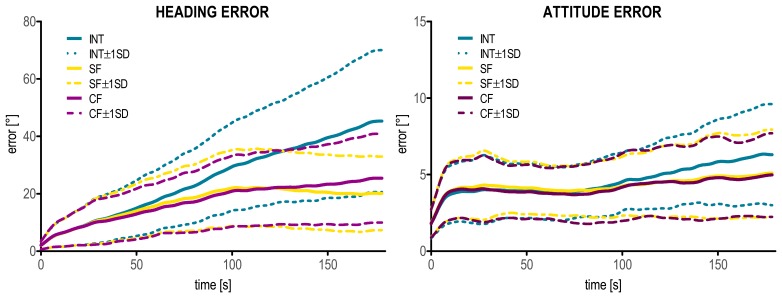
Magnetic and inertial measurement units are an emerging technology to obtain 3D orientation of body segments in human movement analysis. In this respect, sensor fusion is used to limit the drift errors resulting from the gyroscope data integration by exploiting accelerometer and magnetic aiding sensors. The present study aims at investigating the effectiveness of sensor fusion methods under different experimental conditions. Manual and locomotion tasks, differing in time duration, measurement volume, presence/absence of static phases, and out-of-plane movements, were performed by six subjects, and recorded by one unit located on the forearm or the lower trunk, respectively. Two sensor fusion methods, representative of the stochastic (Extended Kalman Filter) and complementary (Non-linear observer) filtering, were selected, and their accuracy was assessed in terms of attitude (pitch and roll angles) and heading (yaw angle) errors using stereophotogrammetric data as a reference. The sensor fusion approaches provided significantly more accurate results than gyroscope data integration. Accuracy improved mostly for heading and when the movement exhibited stationary phases, evenly distributed 3D rotations, it occurred in a small volume, and its duration was greater than approximately 20 s. These results were independent from the specific sensor fusion method used. Practice guidelines for improving the outcome accuracy are provided.
Figures
References
-
- Ounpuu S., Davis R.B., DeLuca P.A. Joint kinetics: methods, interpretation and treatment decision-making in children with cerebral palsy and myelomeningocele. Gait Posture. 1996;4:62–78.
-
- Aminian K., Trevisan C., Najafi B., Dejnabadi H., Frigo C., Pavan E., Telonio A., Cerati F., Marinoni E.C., Robert P., Leyvraz P.-F. Evaluation of an ambulatory system for gait analysis in hip osteoarthritis and after total hip replacement. Gait Posture. 2004;20:102–107. - PubMed
-
- Mont M.A., Seyler T.M., Ragland P.S., Starr R., Erhart J., Bhave A. Gait analysis of patients with resurfacing hip arthroplasty compared with hip osteoarthritis and standard total hip arthroplasty. J. Arthroplast. 2007;22:100–108. - PubMed
-
- Ishigaki N., Kimura T., Usui Y., Aoki K., Narita N., Shimizu M., Hara K., Ogihara N., Nakamura K., Kato H., et al. Analysis of pelvic movement in the elderly during walking using a posture monitoring system equipped with a triaxial accelerometer and a gyroscope. J. Biomech. 2011;44:1788–1792. - PubMed
Publication types
MeSH terms
LinkOut - more resources
Full Text Sources
Other Literature Sources
