. 2014 Sep 26;113(13):133902.
doi: 10.1103/PhysRevLett.113.133902. Epub 2014 Sep 26.

Optimal point spread function design for 3D imaging

Affiliations

Optimal point spread function design for 3D imaging

Yoav Shechtman et al. Phys Rev Lett. .

Abstract

To extract from an image of a single nanoscale object maximum physical information about its position, we propose and demonstrate a framework for pupil-plane modulation for 3D imaging applications requiring precise localization, including single-particle tracking and superresolution microscopy. The method is based on maximizing the information content of the system, by formulating and solving the appropriate optimization problem--finding the pupil-plane phase pattern that would yield a point spread function (PSF) with optimal Fisher information properties. We use our method to generate and experimentally demonstrate two example PSFs: one optimized for 3D localization precision over a 3 μm depth of field, and another with an unprecedented 5 μm depth of field, both designed to perform under physically common conditions of high background signals.


Figures
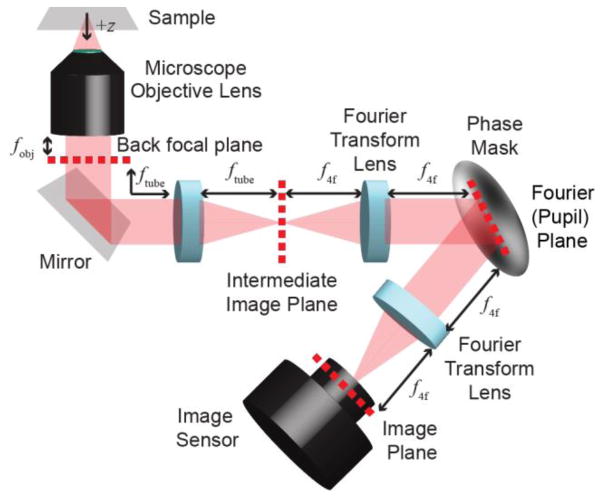
FIG 1
FIG 1
(Color online): Experimental pupil plane modulation setup with a phase mask in the Fourier plane of a 4f optical processing unit.
FIG 2
FIG 2
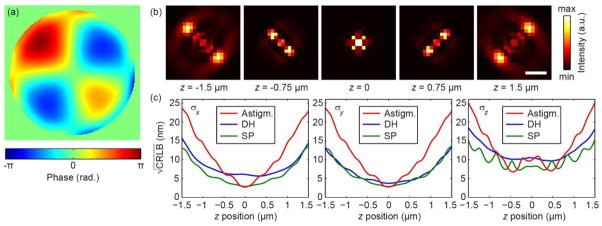
(Color online): (a) Saddle-Point (SP) PSF, optimized for high background, low signal 3D precision over a 3 μm depth range. (b) Calculated PSF for various z positions (stated). Scale bar: 1 μm (in sample space). (c) Calculated CRLB of the SP PSF for x, y, z vs. astigmatic (Astigm.) and DH PSF as a function of z. 3500 detected signal photons per frame and β = 50 were considered. Astigmatic axes are at 450 relative to camera axes, hence the similar x and y behavior.
FIG 3
FIG 3
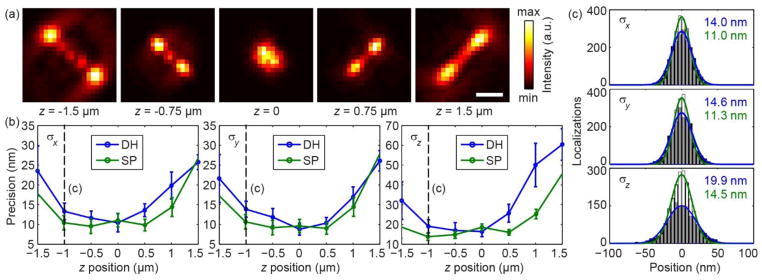
(Color online): (a) Experimental realizations of the Saddle-Point (SP) PSF for various z positions (stated). Scale bar: 1 μm (in sample space). Images were re-scaled to min/max intensity on an individual basis. (b) Experimental measurements of statistical localization precisions as the standard deviations σx, σy, σz of localization outcomes from 500 camera frames. Bars show standard deviations derived from n = 4 independent experiments. (c) Experimental histograms of localization outcomes along the x, y and z dimensions, recorded at z = −1 μm (dotted lines in (b), data from 4 measurements). Extracted σx, σy, σz are stated.

References

    1. Dupont A, Lamb DC. Nanoscale. 2011;3:4532. - PubMed
    1. Thompson MA, Casolari JM, Badieirostami M, Brown PO, Moerner WE. Proc Natl Acad Sci U S A. 2010;107:17864. - PMC - PubMed
    1. Betzig E, Patterson GH, Sougrat R, Lindwasser OW, Olenych S, Bonifacino JS, Davidson MW, Lippincott-Schwartz J, Hess HF. Science. 2006;313:1642. - PubMed
    1. Hess ST, Girirajan TPK, Mason MD. Biophys J. 2006;91:4258. - PMC - PubMed
    1. Rust MJ, Bates M, Zhuang X. Nat Methods. 2006;3:793. - PMC - PubMed

Publication types

MeSH terms