


The next step towards making use meaningful: electronic information exchange and care coordination across clinicians and delivery sites
- PMID: 25304020
- PMCID: PMC5131789
- DOI: 10.1097/MLR.0000000000000245
The next step towards making use meaningful: electronic information exchange and care coordination across clinicians and delivery sites
Abstract
Background: Care for patients with chronic conditions often requires coordination between multiple physicians and delivery sites. Electronic Health Record (EHR) use could improve care quality and efficiency in part by facilitating care coordination.
Objective: We examined the association between EHR use and clinician perceptions of care coordination for patients transferred across clinicians and delivery sites.
Research design: Repeated surveys of primary care clinicians during the staggered implementation of an outpatient EHR (2005-2008), followed by an integrated inpatient EHR (2006-2010). We measured the association between EHR use stages (no use, outpatient EHR only, and integrated inpatient-outpatient EHR) and care coordination using logistic regression, adjusting for clinician characteristics, study year, and medical center.
Subjects: Adult primary care clinicians in a large Integrated Delivery System.
Measures: Three measures of clinician-reported care coordination for patient care transferred across clinicians (eg, from specialist to primary care team) and across delivery sites (eg, from the hospital to outpatient care).
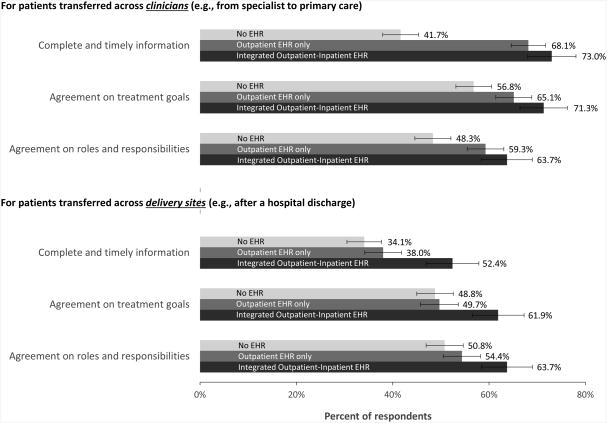
Results: Outpatient EHR use was associated with higher reports of access to complete and timely clinical information and higher agreement on clinician roles and responsibilities for patients transferred across clinicians, but not for patients transferred across delivery sites. Use of the integrated outpatient-inpatient EHR was associated with higher reports of access to timely and complete clinical information, clinician agreement on the patient's treatment plan for patients transferred across delivery sites, and with all coordination measures for patients transferred across clinicians.
Conclusion: Use of an integrated EHR with health information exchange across delivery settings improved patient care coordination.
Conflict of interest statement
The authors declare no conflict of interest.
Figures
References
-
- Schoen C, Osborn R, How SK, Doty MM, Peugh J. In chronic condition: experiences of patients with complex health care needs, in eight countries, 2008. Health Affairs. 2009 Jan-Feb;28(1):w1–16. - PubMed
-
- Thorpe KE, Ogden LL, Galactionova K. Chronic conditions account for rise in Medicare spending from 1987 to 2006. Health Affairs. 2010 Apr;29(4):718–724. - PubMed
-
- Bodenheimer T, Chen E, Bennett HD. Confronting the growing burden of chronic disease: can the U.S. health care workforce do the job? Health Affairs. 2009 Jan-Feb;28(1):64–74. - PubMed
-
- Partnership for S, Johns Hopkins U. Chronic Conditions: Making The Case for Ongoing Care. 0-9727261-0-1.
Publication types
MeSH terms
Grants and funding
LinkOut - more resources
Full Text Sources
Other Literature Sources
